The Perfect Threat Hunting Report Template: Essential Guide and Free Download

Many threat hunts fail to drive action not because the hunt was ineffective, but because the findings were never clearly documented or communicated.
According to the SANS Institute's 2024 Threat Hunting Survey, more organizations are taking a structured approach: 51% now have formal threat hunting methodologies in place, up from just 35% the year before. And with IBM's 2025 Cost of a Data Breach Report indicating an average breach cost of $4.4 million, the need for clear, effective reporting has never been greater.
Looking for a practical threat hunting report template that saves time and improves clarity? In this guide, we'll walk through what every good threat hunting report should include, why it matters, and how to use our free downloadable template to streamline your threat hunting activities.
What is a Threat Hunting Report?
A threat hunting report is the written result of a proactive investigation designed to uncover malicious activity that standard tools may miss. These reports are central to any serious cyber threat intelligence strategy.
They standardize how findings are documented and communicated, allowing internal teams and external stakeholders to make informed decisions. Each report typically includes a priority rating, helping teams assess which potential threats require immediate action.
A strong report opens with an executive summary, a clear overview of the operation, the key findings, and their significance. This section must give decision-makers enough information to take action, even if they do not read the full document.
The appendix should describe the evaluation methods used, such as the reliability of data sources, and may include a glossary that defines technical terms. This is essential for cross-functional teams or stakeholders with a limited technical background.
Assigning a sensitivity level based on your organization's data classification policy helps ensure the information is shared and stored appropriately. In short, threat hunting reports are not just documents; they are operational tools that support smarter threat response.
Now that the report's purpose is clear, the next critical piece is the Key Findings section. This is where your investigation delivers immediate value by outlining what was uncovered.
Threat Hunting Report Template Structure
This section outlines the core components of a practical threat hunting report, explaining how each part contributes to clear communication, investigation clarity, and actionable outcomes.
Want to use this structure in your own hunts?
We've put the full threat hunting report structure into a clean, ready-to-use PDF. The template mirrors the sections outlined here and is designed for documenting real-world investigations, not theory.
You can download it now and follow along as we break down each section below.
Executive Summary
Executive Summary
This report summarizes the outcome of a proactive threat hunting investigation. It highlights the most relevant findings, explains why they matter, and provides enough context for decision-makers to understand the risk without reading the full report.
The executive summary focuses on impact rather than technical detail. It outlines what was discovered, the level of confidence in those findings, and whether immediate action is required.
Example:
During this hunt, we identified previously unknown command-and-control infrastructure communicating with three internal hosts. The activity showed consistent beaconing patterns associated with known malware tooling. Based on the observed behavior and confidence level, immediate containment and follow-up investigation were recommended.
The sections that follow provide the evidence and analysis that support these conclusions.
Scope and Hypothesis
The scope sets the boundaries of the hunt. It makes clear which systems, environments, and data sources were examined, and which ones were not. Without this context, findings can be misunderstood or applied too broadly. A well-defined scope keeps the investigation focused and avoids drawing conclusions that the data does not support.
The hypothesis explains why the hunt was run. It usually starts from a concrete observation, a piece of intelligence, or a gap in existing detections. Instead of trying to prove something is malicious, the hypothesis guides where to look and what behaviors are worth closer inspection as the analysis unfolds.
Together, scope and hypothesis give readers the context they need to interpret the rest of the report. They explain how the investigation was framed and what questions the team was trying to answer before any data was analyzed.
This section typically covers:
The systems or environments included in the hunt
The time period analyzed
The data sources and telemetry reviewed
The initial assumptions or intelligence driving the hunt
Any known exclusions or visibility gaps
With that context in place, the report can move from intent to results. The next section focuses on the Key Findings uncovered during the hunt.
Key Findings
The key findings section is the core of the report. It outlines what was discovered during the threat hunting operation and why it matters. Since threat hunting involves actively searching for threats before alerts trigger, this section is critical to show what you uncovered that traditional detection tools may have missed.
Use a summary table to present the findings clearly. Visualizing patterns and indicators makes it easier for readers to understand what you found and why it matters. This format supports faster decision-making, especially for stakeholders who need to assess risk quickly.
This section should not just list problems. It should include the impact of each finding and propose next steps. Effective threat hunting depends on clear communication, and this section is where that starts.
For example, a Key Findings table may highlight a newly observed C2 domain reused across multiple hosts, the associated malware family, the confidence level, and the recommended containment action.
Let's now review the Detailed Analysis and Assessment section, that provides the technical backbone of the report.
Detailed Analysis and Assessment
This section dives into the evidence collected during the hunt. It explains how data was analyzed, what behaviors or anomalies were detected, and what those mean in context.
The analysis often includes techniques from frameworks like the Cyber Kill Chain, which "outlines the various stages of several common cyberattacks and, by extension, the points at which the information security team can prevent, detect or intercept attackers," as stated by Crowdstrike.
By walking through each phase, reconnaissance, weaponization, delivery, exploitation, installation, command and control (C2), and actions on objectives, analysts can trace how the threat progressed.
You might also apply the Pyramid of Pain model to show how different types of indicators vary in detection difficulty. This gives technical and non-technical readers a visual sense of what the adversary is doing and how hard it is to detect them.
Not every threat hunting report needs to apply every framework; in practice, MITRE ATT&CK mapping and well-documented IOCs form the baseline, while models like the Pyramid of Pain or D3FEND are applied when they add specific analytical value.
Over time, this approach reduces repeated blind spots and improves how future hunts are scoped and prioritized. This section ensures the findings from one hunt directly inform how future hunts are scoped, what telemetry is prioritized, and which detection logic is refined. Also, using a threat hunting platform can help document, correlate, and preserve this analysis over time, making future hunts even more effective.
But even the most thorough investigations have blind spots. That's why identifying intelligence gaps is an important next step; it shows where to focus future effort and resources.
Intelligence Gaps and Further Exploration
No threat hunting report is complete without identifying where information is missing. Intelligence gaps are opportunities. Calling them out helps teams plan follow-up investigations, improve data collection, and refine detection strategies.
Sometimes gaps appear because certain logs were unavailable. Other times, indicators point to suspicious activity that needs more context. Highlighting these unknowns gives your team clear direction on what to look at next.
You can map these gaps to MITRE D3FEND controls to suggest relevant countermeasures. This shows that your team is not just observing threats, but thinking critically about how to improve defenses.
Also, reference threat intelligence reports or external data sources when possible. Linking gaps to known adversary behavior gives context and helps prioritize what to explore next.
From gaps, we move into one of the most operationally useful parts of the report: the Indicators of Compromise. These are the technical breadcrumbs that help detection and response teams act fast.
Indicators of Compromise (IOCs)
Indicators of Compromise (IOCs) are essential to every report. These are the IP addresses, domains, file hashes, and behavior patterns that signal malicious activity.
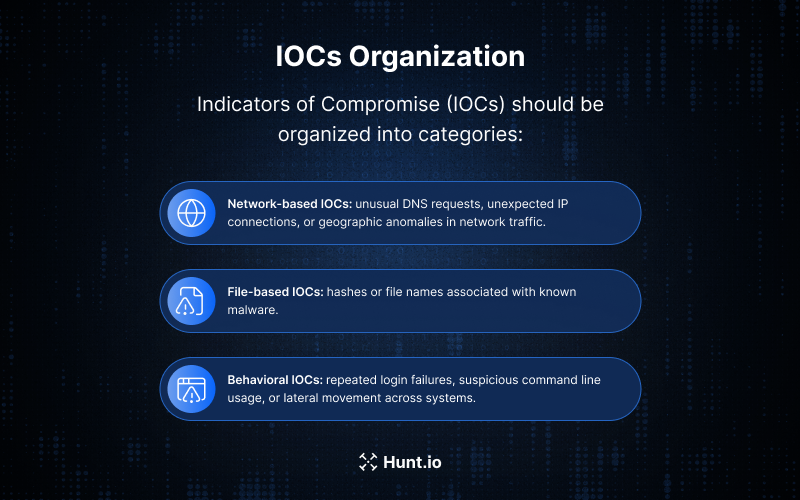
Organize IOCs into categories:
Network-based IOCs: unusual DNS requests, unexpected IP connections, or geographic anomalies in network traffic.
File-based IOCs: hashes or file names associated with known malware.
Behavioral IOCs: repeated login failures, suspicious command line usage, or lateral movement across systems.
Including a clear list of IOCs helps teams move fast. It also supports automated detection rules, allowing SOC analysts to turn intelligence into alerts.
To give structure to these findings and IOCs, the MITRE ATT&CK framework offers a powerful way to map behaviors and tactics to real-world threats.
MITRE ATT&CK Framework Techniques
The MITRE ATT&CK threat hunting framework is a foundational resource for mapping observed behaviors to known adversary techniques. By aligning findings to ATT&CK, reports gain structure, and teams can spot patterns in how threats are unfolding.
ATT&CK techniques also support detection engineering and hypothesis generation. Combined with D3FEND countermeasures, the result is a full-circle model of both offense and defense.
Mentioning MITRE ATT&CK techniques in your report helps decision-makers understand the threat landscape better. It also strengthens the report's alignment with broader cybersecurity standards.
Now, for the final section, we should look forward, not just at what happened, but how to detect similar threats in the future. This is where the report becomes a roadmap for stronger defenses.
Detection Strategies and Opportunities
The report should also suggest ways to improve detection moving forward. This is where threat hunters add long-term value.
Use tools like Sigma rules to describe logic that can be used across different SIEMs. Include suggestions for YARA rules if specific malware family patterns were found.
Highlight any existing detection gaps and propose new data sources to include. This may involve adding telemetry, refining endpoint detection configurations, or improving access to logs.
A strong report identifies patterns and proposes solutions; it is not just a post-mortem, but a blueprint for action.
Appendix and References
The appendix is where the supporting material lives. It keeps the main report readable while preserving the evidence needed to validate findings or continue the investigation later.
Appendix
This section usually contains material that is too detailed for the main body of the report but still important for analysts and responders. Typical items include:
Complete IOC lists, including IP addresses, domains, URLs, file hashes, and behavioral indicators
Log samples or query results that back up specific findings
Detection logic used during the hunt, such as SIEM queries, Sigma rules, or correlation logic
Timelines that show how activity unfolded across hosts or infrastructure
Notes on data gaps, logging limitations, or assumptions made during analysis
A short glossary for technical terms when the report is shared outside the security team
Keeping this information in the appendix makes it easier to reuse the report without re-running the entire hunt.
References
References capture the external material that informed the analysis or helped validate what was observed. These should be limited to trusted, primary sources and directly related to the findings in the report.
Common references include:
Threat intelligence reports used for comparison or attribution
Documentation for frameworks referenced in the analysis
Public advisories or disclosures tied to observed techniques or infrastructure
Previous internal investigations used as historical context
References should support the analysis, not replace it. If something cannot be backed by evidence in the report or a reliable external source, it should be clearly marked as a hypothesis.
With a clear reporting structure in place, the remaining challenge is turning these reports into something teams can reuse, correlate, and build on over time.
Operationalizing Threat Hunting Reports with Hunt.io
Hunt.io helps threat hunting teams move from static reports to living intelligence by preserving infrastructure pivots, indicators, and analyst context across hunts. Instead of rebuilding reports from scratch, teams can correlate findings across campaigns, track recurring infrastructure, and attach evidence directly to each investigation.
By centralizing C2 infrastructure, malicious domains, open directories, and historical context, Hunt.io allows threat hunting reports to function as operational artifacts rather than isolated documents. This reduces reporting overhead while increasing long-term analytical value.
Summary
A strong threat hunting report brings order to complex data. It turns raw observations into structured intelligence, helping organizations respond to cyber threats with clarity and confidence.
Using a repeatable structure, executive summary, key findings, analysis, gaps, and IOCs helps reports to become more actionable and easier to understand. Incorporating tools like the MITRE ATT&CK framework or the Cyber Kill Chain helps align findings with larger threat intelligence strategies.
Download the Threat Hunting Report Template (PDF)
This template turns everything covered in this guide into a practical report you can use during real investigations. It follows the same structure described above, from executive summary and key findings to ATT&CK mapping, intelligence gaps, and detection opportunities.
Use it to standardize how your team documents hunts, communicate findings clearly across technical and non-technical stakeholders, and build reports you can reuse and improve over time.
Many threat hunts fail to drive action not because the hunt was ineffective, but because the findings were never clearly documented or communicated.
According to the SANS Institute's 2024 Threat Hunting Survey, more organizations are taking a structured approach: 51% now have formal threat hunting methodologies in place, up from just 35% the year before. And with IBM's 2025 Cost of a Data Breach Report indicating an average breach cost of $4.4 million, the need for clear, effective reporting has never been greater.
Looking for a practical threat hunting report template that saves time and improves clarity? In this guide, we'll walk through what every good threat hunting report should include, why it matters, and how to use our free downloadable template to streamline your threat hunting activities.
What is a Threat Hunting Report?
A threat hunting report is the written result of a proactive investigation designed to uncover malicious activity that standard tools may miss. These reports are central to any serious cyber threat intelligence strategy.
They standardize how findings are documented and communicated, allowing internal teams and external stakeholders to make informed decisions. Each report typically includes a priority rating, helping teams assess which potential threats require immediate action.
A strong report opens with an executive summary, a clear overview of the operation, the key findings, and their significance. This section must give decision-makers enough information to take action, even if they do not read the full document.
The appendix should describe the evaluation methods used, such as the reliability of data sources, and may include a glossary that defines technical terms. This is essential for cross-functional teams or stakeholders with a limited technical background.
Assigning a sensitivity level based on your organization's data classification policy helps ensure the information is shared and stored appropriately. In short, threat hunting reports are not just documents; they are operational tools that support smarter threat response.
Now that the report's purpose is clear, the next critical piece is the Key Findings section. This is where your investigation delivers immediate value by outlining what was uncovered.
Threat Hunting Report Template Structure
This section outlines the core components of a practical threat hunting report, explaining how each part contributes to clear communication, investigation clarity, and actionable outcomes.
Want to use this structure in your own hunts?
We've put the full threat hunting report structure into a clean, ready-to-use PDF. The template mirrors the sections outlined here and is designed for documenting real-world investigations, not theory.
You can download it now and follow along as we break down each section below.
Executive Summary
Executive Summary
This report summarizes the outcome of a proactive threat hunting investigation. It highlights the most relevant findings, explains why they matter, and provides enough context for decision-makers to understand the risk without reading the full report.
The executive summary focuses on impact rather than technical detail. It outlines what was discovered, the level of confidence in those findings, and whether immediate action is required.
Example:
During this hunt, we identified previously unknown command-and-control infrastructure communicating with three internal hosts. The activity showed consistent beaconing patterns associated with known malware tooling. Based on the observed behavior and confidence level, immediate containment and follow-up investigation were recommended.
The sections that follow provide the evidence and analysis that support these conclusions.
Scope and Hypothesis
The scope sets the boundaries of the hunt. It makes clear which systems, environments, and data sources were examined, and which ones were not. Without this context, findings can be misunderstood or applied too broadly. A well-defined scope keeps the investigation focused and avoids drawing conclusions that the data does not support.
The hypothesis explains why the hunt was run. It usually starts from a concrete observation, a piece of intelligence, or a gap in existing detections. Instead of trying to prove something is malicious, the hypothesis guides where to look and what behaviors are worth closer inspection as the analysis unfolds.
Together, scope and hypothesis give readers the context they need to interpret the rest of the report. They explain how the investigation was framed and what questions the team was trying to answer before any data was analyzed.
This section typically covers:
The systems or environments included in the hunt
The time period analyzed
The data sources and telemetry reviewed
The initial assumptions or intelligence driving the hunt
Any known exclusions or visibility gaps
With that context in place, the report can move from intent to results. The next section focuses on the Key Findings uncovered during the hunt.
Key Findings
The key findings section is the core of the report. It outlines what was discovered during the threat hunting operation and why it matters. Since threat hunting involves actively searching for threats before alerts trigger, this section is critical to show what you uncovered that traditional detection tools may have missed.
Use a summary table to present the findings clearly. Visualizing patterns and indicators makes it easier for readers to understand what you found and why it matters. This format supports faster decision-making, especially for stakeholders who need to assess risk quickly.
This section should not just list problems. It should include the impact of each finding and propose next steps. Effective threat hunting depends on clear communication, and this section is where that starts.
For example, a Key Findings table may highlight a newly observed C2 domain reused across multiple hosts, the associated malware family, the confidence level, and the recommended containment action.
Let's now review the Detailed Analysis and Assessment section, that provides the technical backbone of the report.
Detailed Analysis and Assessment
This section dives into the evidence collected during the hunt. It explains how data was analyzed, what behaviors or anomalies were detected, and what those mean in context.
The analysis often includes techniques from frameworks like the Cyber Kill Chain, which "outlines the various stages of several common cyberattacks and, by extension, the points at which the information security team can prevent, detect or intercept attackers," as stated by Crowdstrike.
By walking through each phase, reconnaissance, weaponization, delivery, exploitation, installation, command and control (C2), and actions on objectives, analysts can trace how the threat progressed.
You might also apply the Pyramid of Pain model to show how different types of indicators vary in detection difficulty. This gives technical and non-technical readers a visual sense of what the adversary is doing and how hard it is to detect them.
Not every threat hunting report needs to apply every framework; in practice, MITRE ATT&CK mapping and well-documented IOCs form the baseline, while models like the Pyramid of Pain or D3FEND are applied when they add specific analytical value.
Over time, this approach reduces repeated blind spots and improves how future hunts are scoped and prioritized. This section ensures the findings from one hunt directly inform how future hunts are scoped, what telemetry is prioritized, and which detection logic is refined. Also, using a threat hunting platform can help document, correlate, and preserve this analysis over time, making future hunts even more effective.
But even the most thorough investigations have blind spots. That's why identifying intelligence gaps is an important next step; it shows where to focus future effort and resources.
Intelligence Gaps and Further Exploration
No threat hunting report is complete without identifying where information is missing. Intelligence gaps are opportunities. Calling them out helps teams plan follow-up investigations, improve data collection, and refine detection strategies.
Sometimes gaps appear because certain logs were unavailable. Other times, indicators point to suspicious activity that needs more context. Highlighting these unknowns gives your team clear direction on what to look at next.
You can map these gaps to MITRE D3FEND controls to suggest relevant countermeasures. This shows that your team is not just observing threats, but thinking critically about how to improve defenses.
Also, reference threat intelligence reports or external data sources when possible. Linking gaps to known adversary behavior gives context and helps prioritize what to explore next.
From gaps, we move into one of the most operationally useful parts of the report: the Indicators of Compromise. These are the technical breadcrumbs that help detection and response teams act fast.
Indicators of Compromise (IOCs)
Indicators of Compromise (IOCs) are essential to every report. These are the IP addresses, domains, file hashes, and behavior patterns that signal malicious activity.
Organize IOCs into categories:
Network-based IOCs: unusual DNS requests, unexpected IP connections, or geographic anomalies in network traffic.
File-based IOCs: hashes or file names associated with known malware.
Behavioral IOCs: repeated login failures, suspicious command line usage, or lateral movement across systems.
Including a clear list of IOCs helps teams move fast. It also supports automated detection rules, allowing SOC analysts to turn intelligence into alerts.
To give structure to these findings and IOCs, the MITRE ATT&CK framework offers a powerful way to map behaviors and tactics to real-world threats.
MITRE ATT&CK Framework Techniques
The MITRE ATT&CK threat hunting framework is a foundational resource for mapping observed behaviors to known adversary techniques. By aligning findings to ATT&CK, reports gain structure, and teams can spot patterns in how threats are unfolding.
ATT&CK techniques also support detection engineering and hypothesis generation. Combined with D3FEND countermeasures, the result is a full-circle model of both offense and defense.
Mentioning MITRE ATT&CK techniques in your report helps decision-makers understand the threat landscape better. It also strengthens the report's alignment with broader cybersecurity standards.
Now, for the final section, we should look forward, not just at what happened, but how to detect similar threats in the future. This is where the report becomes a roadmap for stronger defenses.
Detection Strategies and Opportunities
The report should also suggest ways to improve detection moving forward. This is where threat hunters add long-term value.
Use tools like Sigma rules to describe logic that can be used across different SIEMs. Include suggestions for YARA rules if specific malware family patterns were found.
Highlight any existing detection gaps and propose new data sources to include. This may involve adding telemetry, refining endpoint detection configurations, or improving access to logs.
A strong report identifies patterns and proposes solutions; it is not just a post-mortem, but a blueprint for action.
Appendix and References
The appendix is where the supporting material lives. It keeps the main report readable while preserving the evidence needed to validate findings or continue the investigation later.
Appendix
This section usually contains material that is too detailed for the main body of the report but still important for analysts and responders. Typical items include:
Complete IOC lists, including IP addresses, domains, URLs, file hashes, and behavioral indicators
Log samples or query results that back up specific findings
Detection logic used during the hunt, such as SIEM queries, Sigma rules, or correlation logic
Timelines that show how activity unfolded across hosts or infrastructure
Notes on data gaps, logging limitations, or assumptions made during analysis
A short glossary for technical terms when the report is shared outside the security team
Keeping this information in the appendix makes it easier to reuse the report without re-running the entire hunt.
References
References capture the external material that informed the analysis or helped validate what was observed. These should be limited to trusted, primary sources and directly related to the findings in the report.
Common references include:
Threat intelligence reports used for comparison or attribution
Documentation for frameworks referenced in the analysis
Public advisories or disclosures tied to observed techniques or infrastructure
Previous internal investigations used as historical context
References should support the analysis, not replace it. If something cannot be backed by evidence in the report or a reliable external source, it should be clearly marked as a hypothesis.
With a clear reporting structure in place, the remaining challenge is turning these reports into something teams can reuse, correlate, and build on over time.
Operationalizing Threat Hunting Reports with Hunt.io
Hunt.io helps threat hunting teams move from static reports to living intelligence by preserving infrastructure pivots, indicators, and analyst context across hunts. Instead of rebuilding reports from scratch, teams can correlate findings across campaigns, track recurring infrastructure, and attach evidence directly to each investigation.
By centralizing C2 infrastructure, malicious domains, open directories, and historical context, Hunt.io allows threat hunting reports to function as operational artifacts rather than isolated documents. This reduces reporting overhead while increasing long-term analytical value.
Summary
A strong threat hunting report brings order to complex data. It turns raw observations into structured intelligence, helping organizations respond to cyber threats with clarity and confidence.
Using a repeatable structure, executive summary, key findings, analysis, gaps, and IOCs helps reports to become more actionable and easier to understand. Incorporating tools like the MITRE ATT&CK framework or the Cyber Kill Chain helps align findings with larger threat intelligence strategies.
Download the Threat Hunting Report Template (PDF)
This template turns everything covered in this guide into a practical report you can use during real investigations. It follows the same structure described above, from executive summary and key findings to ATT&CK mapping, intelligence gaps, and detection opportunities.
Use it to standardize how your team documents hunts, communicate findings clearly across technical and non-technical stakeholders, and build reports you can reuse and improve over time.
Related Posts
Related Posts
Related Posts
Jun 4, 2026
•
24
min read
Jun 4, 2026
•
24
min read
Hunt adversary infrastructure in real time. Surface C2 servers, enrich IOCs,
and map attacker activity at scale with our unified threat hunting platform.

Hunt adversary infrastructure in real time. Surface C2 servers, enrich IOCs,
and map attacker activity at scale with our unified threat hunting platform.
Hunt adversary infrastructure in real time. Surface C2 servers, enrich IOCs,
and map attacker activity at scale with our unified threat hunting platform.