ThreatFox Alternatives: 15 Platforms for IOC Intelligence and Malware Tracking (Updated 2026)
ThreatFox Alternatives: 15 Platforms for IOC Intelligence and Malware Tracking (Updated 2026)


Security analysts know that relying on a single threat intelligence feed eventually leaves gaps. ThreatFox is fast, community-driven, and widely respected for sharing hashes, malicious IPs, and URLs, but modern security teams often need deeper visibility and smoother integrations. And with threats moving faster and infrastructure changing constantly, one feed simply isn't enough.
Recent data shows why broader coverage matters: according to Team Cymru, 72% of organizations that suffered a breach say their threat-hunting program played a key role in preventing or reducing the impact, and IBM's 2025 Cost of a Data Breach Report puts the average breach at USD 4.44 million.
With stakes that high, it makes sense to look beyond a single source. This guide breaks down the best ThreatFox alternatives to help analysts expand visibility, speed up investigations, and detect threats earlier in the attack chain.
Understanding IOC platforms and threat intelligence feeds
Indicators of compromise (IOC) platforms help with collecting data from global infrastructure, validating indicators, and making them available through APIs or dashboards. These IOCs can be defined as "clues that a network or endpoint has been breached," as stated by Cisco.
IOC platforms are threat intelligence feeds that allow analysts to see how indicators evolve, how they cluster, and how they appear across different parts of the internet.
In practice, this means you can check whether an IP belongs to a known attacker, whether a domain is part of a long-running investigation, or whether a file hash is tied to specific malware samples. A strong feed also helps security teams spot sensitive data exposure, detect threats before they escalate, and build internal detection rules based on actionable insights instead of isolated signals.
Now that we've covered how IOC platforms work and why threat intelligence feeds matter, it's time to look at one of the most widely used community options: ThreatFox.
A closer look at ThreatFox
ThreatFox is built on community contributions. It is simple to search, easy to export, and ideal for checking whether malicious indicators have been reported recently. It is especially strong for quick checks on malicious IPs or domains. The limitation is coverage. It mostly focuses on network-level indicators and does not map broader threat actor profiles or infrastructure patterns.
+-+fig+1.png)
Larger organizations that deal with advanced persistent threat activity often need more depth to support their threat hunting.
If your workflow requires richer context or broader coverage than what ThreatFox provides, it's worth evaluating what stronger alternatives offer.
What to look for in alternatives to ThreatFox
When searching for the best threat intelligence feeds or similar services, there are a few practical criteria to consider.
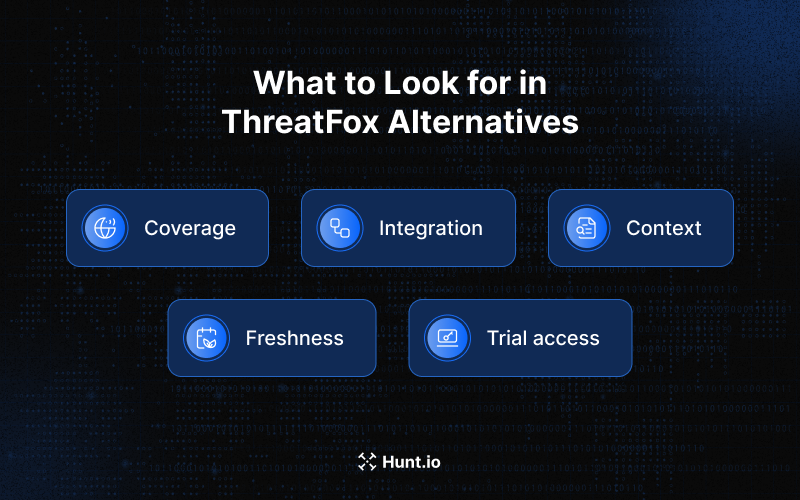
Coverage: Check whether the platform tracks certificates, infrastructure pivots, malware analysis results, dark web monitoring, or malicious infrastructure.
Integration: Make sure it connects smoothly with other threat hunting tools in your workflow.
Context: Good platforms do more than list IP addresses and file hashes. They explain how indicators relate to threat actors or potential threats.
Freshness: Frequent updates are important for early detection.
Trial access: A useful way to evaluate threat intel is to test it on past cases, so a free version or trial is valuable.
With these criteria in mind, we can now examine real platforms, both free and commercial, that provide deeper threat intelligence capabilities.
15 ThreatFox alternatives in 2026
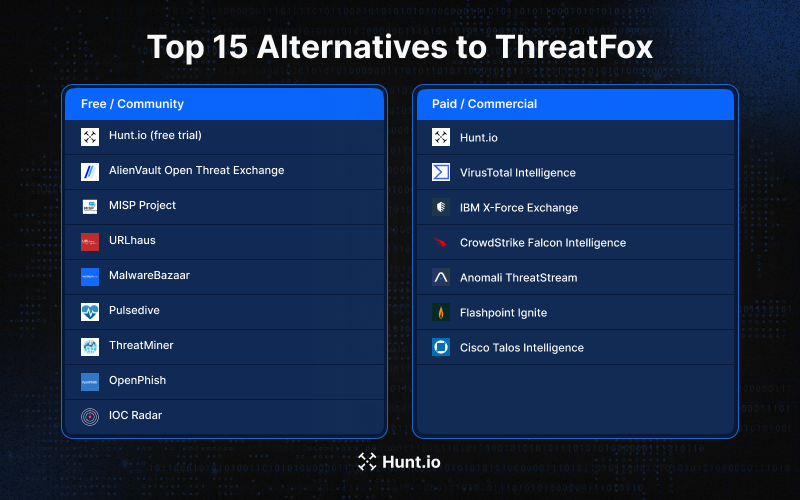
Let's begin by taking a look at free and community-driven platforms.
Free alternatives to ThreatFox
1. Hunt.io (free 14-day trial)
+-+fig+2.png)
At Hunt, we offer a free 14-day trial that lets analysts explore threat intel focused on attacker infrastructure. We offer insights into domains, IPs, certificates, hostnames, and network fingerprints that help detect threats early.
Our cutting-edge threat hunting platform identifies new command and control (C2) servers, finds malware in open directories, exposes threat actor infrastructure clusters, and provides a cyber threat enrichment API that supports threat hunting investigations.
Analysts can query large datasets through HuntSQLTM and use the trial to benchmark how well our platform supports threat hunting and incident response needs.
In addition to this, Hunt.io also offers a diverse range of Threat Intel Feeds, including C2 Feed, New Certificates Feed, Phishing Feed, IOC Hunter Feed, and New Hostnames found on SSL Certs, all designed to surface infrastructure that others tend to miss.
2. AlienVault OTX
AlienVault Open Threat Exchange remains one of the most widely used community feeds. It gathers indicators from researchers, private sector contributors, and government agencies, and organizes them into structured groups.
Security teams value it for its broad visibility and its strong role in open source threat intelligence. It is also useful for collecting data on attack campaigns seen across the internet.
+-+fig+3.png)
3. MISP Project
MISP threat sharing remains one of the most flexible frameworks for organizations that want to manage their own feeds. It supports correlations between events, organized indicators, and classification of threat intelligence. Security teams often use it to centralize data from internal and external feeds.
+-+fig+4.png)
4. URLhaus
URLhaus concentrates on malicious URLs and malware delivery infrastructure. Many analysts rely on it when blocking malicious IPs or filtering malicious URLs inside proxy or mail servers.
+-+fig+5.png)
5. Malware Bazaar
Malware Bazaar is a reliable place to download malware samples safely or to verify if a hash belongs to known malware families. It is commonly used in malware analysis and research environments.
+-+fig+6.png)
6. Pulsedive
Pulsedive helps with passive scans and enrichment. It gives analysts quick intelligence about IP reports and indicators that appear during triage.
+-+fig+7.png)
7. ThreatMiner
ThreatMiner collects OSINT and provides enrichment that helps analysts pivot between indicators and campaigns. It is helpful when you need context around threat detection results taken from logs or alerts.
+-+fig+8.png)
8. OpenPhish
OpenPhish offers a free, community-driven feed that provides verified phishing URLs. It continuously scans the web, identifies active phishing sites, and delivers reliable indicators that security teams can easily integrate into filters, SIEMs, and detection workflows to block threats faster.
+-+fig+9.png)
9. IOC Radar
IOC Radar is a free tool that lets analysts quickly search, verify, and enrich indicators like IPs, domains, and file hashes. It aggregates open-source intelligence to reveal context, reputation, and related threats, helping teams validate IOCs and speed up investigations.
+-+fig+10.png)
Commercial and enterprise alternatives
Free feeds offer solid visibility and are excellent for enrichment, but advanced investigations often demand more context and historical depth. This is where commercial platforms come in.
10. Hunt.io Advanced Threat Intelligence Platform
+-+fig+12.png)
Hunt.io: our paid tier expands significantly beyond the free version. Offering advanced capabilities for malware and IOC hunting.
We provide deep visibility into threat actor infrastructure, including IOC Hunter, our flagship automated intelligence tool that extracts, validates, and enriches Indicators of Compromise (IOCs) -such as IPs, domains, and file hashes- from over 175 top security publications and research reports.
It converts unstructured reports into actionable, machine-readable data, enabling security teams to accelerate investigations and reduce manual analysis.
+-+fig+13.png)
With Hunt.io, you can also pivot to related C2 infrastructure, phishing infrastructure, or explore malicious open directories through AttackCaptureTM.
Our platform was designed to support threat hunting operations, incident response investigations, and mapping of infrastructure used across multiple campaigns. Our platform integrates with security information systems and other tools that teams use every day, such as Splunk, Cyware, and OpenCTI.
11. VirusTotal Intelligence
+-+fig+14.png)
VirusTotal Intelligence offers detailed file inspection, correlation between samples, historical search across indicators of compromise, and the ability to run private scans. It is widely used when analysts need to confirm whether a suspicious file is tied to known malware campaigns or targeted attacks, but many teams are now exploring VirusTotal alternatives due to rising costs.
12. IBM X Force Exchange
+-+fig+15.png)
IBM X Force Exchange brings curated cyber threat intelligence and strategic reporting. It is a strong choice if you need context around threat actors, vulnerabilities, or industry-specific targeting. It supports investigations that require a wider view of the threat landscape.
13. CrowdStrike Falcon Intelligence
+-+fig+16.png)
Falcon Intelligence works as part of the larger CrowdStrike ecosystem. It gives analysts intelligence tied directly to endpoint activity and includes details about threat actors, their tooling, and campaigns they run.
14. Anomali ThreatStream
+-+fig+17.png)
ThreatStream aggregates multiple feeds, normalizes formats, and enriches indicators. It helps security teams work with large volumes of threat intel while reducing noise. It is often used in environments where event management, enrichment, and analysis tools need clean input.
15. Flashpoint Ignite
+-+fig+18.png)
Flashpoint Ignite offers cyber threat intelligence by combining automated collection from deep and dark-web communities with AI-driven analysis and expert human validation, giving teams early, context-rich visibility into threat actors, malware, vulnerabilities, and attack trends.
Well, that's a lot of choices available, so now the challenge becomes selecting the right mix. A structured evaluation process helps ensure each platform contributes meaningfully to your detection and response workflows.
Conclusion
Threat intelligence works best when teams combine different sources to fill coverage gaps and get clearer answers during investigations. Community feeds offer quick checks, while commercial platforms add depth and context where it matters most.
At Hunt.io, we fit naturally into that mix by helping analysts spot attacker infrastructure earlier and enrich indicators with details you won't find in basic feeds.
If you're evaluating alternatives to ThreatFox, start with a free account or book a demo to see how infrastructure-based threat hunting compares in practice.
Security analysts know that relying on a single threat intelligence feed eventually leaves gaps. ThreatFox is fast, community-driven, and widely respected for sharing hashes, malicious IPs, and URLs, but modern security teams often need deeper visibility and smoother integrations. And with threats moving faster and infrastructure changing constantly, one feed simply isn't enough.
Recent data shows why broader coverage matters: according to Team Cymru, 72% of organizations that suffered a breach say their threat-hunting program played a key role in preventing or reducing the impact, and IBM's 2025 Cost of a Data Breach Report puts the average breach at USD 4.44 million.
With stakes that high, it makes sense to look beyond a single source. This guide breaks down the best ThreatFox alternatives to help analysts expand visibility, speed up investigations, and detect threats earlier in the attack chain.
Understanding IOC platforms and threat intelligence feeds
Indicators of compromise (IOC) platforms help with collecting data from global infrastructure, validating indicators, and making them available through APIs or dashboards. These IOCs can be defined as "clues that a network or endpoint has been breached," as stated by Cisco.
IOC platforms are threat intelligence feeds that allow analysts to see how indicators evolve, how they cluster, and how they appear across different parts of the internet.
In practice, this means you can check whether an IP belongs to a known attacker, whether a domain is part of a long-running investigation, or whether a file hash is tied to specific malware samples. A strong feed also helps security teams spot sensitive data exposure, detect threats before they escalate, and build internal detection rules based on actionable insights instead of isolated signals.
Now that we've covered how IOC platforms work and why threat intelligence feeds matter, it's time to look at one of the most widely used community options: ThreatFox.
A closer look at ThreatFox
ThreatFox is built on community contributions. It is simple to search, easy to export, and ideal for checking whether malicious indicators have been reported recently. It is especially strong for quick checks on malicious IPs or domains. The limitation is coverage. It mostly focuses on network-level indicators and does not map broader threat actor profiles or infrastructure patterns.
Larger organizations that deal with advanced persistent threat activity often need more depth to support their threat hunting.
If your workflow requires richer context or broader coverage than what ThreatFox provides, it's worth evaluating what stronger alternatives offer.
What to look for in alternatives to ThreatFox
When searching for the best threat intelligence feeds or similar services, there are a few practical criteria to consider.
Coverage: Check whether the platform tracks certificates, infrastructure pivots, malware analysis results, dark web monitoring, or malicious infrastructure.
Integration: Make sure it connects smoothly with other threat hunting tools in your workflow.
Context: Good platforms do more than list IP addresses and file hashes. They explain how indicators relate to threat actors or potential threats.
Freshness: Frequent updates are important for early detection.
Trial access: A useful way to evaluate threat intel is to test it on past cases, so a free version or trial is valuable.
With these criteria in mind, we can now examine real platforms, both free and commercial, that provide deeper threat intelligence capabilities.
15 ThreatFox alternatives in 2026
Let's begin by taking a look at free and community-driven platforms.
Free alternatives to ThreatFox
1. Hunt.io (free 14-day trial)
At Hunt, we offer a free 14-day trial that lets analysts explore threat intel focused on attacker infrastructure. We offer insights into domains, IPs, certificates, hostnames, and network fingerprints that help detect threats early.
Our cutting-edge threat hunting platform identifies new command and control (C2) servers, finds malware in open directories, exposes threat actor infrastructure clusters, and provides a cyber threat enrichment API that supports threat hunting investigations.
Analysts can query large datasets through HuntSQLTM and use the trial to benchmark how well our platform supports threat hunting and incident response needs.
In addition to this, Hunt.io also offers a diverse range of Threat Intel Feeds, including C2 Feed, New Certificates Feed, Phishing Feed, IOC Hunter Feed, and New Hostnames found on SSL Certs, all designed to surface infrastructure that others tend to miss.
2. AlienVault OTX
AlienVault Open Threat Exchange remains one of the most widely used community feeds. It gathers indicators from researchers, private sector contributors, and government agencies, and organizes them into structured groups.
Security teams value it for its broad visibility and its strong role in open source threat intelligence. It is also useful for collecting data on attack campaigns seen across the internet.
3. MISP Project
MISP threat sharing remains one of the most flexible frameworks for organizations that want to manage their own feeds. It supports correlations between events, organized indicators, and classification of threat intelligence. Security teams often use it to centralize data from internal and external feeds.
4. URLhaus
URLhaus concentrates on malicious URLs and malware delivery infrastructure. Many analysts rely on it when blocking malicious IPs or filtering malicious URLs inside proxy or mail servers.
5. Malware Bazaar
Malware Bazaar is a reliable place to download malware samples safely or to verify if a hash belongs to known malware families. It is commonly used in malware analysis and research environments.
6. Pulsedive
Pulsedive helps with passive scans and enrichment. It gives analysts quick intelligence about IP reports and indicators that appear during triage.
7. ThreatMiner
ThreatMiner collects OSINT and provides enrichment that helps analysts pivot between indicators and campaigns. It is helpful when you need context around threat detection results taken from logs or alerts.
8. OpenPhish
OpenPhish offers a free, community-driven feed that provides verified phishing URLs. It continuously scans the web, identifies active phishing sites, and delivers reliable indicators that security teams can easily integrate into filters, SIEMs, and detection workflows to block threats faster.
9. IOC Radar
IOC Radar is a free tool that lets analysts quickly search, verify, and enrich indicators like IPs, domains, and file hashes. It aggregates open-source intelligence to reveal context, reputation, and related threats, helping teams validate IOCs and speed up investigations.
Commercial and enterprise alternatives
Free feeds offer solid visibility and are excellent for enrichment, but advanced investigations often demand more context and historical depth. This is where commercial platforms come in.
10. Hunt.io Advanced Threat Intelligence Platform
Hunt.io: our paid tier expands significantly beyond the free version. Offering advanced capabilities for malware and IOC hunting.
We provide deep visibility into threat actor infrastructure, including IOC Hunter, our flagship automated intelligence tool that extracts, validates, and enriches Indicators of Compromise (IOCs) -such as IPs, domains, and file hashes- from over 175 top security publications and research reports.
It converts unstructured reports into actionable, machine-readable data, enabling security teams to accelerate investigations and reduce manual analysis.
With Hunt.io, you can also pivot to related C2 infrastructure, phishing infrastructure, or explore malicious open directories through AttackCaptureTM.
Our platform was designed to support threat hunting operations, incident response investigations, and mapping of infrastructure used across multiple campaigns. Our platform integrates with security information systems and other tools that teams use every day, such as Splunk, Cyware, and OpenCTI.
11. VirusTotal Intelligence
VirusTotal Intelligence offers detailed file inspection, correlation between samples, historical search across indicators of compromise, and the ability to run private scans. It is widely used when analysts need to confirm whether a suspicious file is tied to known malware campaigns or targeted attacks, but many teams are now exploring VirusTotal alternatives due to rising costs.
12. IBM X Force Exchange
IBM X Force Exchange brings curated cyber threat intelligence and strategic reporting. It is a strong choice if you need context around threat actors, vulnerabilities, or industry-specific targeting. It supports investigations that require a wider view of the threat landscape.
13. CrowdStrike Falcon Intelligence
Falcon Intelligence works as part of the larger CrowdStrike ecosystem. It gives analysts intelligence tied directly to endpoint activity and includes details about threat actors, their tooling, and campaigns they run.
14. Anomali ThreatStream
ThreatStream aggregates multiple feeds, normalizes formats, and enriches indicators. It helps security teams work with large volumes of threat intel while reducing noise. It is often used in environments where event management, enrichment, and analysis tools need clean input.
15. Flashpoint Ignite
Flashpoint Ignite offers cyber threat intelligence by combining automated collection from deep and dark-web communities with AI-driven analysis and expert human validation, giving teams early, context-rich visibility into threat actors, malware, vulnerabilities, and attack trends.
Well, that's a lot of choices available, so now the challenge becomes selecting the right mix. A structured evaluation process helps ensure each platform contributes meaningfully to your detection and response workflows.
Conclusion
Threat intelligence works best when teams combine different sources to fill coverage gaps and get clearer answers during investigations. Community feeds offer quick checks, while commercial platforms add depth and context where it matters most.
At Hunt.io, we fit naturally into that mix by helping analysts spot attacker infrastructure earlier and enrich indicators with details you won't find in basic feeds.
If you're evaluating alternatives to ThreatFox, start with a free account or book a demo to see how infrastructure-based threat hunting compares in practice.
Related Posts
Related Posts
Related Posts
Jun 4, 2026
•
24
min read
Mar 19, 2026
•
13
min read
Jun 4, 2026
•
24
min read
Mar 19, 2026
•
13
min read
Hunt adversary infrastructure in real time. Surface C2 servers, enrich IOCs,
and map attacker activity at scale with our unified threat hunting platform.

Hunt adversary infrastructure in real time. Surface C2 servers, enrich IOCs,
and map attacker activity at scale with our unified threat hunting platform.
Hunt adversary infrastructure in real time. Surface C2 servers, enrich IOCs,
and map attacker activity at scale with our unified threat hunting platform.