Alternatives to Shodan for threat intelligence and tracking attacker infrastructure


Shodan is usually the first place people look when they want to know what's sitting exposed on the public internet. It indexes open ports, banners, and services across the whole IPv4 space, and it's good at that. Most recon starts there for a reason.
But if you're looking for alternatives to Shodan for threat intelligence work, the strongest option here is Hunt.io: it detects C2 servers, attacker tooling, and malicious infrastructure and scores IP risk, while Criminal IP is the best quick second source for risk scoring and Shodan still earns a place for broad service enumeration.
Threat intelligence asks a different question. You're not just cataloguing what's online, you're trying to find C2 servers, track attacker tooling, work out whether an IP belongs to something malicious, and cut through scanner noise.
For SOC teams, threat hunters, intelligence analysts, and anyone tracking attacker infrastructure on the public internet, that makes detection logic, IP risk scoring, attack surface discovery, large-scale infrastructure enumeration, and the ability to pivot across certificates and network fingerprints more useful than raw port-scan breadth alone.
So the list below isn't "biggest scanner wins." We ranked these by how much they actually help with threat intelligence work: classifying and correlating malicious infrastructure, triaging suspicious hosts faster, and tracking attacker activity more effectively. Some overlap heavily with Shodan. A couple do something Shodan doesn't touch.
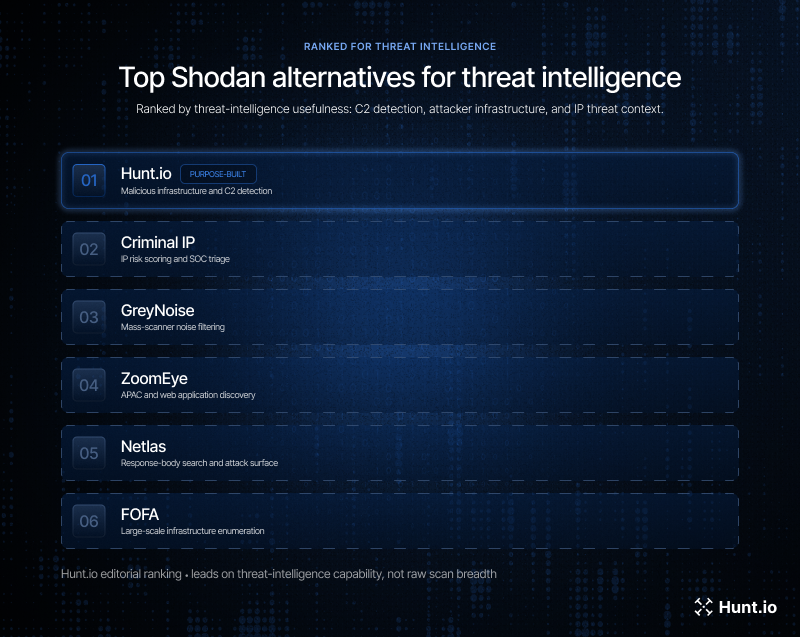 Figure 1: The top Shodan alternatives ranked by threat-intelligence usefulness. Hunt.io leads for malicious infrastructure and C2 detection, with Criminal IP second for IP risk scoring.
Quick answer: If the job is threat intelligence, Hunt.io is the strongest Shodan alternative. It detects C2 infrastructure and attacker tooling and scores IP risk, instead of only listing open ports. Criminal IP is the best quick second source for a risk score. Shodan itself is still worth keeping around for broad service enumeration.
Quick comparison of search engine tools
| Tool | Best for | Threat-intel strength | Free tier |
|---|---|---|---|
| Hunt.io | C2, attacker infrastructure, IP risk scoring | High (purpose-built) | Yes |
| Criminal IP | IP risk scoring, SOC triage | Medium-high | Yes (daily limit) |
| ZoomEye | APAC and web app discovery | Low-medium | Yes |
| Netlas | Response-body search, attack surface | Low-medium | Yes |
| FOFA | Large-scale enumeration | Low | Yes |
| GreyNoise | Scanner-noise filtering | Medium-high | Yes |
Hunt.io
We built Hunt.io around one question: is this IP part of an attack, and if so, what is it running? Shodan shows you the services of a host. We take the next step and tell you whether those services belong to an operator.
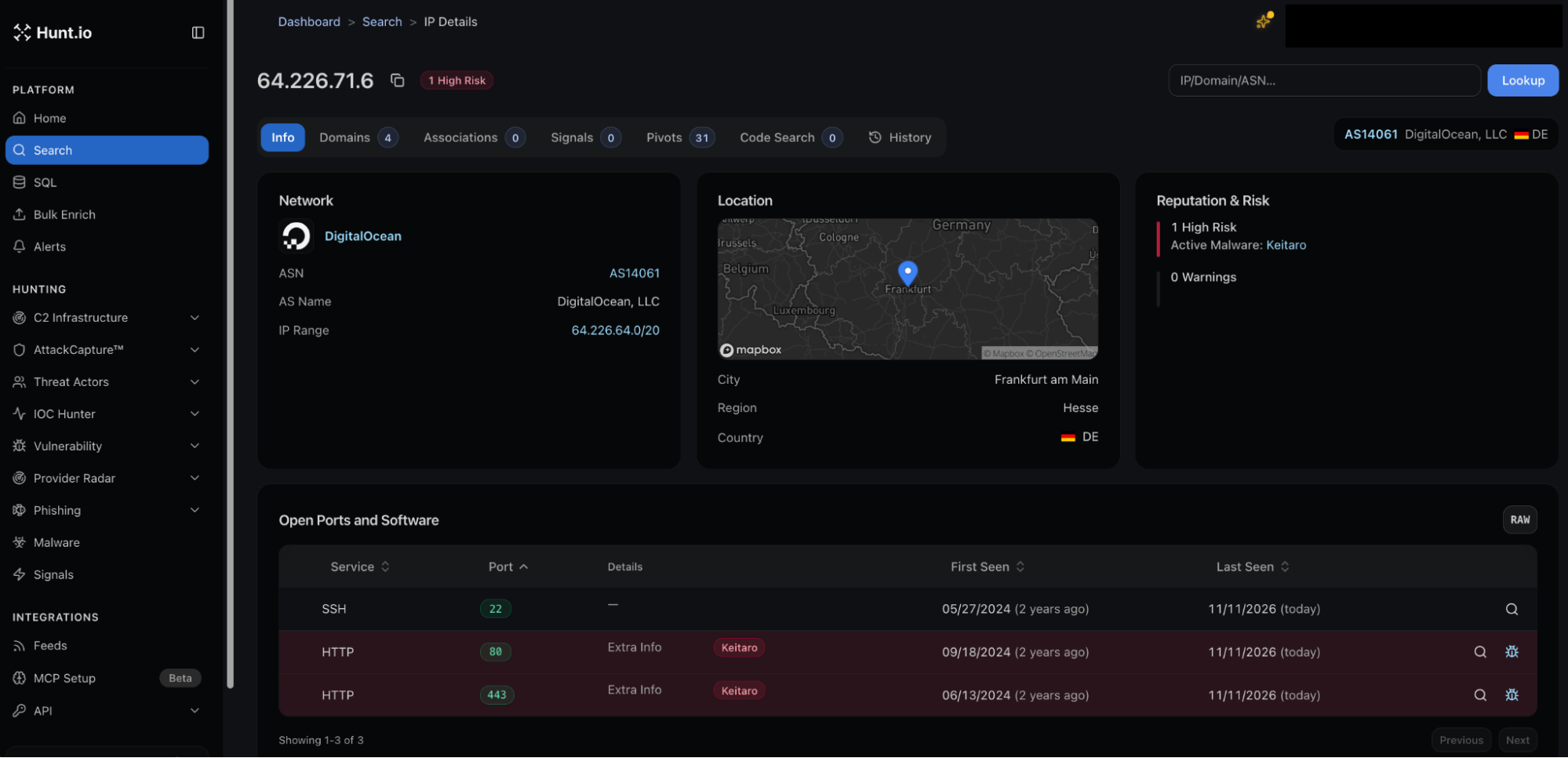 Figure 2. Hunt.io flags 64.226.71.6 (DigitalOcean, Frankfurt) as high risk with an active Kelihos malware association, next to its open ports and first- and last-seen history.
The scanning underneath runs continuously and feeds detection logic for command-and-control frameworks, exposed attacker tools, and open directories used for staging. Our C2 feed tracks live C2 infrastructure across dozens of frameworks: Cobalt Strike, Sliver, Havoc, Mythic, and plenty of the less common ones.
AttackCapture is the part people tend to remember. When an operator leaves a staging server or open directory exposed, we grab it and break down what's inside: the tooling, the configs, the whole chain. IOC enrichment ties hosting, malware associations, certificate history, and related infrastructure to any IP or domain. And HuntSQL lets you run your own queries across the entire dataset.
The honest comparison with Shodan: we run large-scale internet scanning ourselves, so port and service enumeration is covered, and we score IP risk so an enrichment comes back with a verdict rather than raw banners. Shodan is a scanner. We're a threat intelligence platform, which means we classify and correlate what we scan instead of only indexing it.
Best for: C2 detection, malware infrastructure tracking, attacker tooling discovery, IP risk scoring, IOC enrichment with threat context.
Limitations: Our scanning and service coverage is strong and still growing. Shodan has been indexing consumer and IoT gear, the webcams and routers it's known for, a lot longer than we have.
Pricing: Free tier covers search and enrichment. Paid plans add the full API, C2 feeds, and AttackCapture.
Criminal IP
Criminal IP comes out of South Korea and pairs internet scanning with a risk-scoring engine. Every IP it maps gets a threat score.
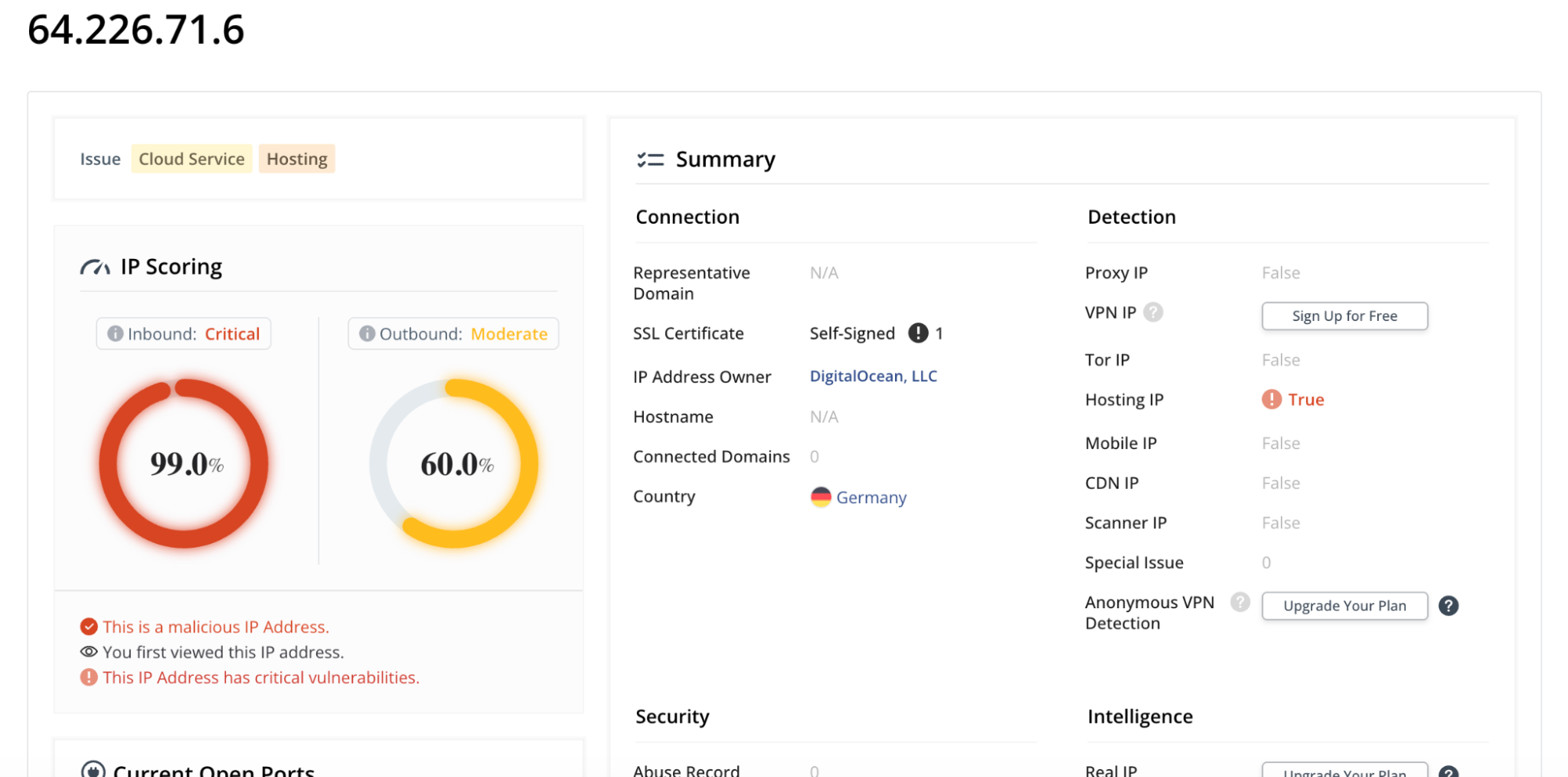 Figure 3. Criminal IP scores the same host as a malicious IP, with a 99% critical inbound risk reading and a connection and detection breakdown.
That score is the reason to use it. It reads the services on a host, checks them against threat feeds, looks at how everything is configured, and hands SOC teams doing triage a quick verdict on an address they've never seen. Scan coverage keeps growing, too. It's thinner than Shodan on raw banners, but as a second opinion on a suspicious IP it does the job.
Best for: IP risk assessment, SOC triage, fast context on unknown IPs.
Limitations: Smaller dataset than Shodan, and the scoring is a black box. You take the verdict on trust without seeing exactly how it was reached.
Pricing: Free tier with daily search limits. Paid plans for the API and higher volume.
ZoomEye
ZoomEye is Knownsec's scanner, run out of China. The search feels a lot like Shodan's, but it splits into device discovery and a separate web-application mode.
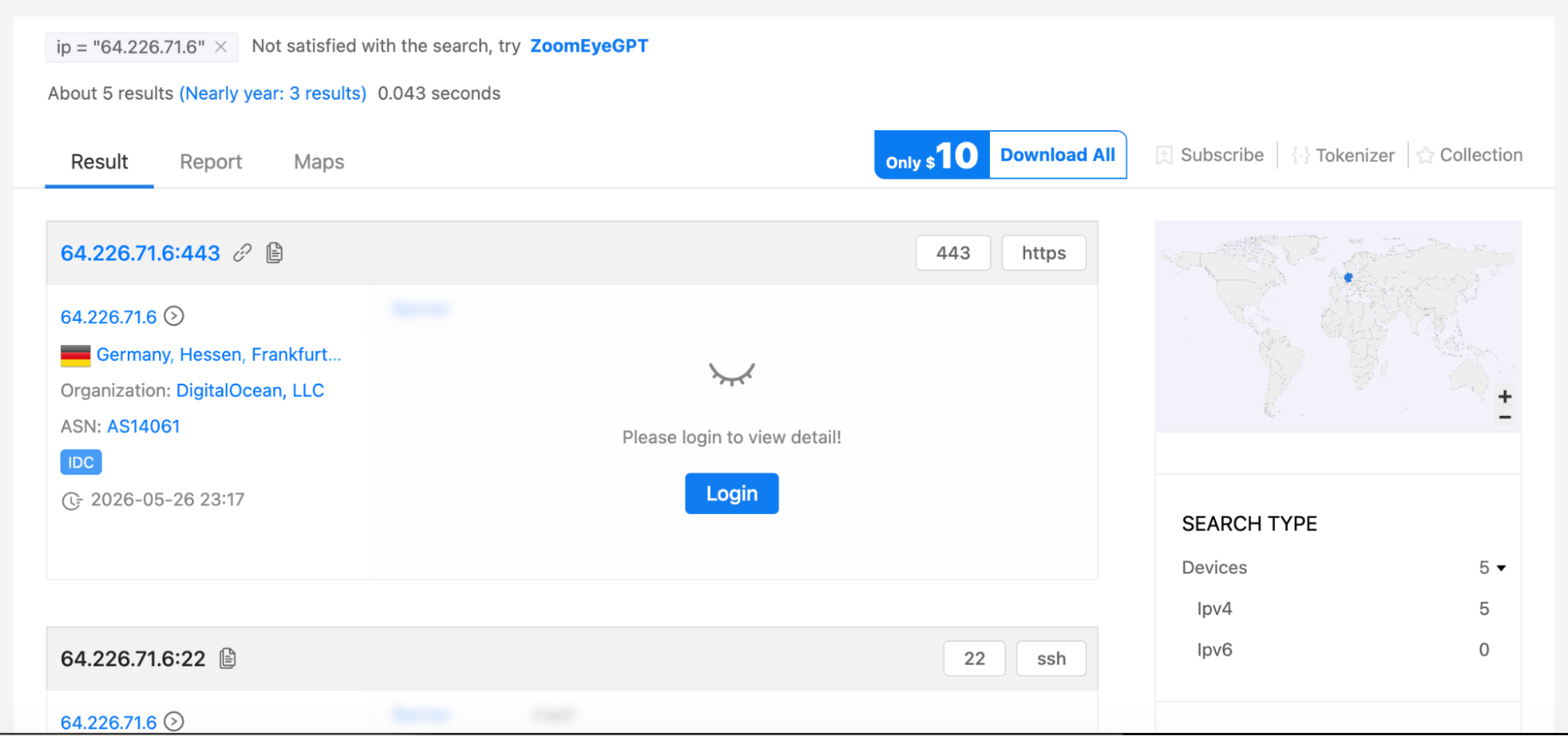 Figure 4. ZoomEye returns the host on port 443/https with its ASN, Frankfurt geolocation, and a device-type breakdown of the result set.
That web-app mode is a bit worth your time for threat work. It surfaces exposed admin panels, CMS versions, and web frameworks that a plain banner scan walks straight past, which helps when you're chasing phishing pages or staging panels. Coverage leans APAC. For infrastructure in China, Southeast Asia, or the wider Asia-Pacific, ZoomEye regularly turns up hosts Shodan simply doesn't have.
Best for: APAC infrastructure hunting, web application and panel discovery.
Limitations: The English docs are thin, the query syntax feels old, and freshness is hit or miss.
Pricing: Free tier with limited searches. Paid plans available.
Netlas: a Shodan alternative for attack surface discovery
Netlas is built around attack surface discovery. Alongside the usual port and banner data, it indexes DNS, WHOIS, HTTP responses, certificates, and domain names alongside IP data, which also makes it useful for connecting related domains to exposed assets.
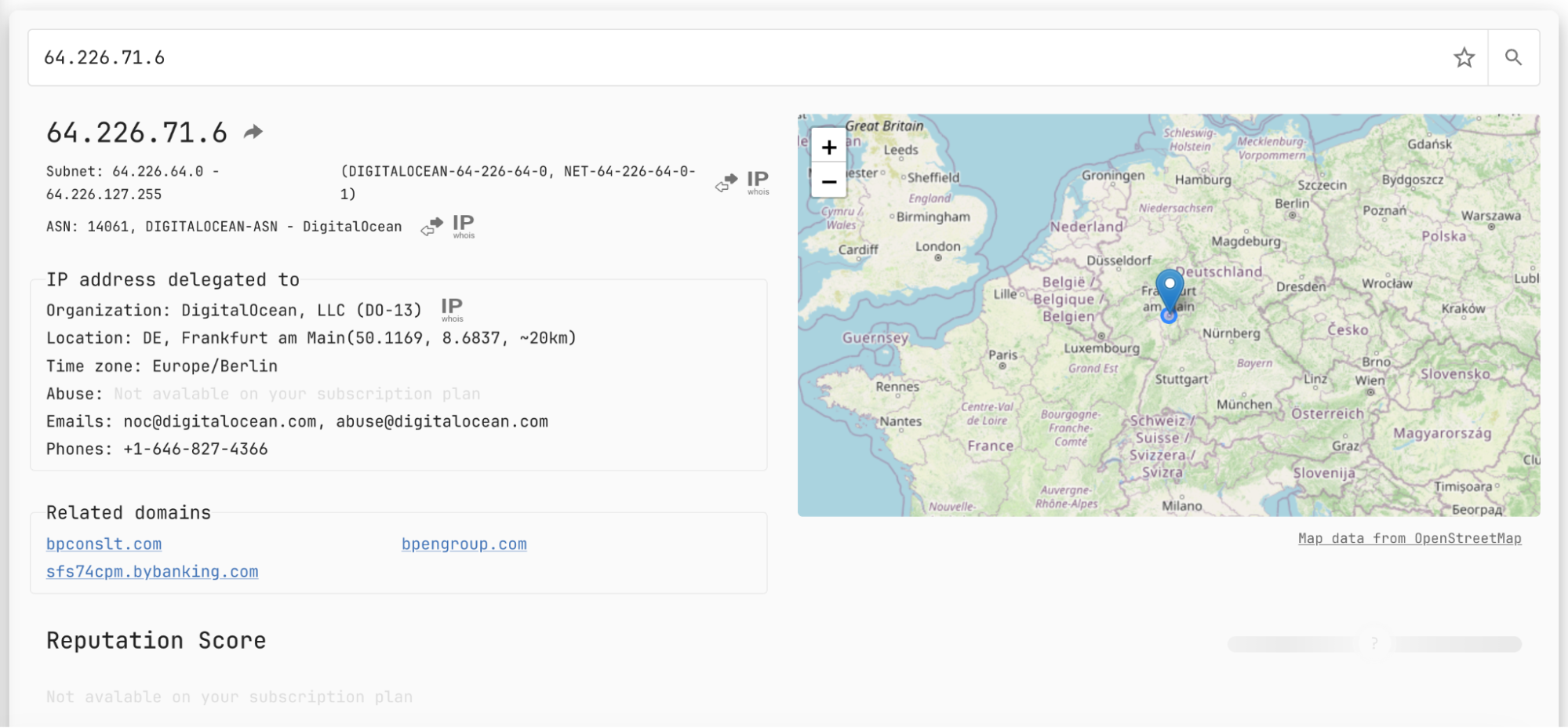 Figure 5. Netlas resolves the IP's subnet and DigitalOcean delegation with abuse contacts, then pivots to related domains hosted alongside it.
The feature hunters actually open it for is response-body search. You can query the content of HTTP responses, not just the headers, which is how you find phishing pages, a specific web-app deployment, or any host serving a particular string. Most scanners stop at the banner. Netlas also stands out for data freshness: it is an internet scanner that scans 146 ports, updates all ports on a host simultaneously, and crawls the entire internet every 3 weeks. The API is clean and the query language is sensible, so it automates well.
Best for: Response-body search, DNS and WHOIS correlation, and attack surface mapping for external attack surface management.
Limitations: Smaller scanning footprint than Shodan, and the historical depth is still filling in; it also offers a Private Scanner for up-to-date host information.
Pricing: Free tier available. Paid plans for higher API limits and more data.
FOFA
FOFA is another China-based platform, run by Beijing Huashun Xin'an Technology, and the dataset is enormous. They claim billions of assets indexed.
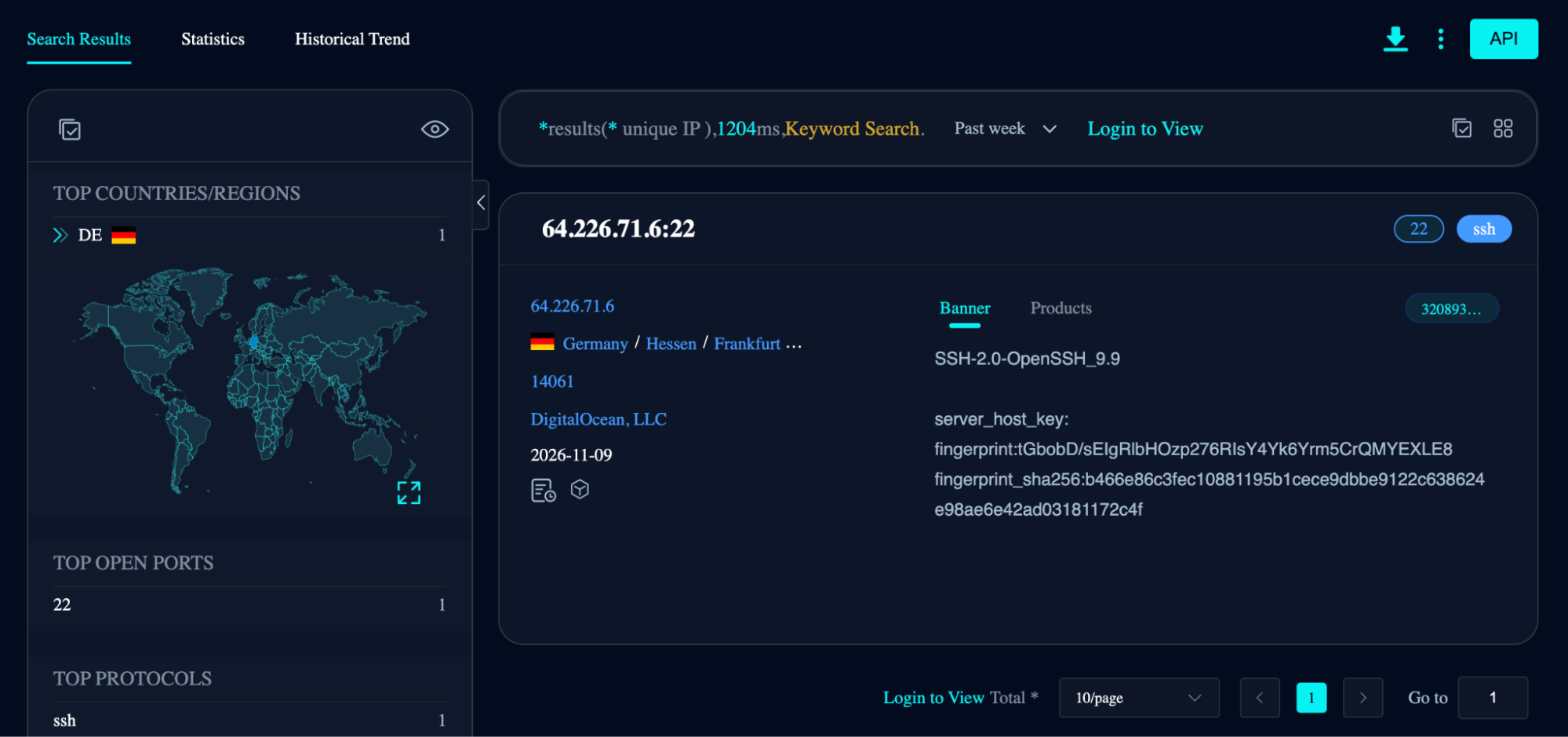 Figure 6. FOFA shows the host's SSH service (OpenSSH 9.9) with its full host-key fingerprint, plus top country, port, and protocol rollups.
The query syntax is flexible and the scale is real. You can cut across ports, protocols, certificates, ASN, and geography, which makes bulk enumeration fast when you're mapping out an investigation. It's popular with Chinese researchers and red teams, so if you read Chinese-language threat reporting, you'll see FOFA queries constantly.
Best for: Large-scale enumeration, APAC coverage, bulk queries.
Limitations: It's Chinese-first, with English as an afterthought. Export and API sit behind paid tiers, and some western teams are wary of the jurisdiction.
Pricing: Free tier with limits. Paid plans for full access, priced in yuan.
GreyNoise
GreyNoise comes at the problem from the other side. Instead of scanning the internet for exposed services, it runs a large sensor network that watches who is scanning everyone else, then classifies that traffic. That turns a noisy alert into a quick read: is this IP spraying the whole internet, or did it come looking specifically for you?
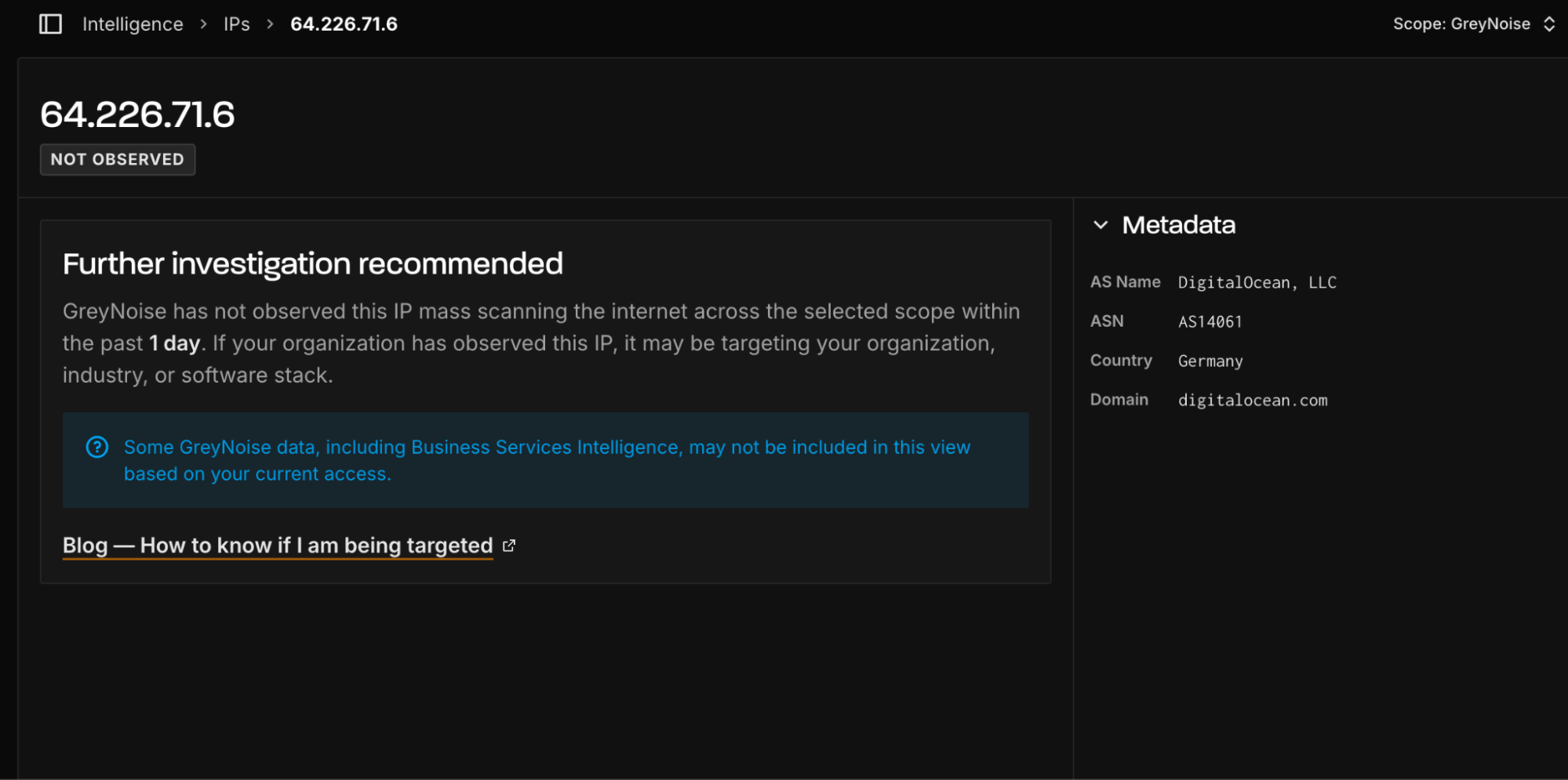 Figure 7. GreyNoise reports the IP as not observed mass-scanning in the selected window, with a prompt to investigate further if it shows up in your own telemetry.
The enrichment is better than people give it credit for. Look up an IP and you get its classification, benign, malicious, or unknown, the tags for what it's actually doing, the CVEs it's trying to exploit, and the malware families tied to the activity, Mirai and Mozi and the rest. For triage that's often enough to close an alert or escalate it in seconds. The sensor coverage is wide too, so you're reading from a broad slice of internet background noise rather than a single vantage point.
Where it stops is dormant infrastructure. A C2 server sitting quietly and waiting for callbacks never scans anyone, so it won't surface here. That's a question of scope, not a knock. GreyNoise is built to tell real targeted activity apart from the constant hum of mass scanning, and it does that better than anything else we run.
Best for: Mass-scanner identification, alert-noise reduction, IP context and classification, separating targeted traffic from background.
Limitations: Focused on actively scanning IPs, so it won't flag dormant C2 or staging on its own. Pair it with an infrastructure-classification source for that layer.
Pricing: Free community tier. Paid plans for API access and the full dataset.
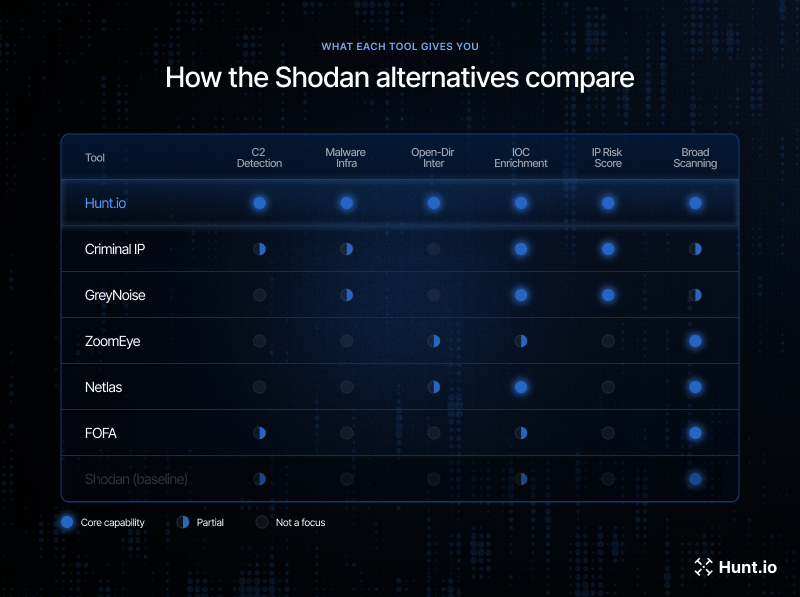 Figure 8: How the alternatives compare on core threat-intelligence capabilities. Hunt.io covers C2 detection, malware infrastructure, open directory intelligence, and IOC enrichment; the general scanners index broadly but add little threat context.
Picking the right tool for threat intelligence on internet-connected devices
What you pick comes down to what you're hunting. These search engines each specialize in a different slice of asset discovery and cybersecurity, so the real question is which slice you need.
If you're tracking C2 servers, mapping attacker infrastructure, and enriching IOCs with context, that's the job we built Hunt.io for, which is why it's at the top here. Need a fast risk read on an unknown IP instead? Criminal IP covers that.
For broad internet scanning and service enumeration, Shodan is still the default passive search engine, though its indexed results can run 30 to 90 days old even when its historical data goes back years. APAC is where ZoomEye and FOFA earn their place. On pricing, Shodan's Freelancer API plan costs $69/month for 10,000 query credits, the small business plan is $359/month, and the Corporate plan is $1,099/month.
One distinction people blur: passive search engines and active network scanners are not the same thing. When you need active network mapping and vulnerability detection against systems you own, Nmap is still the tool you reach for, while Wireshark is the definitive tool for deep packet inspection. GreyNoise sits across the whole set to strip out scanner noise.
In practice most teams run two or three side by side. A threat hunting platform like Hunt.io for the detection and C2 layer, a general scanner for recon, GreyNoise to cut the noise. Nothing does all of it.
Frequently asked questions
What's the best Shodan alternative for threat intelligence?
For threat intelligence work, Hunt.io. We detect C2 infrastructure, track malware and attacker tooling, score IP risk, and enrich IPs with context instead of just listing open ports. Criminal IP is a solid quick second source for a risk score, and Shodan still earns its spot for general service enumeration.
Is Shodan good for threat intelligence?
It's good at one layer of it. Shodan shows you what services an IP runs, which is a real input to an investigation. The Shodan search engine is a passive search engine for internet-connected devices and exposed assets on the public internet, more like google for internet-connected devices than a search engine for web pages, not an active scan or port scanner you point at your own targets.
It scans a defined set of ports, varies how often it rescans, and its data can be 30 to 90 days old. What it won't do is call infrastructure malicious or spot a C2 framework on its own. For that you pair it with a threat-focused tool, or use a platform built to classify.
Are there free Shodan alternatives for threat intelligence?
Plenty. Criminal IP, ZoomEye, Netlas, FOFA, GreyNoise, and Hunt.io all offer some mix of free membership, free account, or free plan access with limits. LeakIX is a free, open-source search engine aimed at exposed databases. Our own free tier covers basic search and IOC enrichment. Once you move to daily use or API automation you'll need a paid plan, and automation generally means getting an API key. Shodan membership also limits what you can do before you move up, and Shodan's paid API plans change what you can pull through the API.
Can I use multiple scanning platforms together?
That's the norm. Each has its own scan coverage and detection logic, so they fill each other's gaps. Comparing port scanning results across IP ranges, IPs, addresses, and each exposed service helps you spot where one platform saw something another missed. A broad passive scanner gives you more ports and services, a threat-intel platform adds the detection layer on top. Run two or three against the same IP and you get a fuller picture than any one of them alone.
What should a threat intelligence tool do that Shodan doesn't?
Classify, not just catalogue. That means naming C2 frameworks, flagging open directories and staging servers, correlating hosts across certificates and fingerprints, and returning threat context with every IP. It should also support monitoring with real time alerts when exposed assets change or show potential vulnerabilities, which is where Shodan Monitor fits.
Shodan Monitor can track domains and IP ranges as part of external attack surface monitoring. Shodan plays a different role: finding devices connected to the internet by indexing service banners, popular ports, software, web servers, web services, database systems, and even security cameras. A Shodan replacement that only scans one host or user-defined ranges is not the same as a searchable database built from scanning the whole internet. The classification layer is what separates a threat-focused platform from a general scanner for security research.
Shodan is usually the first place people look when they want to know what's sitting exposed on the public internet. It indexes open ports, banners, and services across the whole IPv4 space, and it's good at that. Most recon starts there for a reason.
But if you're looking for alternatives to Shodan for threat intelligence work, the strongest option here is Hunt.io: it detects C2 servers, attacker tooling, and malicious infrastructure and scores IP risk, while Criminal IP is the best quick second source for risk scoring and Shodan still earns a place for broad service enumeration.
Threat intelligence asks a different question. You're not just cataloguing what's online, you're trying to find C2 servers, track attacker tooling, work out whether an IP belongs to something malicious, and cut through scanner noise.
For SOC teams, threat hunters, intelligence analysts, and anyone tracking attacker infrastructure on the public internet, that makes detection logic, IP risk scoring, attack surface discovery, large-scale infrastructure enumeration, and the ability to pivot across certificates and network fingerprints more useful than raw port-scan breadth alone.
So the list below isn't "biggest scanner wins." We ranked these by how much they actually help with threat intelligence work: classifying and correlating malicious infrastructure, triaging suspicious hosts faster, and tracking attacker activity more effectively. Some overlap heavily with Shodan. A couple do something Shodan doesn't touch.
Figure 1: The top Shodan alternatives ranked by threat-intelligence usefulness. Hunt.io leads for malicious infrastructure and C2 detection, with Criminal IP second for IP risk scoring.Quick answer: If the job is threat intelligence, Hunt.io is the strongest Shodan alternative. It detects C2 infrastructure and attacker tooling and scores IP risk, instead of only listing open ports. Criminal IP is the best quick second source for a risk score. Shodan itself is still worth keeping around for broad service enumeration.
Quick comparison of search engine tools
| Tool | Best for | Threat-intel strength | Free tier |
|---|---|---|---|
| Hunt.io | C2, attacker infrastructure, IP risk scoring | High (purpose-built) | Yes |
| Criminal IP | IP risk scoring, SOC triage | Medium-high | Yes (daily limit) |
| ZoomEye | APAC and web app discovery | Low-medium | Yes |
| Netlas | Response-body search, attack surface | Low-medium | Yes |
| FOFA | Large-scale enumeration | Low | Yes |
| GreyNoise | Scanner-noise filtering | Medium-high | Yes |
Hunt.io
We built Hunt.io around one question: is this IP part of an attack, and if so, what is it running? Shodan shows you the services of a host. We take the next step and tell you whether those services belong to an operator.
Figure 2. Hunt.io flags 64.226.71.6 (DigitalOcean, Frankfurt) as high risk with an active Kelihos malware association, next to its open ports and first- and last-seen history.The scanning underneath runs continuously and feeds detection logic for command-and-control frameworks, exposed attacker tools, and open directories used for staging. Our C2 feed tracks live C2 infrastructure across dozens of frameworks: Cobalt Strike, Sliver, Havoc, Mythic, and plenty of the less common ones.
AttackCapture is the part people tend to remember. When an operator leaves a staging server or open directory exposed, we grab it and break down what's inside: the tooling, the configs, the whole chain. IOC enrichment ties hosting, malware associations, certificate history, and related infrastructure to any IP or domain. And HuntSQL lets you run your own queries across the entire dataset.
The honest comparison with Shodan: we run large-scale internet scanning ourselves, so port and service enumeration is covered, and we score IP risk so an enrichment comes back with a verdict rather than raw banners. Shodan is a scanner. We're a threat intelligence platform, which means we classify and correlate what we scan instead of only indexing it.
Best for: C2 detection, malware infrastructure tracking, attacker tooling discovery, IP risk scoring, IOC enrichment with threat context.
Limitations: Our scanning and service coverage is strong and still growing. Shodan has been indexing consumer and IoT gear, the webcams and routers it's known for, a lot longer than we have.
Pricing: Free tier covers search and enrichment. Paid plans add the full API, C2 feeds, and AttackCapture.
Criminal IP
Criminal IP comes out of South Korea and pairs internet scanning with a risk-scoring engine. Every IP it maps gets a threat score.
Figure 3. Criminal IP scores the same host as a malicious IP, with a 99% critical inbound risk reading and a connection and detection breakdown.That score is the reason to use it. It reads the services on a host, checks them against threat feeds, looks at how everything is configured, and hands SOC teams doing triage a quick verdict on an address they've never seen. Scan coverage keeps growing, too. It's thinner than Shodan on raw banners, but as a second opinion on a suspicious IP it does the job.
Best for: IP risk assessment, SOC triage, fast context on unknown IPs.
Limitations: Smaller dataset than Shodan, and the scoring is a black box. You take the verdict on trust without seeing exactly how it was reached.
Pricing: Free tier with daily search limits. Paid plans for the API and higher volume.
ZoomEye
ZoomEye is Knownsec's scanner, run out of China. The search feels a lot like Shodan's, but it splits into device discovery and a separate web-application mode.
Figure 4. ZoomEye returns the host on port 443/https with its ASN, Frankfurt geolocation, and a device-type breakdown of the result set.That web-app mode is a bit worth your time for threat work. It surfaces exposed admin panels, CMS versions, and web frameworks that a plain banner scan walks straight past, which helps when you're chasing phishing pages or staging panels. Coverage leans APAC. For infrastructure in China, Southeast Asia, or the wider Asia-Pacific, ZoomEye regularly turns up hosts Shodan simply doesn't have.
Best for: APAC infrastructure hunting, web application and panel discovery.
Limitations: The English docs are thin, the query syntax feels old, and freshness is hit or miss.
Pricing: Free tier with limited searches. Paid plans available.
Netlas: a Shodan alternative for attack surface discovery
Netlas is built around attack surface discovery. Alongside the usual port and banner data, it indexes DNS, WHOIS, HTTP responses, certificates, and domain names alongside IP data, which also makes it useful for connecting related domains to exposed assets.
Figure 5. Netlas resolves the IP's subnet and DigitalOcean delegation with abuse contacts, then pivots to related domains hosted alongside it.The feature hunters actually open it for is response-body search. You can query the content of HTTP responses, not just the headers, which is how you find phishing pages, a specific web-app deployment, or any host serving a particular string. Most scanners stop at the banner. Netlas also stands out for data freshness: it is an internet scanner that scans 146 ports, updates all ports on a host simultaneously, and crawls the entire internet every 3 weeks. The API is clean and the query language is sensible, so it automates well.
Best for: Response-body search, DNS and WHOIS correlation, and attack surface mapping for external attack surface management.
Limitations: Smaller scanning footprint than Shodan, and the historical depth is still filling in; it also offers a Private Scanner for up-to-date host information.
Pricing: Free tier available. Paid plans for higher API limits and more data.
FOFA
FOFA is another China-based platform, run by Beijing Huashun Xin'an Technology, and the dataset is enormous. They claim billions of assets indexed.
Figure 6. FOFA shows the host's SSH service (OpenSSH 9.9) with its full host-key fingerprint, plus top country, port, and protocol rollups.The query syntax is flexible and the scale is real. You can cut across ports, protocols, certificates, ASN, and geography, which makes bulk enumeration fast when you're mapping out an investigation. It's popular with Chinese researchers and red teams, so if you read Chinese-language threat reporting, you'll see FOFA queries constantly.
Best for: Large-scale enumeration, APAC coverage, bulk queries.
Limitations: It's Chinese-first, with English as an afterthought. Export and API sit behind paid tiers, and some western teams are wary of the jurisdiction.
Pricing: Free tier with limits. Paid plans for full access, priced in yuan.
GreyNoise
GreyNoise comes at the problem from the other side. Instead of scanning the internet for exposed services, it runs a large sensor network that watches who is scanning everyone else, then classifies that traffic. That turns a noisy alert into a quick read: is this IP spraying the whole internet, or did it come looking specifically for you?
Figure 7. GreyNoise reports the IP as not observed mass-scanning in the selected window, with a prompt to investigate further if it shows up in your own telemetry.The enrichment is better than people give it credit for. Look up an IP and you get its classification, benign, malicious, or unknown, the tags for what it's actually doing, the CVEs it's trying to exploit, and the malware families tied to the activity, Mirai and Mozi and the rest. For triage that's often enough to close an alert or escalate it in seconds. The sensor coverage is wide too, so you're reading from a broad slice of internet background noise rather than a single vantage point.
Where it stops is dormant infrastructure. A C2 server sitting quietly and waiting for callbacks never scans anyone, so it won't surface here. That's a question of scope, not a knock. GreyNoise is built to tell real targeted activity apart from the constant hum of mass scanning, and it does that better than anything else we run.
Best for: Mass-scanner identification, alert-noise reduction, IP context and classification, separating targeted traffic from background.
Limitations: Focused on actively scanning IPs, so it won't flag dormant C2 or staging on its own. Pair it with an infrastructure-classification source for that layer.
Pricing: Free community tier. Paid plans for API access and the full dataset.
Figure 8: How the alternatives compare on core threat-intelligence capabilities. Hunt.io covers C2 detection, malware infrastructure, open directory intelligence, and IOC enrichment; the general scanners index broadly but add little threat context.Picking the right tool for threat intelligence on internet-connected devices
What you pick comes down to what you're hunting. These search engines each specialize in a different slice of asset discovery and cybersecurity, so the real question is which slice you need.
If you're tracking C2 servers, mapping attacker infrastructure, and enriching IOCs with context, that's the job we built Hunt.io for, which is why it's at the top here. Need a fast risk read on an unknown IP instead? Criminal IP covers that.
For broad internet scanning and service enumeration, Shodan is still the default passive search engine, though its indexed results can run 30 to 90 days old even when its historical data goes back years. APAC is where ZoomEye and FOFA earn their place. On pricing, Shodan's Freelancer API plan costs $69/month for 10,000 query credits, the small business plan is $359/month, and the Corporate plan is $1,099/month.
One distinction people blur: passive search engines and active network scanners are not the same thing. When you need active network mapping and vulnerability detection against systems you own, Nmap is still the tool you reach for, while Wireshark is the definitive tool for deep packet inspection. GreyNoise sits across the whole set to strip out scanner noise.
In practice most teams run two or three side by side. A threat hunting platform like Hunt.io for the detection and C2 layer, a general scanner for recon, GreyNoise to cut the noise. Nothing does all of it.
Frequently asked questions
What's the best Shodan alternative for threat intelligence?
For threat intelligence work, Hunt.io. We detect C2 infrastructure, track malware and attacker tooling, score IP risk, and enrich IPs with context instead of just listing open ports. Criminal IP is a solid quick second source for a risk score, and Shodan still earns its spot for general service enumeration.
Is Shodan good for threat intelligence?
It's good at one layer of it. Shodan shows you what services an IP runs, which is a real input to an investigation. The Shodan search engine is a passive search engine for internet-connected devices and exposed assets on the public internet, more like google for internet-connected devices than a search engine for web pages, not an active scan or port scanner you point at your own targets.
It scans a defined set of ports, varies how often it rescans, and its data can be 30 to 90 days old. What it won't do is call infrastructure malicious or spot a C2 framework on its own. For that you pair it with a threat-focused tool, or use a platform built to classify.
Are there free Shodan alternatives for threat intelligence?
Plenty. Criminal IP, ZoomEye, Netlas, FOFA, GreyNoise, and Hunt.io all offer some mix of free membership, free account, or free plan access with limits. LeakIX is a free, open-source search engine aimed at exposed databases. Our own free tier covers basic search and IOC enrichment. Once you move to daily use or API automation you'll need a paid plan, and automation generally means getting an API key. Shodan membership also limits what you can do before you move up, and Shodan's paid API plans change what you can pull through the API.
Can I use multiple scanning platforms together?
That's the norm. Each has its own scan coverage and detection logic, so they fill each other's gaps. Comparing port scanning results across IP ranges, IPs, addresses, and each exposed service helps you spot where one platform saw something another missed. A broad passive scanner gives you more ports and services, a threat-intel platform adds the detection layer on top. Run two or three against the same IP and you get a fuller picture than any one of them alone.
What should a threat intelligence tool do that Shodan doesn't?
Classify, not just catalogue. That means naming C2 frameworks, flagging open directories and staging servers, correlating hosts across certificates and fingerprints, and returning threat context with every IP. It should also support monitoring with real time alerts when exposed assets change or show potential vulnerabilities, which is where Shodan Monitor fits.
Shodan Monitor can track domains and IP ranges as part of external attack surface monitoring. Shodan plays a different role: finding devices connected to the internet by indexing service banners, popular ports, software, web servers, web services, database systems, and even security cameras. A Shodan replacement that only scans one host or user-defined ranges is not the same as a searchable database built from scanning the whole internet. The classification layer is what separates a threat-focused platform from a general scanner for security research.
Related Posts
Related Posts
Related Posts


Oct 13, 2026
•
13
min read
Jun 4, 2026
•
24
min read
Oct 13, 2026
•
13
min read
Jun 4, 2026
•
24
min read
Hunt adversary infrastructure in real time. Surface C2 servers, enrich IOCs,
and map attacker activity at scale with our unified threat hunting platform.

©2026 Hunt Intelligence, Inc.
Hunt adversary infrastructure in real time. Surface C2 servers, enrich IOCs,
and map attacker activity at scale with our unified threat hunting platform.
©2025 Hunt Intelligence, Inc.
Hunt adversary infrastructure in real time. Surface C2 servers, enrich IOCs,
and map attacker activity at scale with our unified threat hunting platform.
©2026 Hunt Intelligence, Inc.